
The Ghost at the Station
The air on my front porch always feels heavy in late August, thick with the scent of blooming honeysuckle and the approaching autumn. I was seventy-five years old, sitting in my wicker chair with a glass of iced tea, watching the neighborhood kids ride their bicycles down the sun-drenched street. It was a Tuesday. It was ordinary. It was the kind of day where the past is supposed to stay firmly buried beneath the decades of a life well-lived.
Then, a silver sedan pulled into my driveway.
I watched as a woman stepped out, her hair a striking shade of silver, her posture rigid with a nervous, hesitating energy. She walked up my cracked concrete pathway holding a faded, pale-blue ribbon box. As she reached the steps, the afternoon light caught the sharp angle of her jaw and the deep, soulful brown of her eyes. I hadn’t seen that exact shade of brown in fifty-six years.
“Judith?” the woman asked, her voice trembling slightly.
“Eleanor,” I whispered, the name surfacing from a deep, untouched well in my memory. She was Harlan’s younger sister. The last time I saw her, she was fourteen years old, wearing a yellow sundress and waving goodbye as Harlan and I drove off to the county fair in his beat-up Chevrolet.
“I’m sorry to show up unannounced after all this time,” Eleanor said, stepping onto the porch. She looked down at the ribbon box in her hands, her knuckles white. “Harlan passed away last month. A stroke. It was peaceful, in his sleep.”
The world seemed to stop spinning for a fraction of a second. Harlan. My mind immediately flashed back to 1968. We were nineteen years old, invincible, and terrifyingly in love. He had a crooked smile, hands calloused from working at the local lumber yard, and a heart so vast I thought I could live inside it forever. Then the draft notice arrived. The Vietnam War swallowed the boys of our generation whole, pulling them from their porches and dropping them into a nightmare.
When he shipped out for basic training, we made promises. We swore on everything sacred that the distance wouldn’t break us. I wrote to his military address every single week. I poured my soul onto pale blue stationery, smelling of the lavender perfume he loved. I wrote about the changing seasons, about my fears, about the life we would build when he came home.
I wrote forty letters. Not a single one was answered.
By the time a year had passed, the silence had calcified into a bitter, undeniable truth. I thought he had moved on. I thought the war had changed him, or worse, that the hometown girl he left behind simply wasn’t enough anymore. The heartbreak had nearly destroyed me, forcing me to pack away my youth and eventually marry a kind, steady man named Arthur, with whom I built a quiet, safe life. Arthur had been gone for ten years now, but the ghost of Harlan had never truly left me.
“I didn’t know he was sick,” I managed to say, my voice sounding incredibly frail.
“He wasn’t,” Eleanor replied softly. “But he left instructions. He had a safe in his study, and inside was a list of things to do if he passed. You were at the very top of the list.” She held out the faded ribbon box. “Harlan asked me to give you this when he was gone.”
I took the box. It was surprisingly heavy, the velvet ribbon frayed and brittle with age. Eleanor didn’t stay. She offered a sad, knowing smile, squeezed my shoulder, and walked back to her car, leaving me alone with the ghost of 1968.
I sat back down in my wicker chair, the box resting on my knees. My hands shook violently as I untied the ribbon. The cardboard lid gave way with a soft sigh of displaced air.
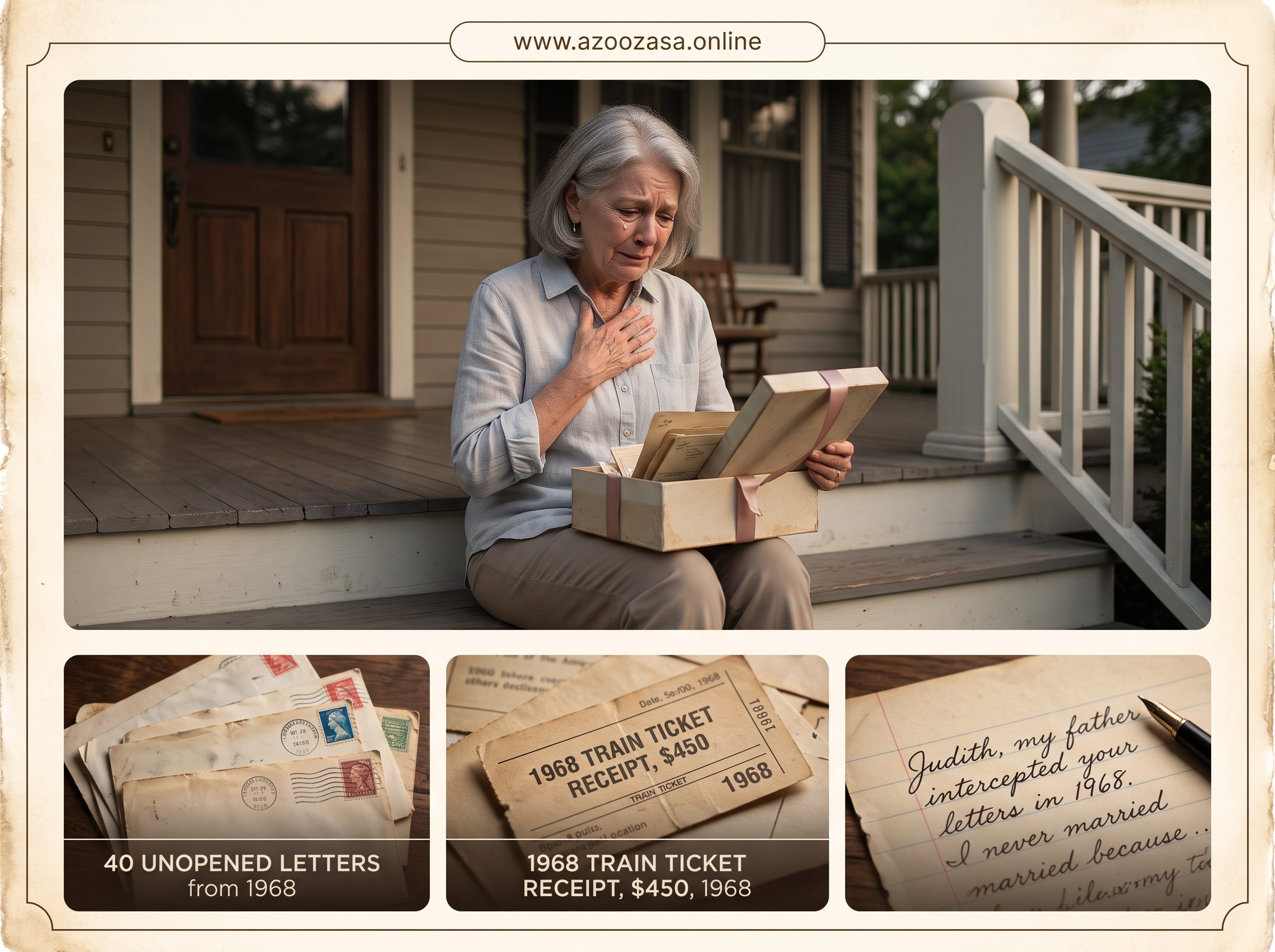
Inside, stacked with a meticulous, reverent precision, were forty pale blue envelopes.
I pulled the top one out. It was addressed in my own looping, nineteen-year-old handwriting. The postage stamp was postmarked October 12, 1968. I turned the envelope over. The seal was completely intact. It had never been opened.
My breath caught in my throat as I frantically sifted through the stack. November 1968. January 1969. March 1969. All forty letters, pristine and entirely unread.
Tucked beneath the heavy stack of envelopes was a piece of stiff, yellowed carbon paper. I pulled it out, my eyes struggling to focus through the sudden well of tears. It was a receipt from the Union Pacific Railroad, dated September 4, 1968. It was a receipt for two cross-country sleeper tickets to Vancouver. The total cost was $450.
In 1968, four hundred and fifty dollars was a staggering, astronomical sum of money for a nineteen-year-old boy. It was the exact value of Harlan’s prized 1965 Mustang, the car he loved more than anything in the world. He had sold it.
Beneath the receipt lay a single sheet of heavy white paper, folded in thirds. The handwriting on the outside was Harlan’s, though the script was shakier, clearly written in the later years of his life.
My knees buckled against the porch steps as I read his words: “Judith, my father intercepted your letters in 1968. I never married because I refused to give the rest of my life to a world that had already stolen my only reason for living it.”
I collapsed onto the top step of the porch, the paper trembling in my hands as the brutal, devastating truth of the past fifty-six years finally unraveled.
If you are reading this, the letter continued, it means I am gone, and the statute of limitations on my silence has finally expired. I need you to know the truth before I face whatever comes next. I need you to know that you were never, for a single second, forgotten.
When the draft notice came, I couldn’t bear the thought of leaving you, or worse, coming back to you in a pine box. I sold the Mustang to old man Henderson for four hundred and fifty dollars in cash. I bought two tickets on the Union Pacific line to Vancouver. The plan was to run. To cross the border, to start over, to build a life where the war couldn’t touch us.
I wrote you a letter detailing the plan. I told you to meet me at the station at midnight on September 6th. I packed a single bag, and I stood on that platform in the pouring rain until the final whistle blew. You never showed up. I thought you had chosen your family over our escape. I thought my request was too cowardly, too massive of a burden. Broken, I walked straight from the train station to the recruitment office, and I shipped out.
It wasn’t until 1982, when my father suffered his fatal heart attack, that I finally learned the truth. I was clearing out his estate. My father was the postmaster of our county, a man obsessed with legacy, duty, and military honor. He believed a mechanic’s daughter would ruin my trajectory. He believed running away would ruin the family name.
I found a locked cedar chest in his attic. Inside were your forty letters. Next to them was the letter I had sent you with the train tickets. He had intercepted both sides of our lives, Judith. He played God, and he condemned us both to the silence.
When I found them, my first instinct was to drive straight to your house. I wanted to burn the world down. But I drove to your street, and I saw you in the front yard. You were holding a little boy with blonde hair. Your husband was painting the window shutters. You were laughing. You had built a beautiful, whole life. I realized that bursting into your world to tell you our entire youth was a stolen lie wouldn’t bring 1968 back. It would only shatter the peace you had found.
So, I made the hardest choice of my life. I chose to carry the grief alone so you wouldn’t have to.
I kept your letters sealed, because reading them felt like a violation of the girl who wrote them to a boy she thought abandoned her. But I kept them safe. I kept them as proof that once, in a lifetime long gone, I was loved completely.
Do not mourn me, Judith. I lived a quiet life, but a proud one. And every time I closed my eyes, I was standing on that platform in the rain, and you were running toward me.
Forever yours,
Harlan.
I sat on the wooden steps of my porch as the sun dipped below the horizon, painting the neighborhood in bruised shades of purple and gold. The summer air suddenly felt cold. I pressed Harlan’s letter against my chest, pulling my knees up, weeping with a fierce, agonizing sorrow that had been trapped inside me for over half a century.
I mourned the boy who sold his favorite car. I mourned the girl who checked the mailbox every afternoon until her heart went entirely numb. I mourned the life we were supposed to live in Vancouver, a phantom existence stolen by a cruel, arrogant man who manipulated the U.S. mail to break his own son’s heart.
But beneath the crushing weight of the grief, a profound, luminous warmth began to spread through my chest.
For fifty-six years, I believed I had been discarded. I believed my first, deepest love was a naive illusion. But as I sat on the porch, surrounded by the physical weight of forty unopened letters and a single, staggering truth, the bitter narrative of my youth was entirely rewritten.
I wasn’t forgotten. I was loved with a fierce, unwavering devotion that had quietly survived a war, a half-century of silence, and the passage of an entire lifetime.
I carefully folded Harlan’s letter and placed it back into the ribbon box. I gathered my forty pale blue envelopes, their edges yellowed with time, and held them tight. I didn’t need to open them. I knew what they said. They were the echoes of a girl who loved a boy with everything she had.
I stood up, the porch boards creaking beneath my feet, and looked out into the darkening street. The world was exactly the same as it had been an hour ago, yet it was fundamentally, entirely different. The ghost that had haunted the edges of my life for five decades was finally at peace, and for the first time since the summer of 1968, so was I.


0 comments