
Fourteen Years of Tuesdays
Every Tuesday night for fourteen years, my husband, Raymond, disappeared for exactly four hours. He claimed it was his men’s bowling league, a sacred weekly ritual with his college buddies at a rundown alley on the edge of town. He would kiss my forehead at six o’clock, grab his scuffed leather bowling bag from the hall closet, and back his sedan down the driveway. He always returned precisely at ten, smelling faintly of peppermint gum and cheap cologne, humming a tuneless melody under his breath. For over five thousand nights of our marriage, I believed him. I cherished his reliability. I thought I was married to a man so wonderfully mundane that he was completely incapable of deception.
I was a fool.
The illusion shattered on a rainy Thursday afternoon. Raymond had left for a business trip to Chicago, and I was deep-cleaning his home office, searching for our homeowner’s insurance policy in his mahogany desk. The bottom drawer, which he always kept locked, had not latched properly. When I bumped it with my knee, it slid open with a quiet, damning whisper.
There was no insurance policy inside. Instead, resting on top of a stack of old utility bills, was a heavy, cream-colored envelope from Millbrooke Preparatory Academy.
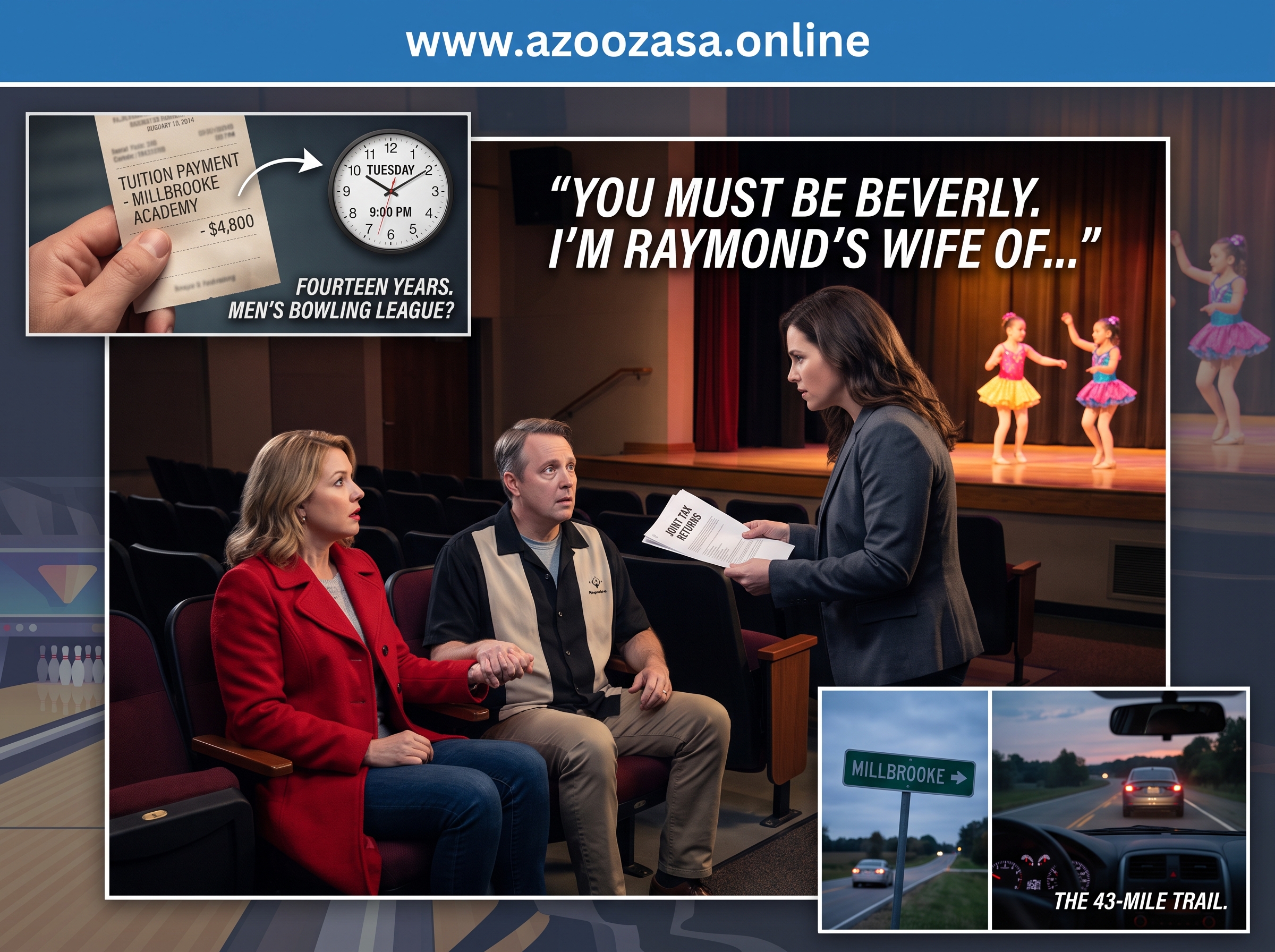
I opened it, expecting some sort of alumni donation request. What I pulled out was a stamped, official receipt for a tuition payment. The amount was $4,800. It was paid in cash, credited to the accounts of two students: Maya and Lily. The payer listed at the bottom was Raymond Vance.
My mouth went completely dry. The moisture evaporated from my tongue, and the walls of the office seemed to lean inward, suffocating the air out of the room. Millbrooke was an affluent, manicured suburb exactly forty-three miles north of our home. I sat perfectly still in his leather desk chair, the heavy silence of the house pressing against my eardrums, and I did the agonizing, undeniable math.
Forty-three miles on the interstate took exactly forty-five minutes. That was an hour and a half of round-trip driving. If Raymond left our house at six on a Tuesday, he would arrive in Millbrooke by a quarter to seven. He would have two and a half hours to live an entirely separate existence before driving back to me, walking through the front door at ten o’clock with peppermint on his breath to mask the scent of another woman’s home.
The leather bowling bag didn’t hold a custom-drilled Brunswick ball. It held a change of clothes. A different wardrobe for a different life.
I didn’t call him in Chicago. I didn’t scream, and I didn’t cry. The betrayal was so massive, so intricately constructed over fourteen years, that it bypassed my capacity for tears and went straight to a cold, clinical rage. I placed the receipt back into the drawer, pushed it shut until the lock clicked, and waited.
When Tuesday evening finally rolled around, the air in our kitchen was thick with unspoken venom. Raymond finished his pot roast, wiped his mouth with a napkin, and offered me his perfectly practiced smile.
“I’ll try not to wake you when I get in, Sarah,” he said, kissing my cheek. His lips felt like ice against my skin. He grabbed his leather bag, walked out the door, and started his car.
I gave him a two-minute head start. I grabbed my keys, my purse, and a thick manila envelope containing our freshly filed joint tax returns. I slid into my sedan, kept my headlights off until I reached the end of the neighborhood, and followed the distant red glow of his taillights onto the northbound interstate.
The drive to Millbrooke was a blur of highway lines and hyper-focused adrenaline. I watched his car navigate the winding, tree-lined roads of the wealthy suburb, eventually pulling into the sprawling, illuminated parking lot of Millbrooke Preparatory Academy. A massive banner hung over the main entrance: Annual Fall Choral Showcase.
I parked three rows behind him, watching from the darkness of my car as Raymond stepped out of his vehicle. He didn’t have his bowling bag. He was wearing a tailored sport coat I had never seen before. I waited until he walked through the heavy glass doors of the auditorium before I stepped out into the crisp autumn air, my fingers gripping the manila envelope so tightly my knuckles turned white.
The auditorium was warm, filled with the murmurs of proud parents and the scent of expensive perfume. I slipped through the back doors and stood in the shadows of the highest tier, my eyes scanning the sea of velvet seats. The stage was set with risers, heavily lit, awaiting the performers.
It only took me a minute to find him.
Raymond was sitting dead center in the front row. The prime seats. Sitting beside him was a stunningly elegant woman in a tailored red coat. Her dark hair fell perfectly over her shoulders, and as I watched, Raymond reached over and intertwined his fingers with hers. He brought her hand to his lips, kissing her knuckles with a tender, practiced familiarity that made my stomach violently heave.
The house lights dimmed, and the heavy velvet curtains parted. A line of children in pristine school uniforms filed onto the risers. The woman in the red coat leaned into Raymond, whispering excitedly in his ear as she pointed to two little girls in the second row. They were twins, perhaps ten years old, with Raymond’s unmistakable jawline and bright, expressive eyes.
Fourteen years. He had met her, courted her, built a home with her, and fathered two children, all within the four-hour margins of my Tuesday nights. He was the perfect, devoted family man in the front row, subsidized by the quiet, childless existence he maintained with me.
The piano began to play, and the children’s voices rose in a sweet, harmonious melody. The music swelled, filling the cavernous room, providing the perfect cover for the end of his world.
I walked down the center aisle.
My heels clicked softly against the carpeted floor, my pace slow, deliberate, and completely unstoppable. I didn’t look at the stage. I didn’t look at the twins. I locked my eyes onto the back of Raymond’s head. With every step, the fourteen years of lies shed from my shoulders, replaced by an armor of absolute, righteous fury.
I reached the front row just as the children hit the crescendo of their song.
I stepped directly in front of Raymond and the woman in the red coat, blocking their view of the stage. Raymond looked up, an annoyed reprimand forming on his lips, until his eyes focused on my face.
The transformation was absolute and horrifying. His jaw went slack. The color drained from his face with such violent speed that he looked like a corpse. His eyes bulged, his pupils dilating in pure, unadulterated terror. He tried to speak, but his vocal cords completely paralyzed. He dropped the woman’s hand as if it were coated in acid.
The woman in the red coat frowned in confusion, looking from Raymond’s ghostly face up to mine.
“Excuse me,” she whispered fiercely, trying not to disrupt the performance. “You’re blocking our view of our daughters.”
I didn’t raise my voice. I didn’t need to. I reached into my purse, pulled out the thick manila envelope, and slipped the heavy stack of our joint tax returns from inside. I calmly laid the stapled documents directly onto the woman’s lap, right over her expensive red coat. The top page prominently displayed our legally bound names: Raymond and Sarah Vance, alongside our home address and shared assets.
I looked her dead in the eyes, my voice carrying the weight of an absolute, devastating truth.
“You must be Beverly. I’m Raymond’s wife of sixteen years.”
Beverly froze. Her eyes dropped to the official government documents resting on her lap. She saw the names. She saw the signature. The breath hitched in her throat, a sickening gasp that sounded like a physical blow. She turned to Raymond, her eyes wide with a desperate, pleading hope that he would laugh, that he would call security and have this insane stranger removed.
But Raymond was suffocating on his own guilt. He shrank back into his velvet seat, pressing his hands against his face, unable to look at her, unable to look at me, unable to look at his daughters singing beautifully on the stage above him.
“Sarah, please,” Raymond finally choked out, his voice a pathetic, broken wheeze. “Not here. Please, God, not here.”
“You don’t get to choose where the truth finds you, Raymond,” I said, my voice completely devoid of pity. “You only got to choose the lies.”
I looked down at Beverly. Tears were rapidly welling in her eyes, her entire reality fracturing just as mine had on Thursday afternoon. She was just another victim of the Tuesday night league.
“The house in Millbrooke?” I said softly to her. “It’s funded by a joint account. Keep the tax returns. Your lawyer is going to need them when we liquidate his life.”
I didn’t wait for a response. The children on stage struck their final, soaring chord, and the auditorium erupted into thunderous, standing applause. Under the cover of the roaring ovation, I turned my back on Raymond Vance forever. I walked up the center aisle, my head held high, the heavy, suffocating weight of his deception finally lifted from my chest.
When I pushed through the heavy glass doors and stepped out into the cool, dark parking lot, the autumn air had never tasted so clean. I started my car, turned the heater on, and drove back toward the interstate. For the first time in fourteen years, I had absolutely no idea where I was going on a Tuesday night, and it was the most beautiful feeling in the world.


0 comments