
The Blood in the Beams
The summer storm tore across the valley with a violent, rhythmic fury, rattling the loose windowpanes of our century-old farmhouse. I was in the upstairs hallway, securing a leaky sash, when the ceiling groaned. It wasn’t the usual settling of old timber. It was a sharp, splintering crack, followed immediately by an explosive crash that shook the floorboards beneath my feet. Plaster dust exploded outward in a choking white cloud, blinding me for several seconds.
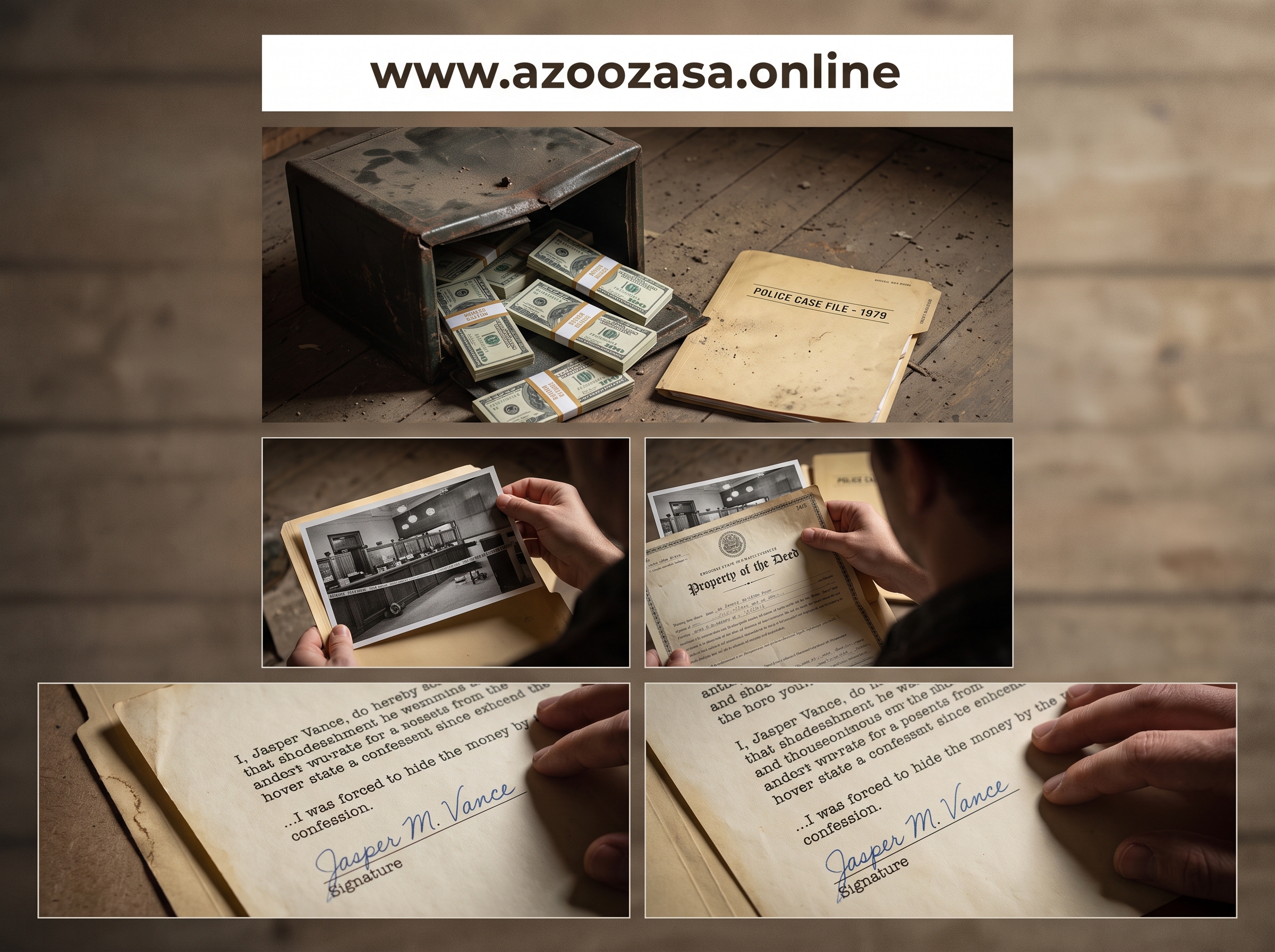
When the air finally cleared, a gaping hole exposed the dark ribs of the attic. Resting in the center of the hallway, surrounded by jagged chunks of drywall and shattered lath, was a heavy, rusted iron lockbox.
The impact of the fall had snapped its ancient brass padlock completely in half.
I stood frozen, the thunder outside momentarily muted by the ringing in my ears. I stared at the box, and a cold dread began to pool in my stomach. My late uncle, Jasper, had lived in the small guest room at the end of this very hallway for twenty-two years until his heart gave out last November. He was a phantom of a man—quiet, intensely private, and fiercely protective of the space above his ceiling. Whenever my father talked about running new electrical wire or checking the insulation, Jasper would block the doorway, his eyes dark and absolute. “Some secrets keep this family alive,” he would warn, his voice a low, gravelly whisper. “Leave the rafters alone.”
We thought it was just the paranoia of an eccentric old man. We were wrong.
I knelt beside the shattered plaster, coughing as the chalky dust coated the back of my throat. I reached out and pushed the heavy iron lid open. The hinges shrieked, a metallic protest against the damp summer air.
Inside, the smell of mildew, aged paper, and oxidized copper wafted up. The box was packed to the brim. Sitting on top were dozens of thick, tightly bound stacks of currency. I picked one up. They were one-hundred-dollar bills, the old design with the smaller portraits, secured by brittle, yellowed paper bank bands. My hands began to shake as I moved the stacks aside, doing the rough math in my head. There was easily a hundred and eighty-five thousand dollars sitting in my hallway.
Beneath the cash lay two items: a folded, heavy-stock property deed, and a thick manila folder sealed with red evidence tape.
I opened the deed first. The embossed stamp at the top dated it to October 14, 1979. It was the original title to the three-hundred-acre apple orchard surrounding our farmhouse—the exact land my family had supposedly inherited from a distant, wealthy cousin. The purchaser listed on the deed wasn’t my father, nor was it the fictitious cousin. It was listed under an LLC I had never heard of, signed by a notary who had vanished from town decades ago.
My heart hammered against my ribs like a trapped bird as I set the deed aside and picked up the police folder. The red tape was old, cracking down the center. I broke the seal and spread the contents across the dusty floorboards.
Dozens of black-and-white crime scene photographs spilled out. They were horrific. They depicted the interior of the First National Bank of Oakhaven, a town thirty miles north of us. The bank’s marble floor was covered in shattered glass and dark, pooling blood. In the center of the frame lay the body of a security guard, his hand still resting near his holstered revolver.
I recognized the robbery from local lore. It was the infamous 1979 Oakhaven Heist. Three masked individuals had walked out with nearly two hundred thousand dollars, leaving a young guard dead. The case was never solved. The money was never recovered.
At the bottom of the folder was a single sheet of typed paper, yellowed at the edges. At the bottom, signed in Jasper’s unmistakable, slanting cursive, was a confession. I held my breath as I began to read.
To whoever brings this into the light,
If you are reading this, I am dead, and the weight of this house has finally broken. I am writing this in November of 1979. For the record, and before God, I did not steal this money. I did not step foot inside the First National Bank, and I did not pull the trigger that ended Arthur Vance’s life on that marble floor.
I was the driver. I was told we were collecting a gambling debt from a back-room card game. I didn’t know about the masks, and I didn’t know about the guns until they came running out of the lobby covered in blood, throwing this iron box into the back of my truck.
I am signing this confession to clear my own conscience, but I cannot take it to the police. I am trapped. I am forced to hide this money, to bury the evidence, and to live in the shadow of this attic for the rest of my natural life because of the people who walked out of that bank.
I was forced to hide it by my own brother, Elias, and your mother, Abigail.
The paper slipped from my trembling fingers, fluttering to the floor like a dead leaf.
My vision blurred. The words on the page reorganized themselves in my mind, fighting against a lifetime of loving memories. Elias was my father. He had passed away ten years ago, celebrated as a pillar of the community, a generous orchard owner, a man who built our family legacy from the ground up. And Abigail—my sweet, soft-spoken mother who was currently downstairs in the kitchen, humming along to the radio as she baked peach cobbler while the storm raged outside.
They used the money to buy the land, Jasper’s letter continued. Elias forged the inheritance. Abigail pulled the trigger. She shot the guard when he reached for his weapon. She told me that if I ever breathed a word to the authorities, she would ensure I went down for the murder, and she would take Elias down with me. She said this family needed a foundation, and sometimes foundations are poured in blood. I stayed in this house to watch them. I stayed to ensure they never hurt anyone again. I am the warden of their secret, but I refuse to take it to hell with me.
I sat in the ruins of the ceiling, surrounded by the physical evidence of my family’s original sin. The $185,000 wasn’t a windfall; it was the blood price of a young security guard. The orchard wasn’t a legacy; it was a money-laundering scheme born of absolute violence. And my mother, the woman who had kissed my scraped knees and taught me how to read, was a cold-blooded killer who had held her own brother-in-law hostage in a guest room for two decades.
A violent crack of lightning illuminated the hallway, casting long, monstrous shadows against the floral wallpaper.
I slowly gathered the money, the deed, and the photographs, placing them back into the iron box. I kept Jasper’s confession folded tightly in my right hand. I stood up, my legs feeling like lead, and brushed the plaster dust from my jeans. The storm pounded against the roof, drowning out the sound of my footsteps as I walked toward the wooden staircase.
Each step down felt like a descent into an entirely different reality. The house smelled of cinnamon, baking peaches, and rain. It was the scent of my childhood, a childhood meticulously constructed over a graveyard of lies.
I reached the bottom of the stairs and walked down the hall toward the kitchen. The warm, yellow light spilled out from the doorway. My mother was standing at the counter, her back to me, wearing her faded blue apron. She was humming a soft, melodic tune, carefully slicing butter into a bowl of flour.
She was seventy-one years old. Her hair was silver, her shoulders slightly stooped. She looked entirely incapable of the violence detailed in Jasper’s letter. But as I stood in the doorway, clutching the undeniable proof of her past, I realized I didn’t know the woman standing in front of me at all.
“The storm is really coming down, isn’t it, sweetheart?” she said without turning around, her voice gentle and melodic over the sound of the rain. “I heard a loud thud upstairs. Did a window blow open?”
I looked at her hands, expertly working the knife through the butter. I thought about those same hands holding a revolver in 1979. I thought about Uncle Jasper, sitting in his room directly above us, day after day, year after year, absorbing the poison of her ambition so our family could thrive in the sunlight.
“No, Mom,” I said, my voice shockingly steady, devoid of any warmth. “A window didn’t blow open. The ceiling finally broke.”
The humming stopped instantly. The knife froze in her hand. For a long, agonizing moment, the only sound in the house was the torrential rain lashing against the kitchen glass.
She didn’t turn around right away. Her shoulders stiffened, the comfortable posture of an elderly baker vanishing, replaced by the rigid, alert tension of a predator sensing a shift in the wind. Slowly, deliberately, she set the knife down on the cutting board. She wiped her hands on her apron, taking a deep, shuddering breath.
When she finally turned to face me, the maternal warmth I had relied on for thirty years was entirely gone from her eyes. In its place was a cold, calculating steel—the look of a woman who had built an empire on a lie and knew the bill had finally come due.
She looked at the folded yellow paper in my tightly clenched fist, and then up to my face.
“Jasper always was a weak man,” she whispered, the quiet words cutting through the room with terrifying precision. “So… what are we going to do now?”
I stood in the doorway, the confession heavy in my hand, staring at the stranger who had given me life. The storm outside raged on, entirely oblivious to the fact that my world had just permanently ended.
When the foundations of everything you know are built on a devastating lie, how do you decide what parts of your life are still real?

0 comments