
The $9,500 Silence
Oakridge Manor was not a medical facility; it was a gilded waiting room for the wealthy to stash their guilt. For nine thousand five hundred dollars a month, families could purchase the illusion of absolute, compassionate care. The facility boasted mahogany wainscoting, a baby grand piano in the sunlit lobby, and a persistent, sterile scent of eucalyptus designed to mask the odor of inevitable decline. As the night nursing supervisor, I was the guardian of the quiet hours, the time when the glossy brochures ceased to matter and the brutal, unvarnished realities of the human body took over. I knew every cough, every wandering footstep, and every shadow in that building.
And I knew that something was deeply, fundamentally wrong with the woman in Room 412.
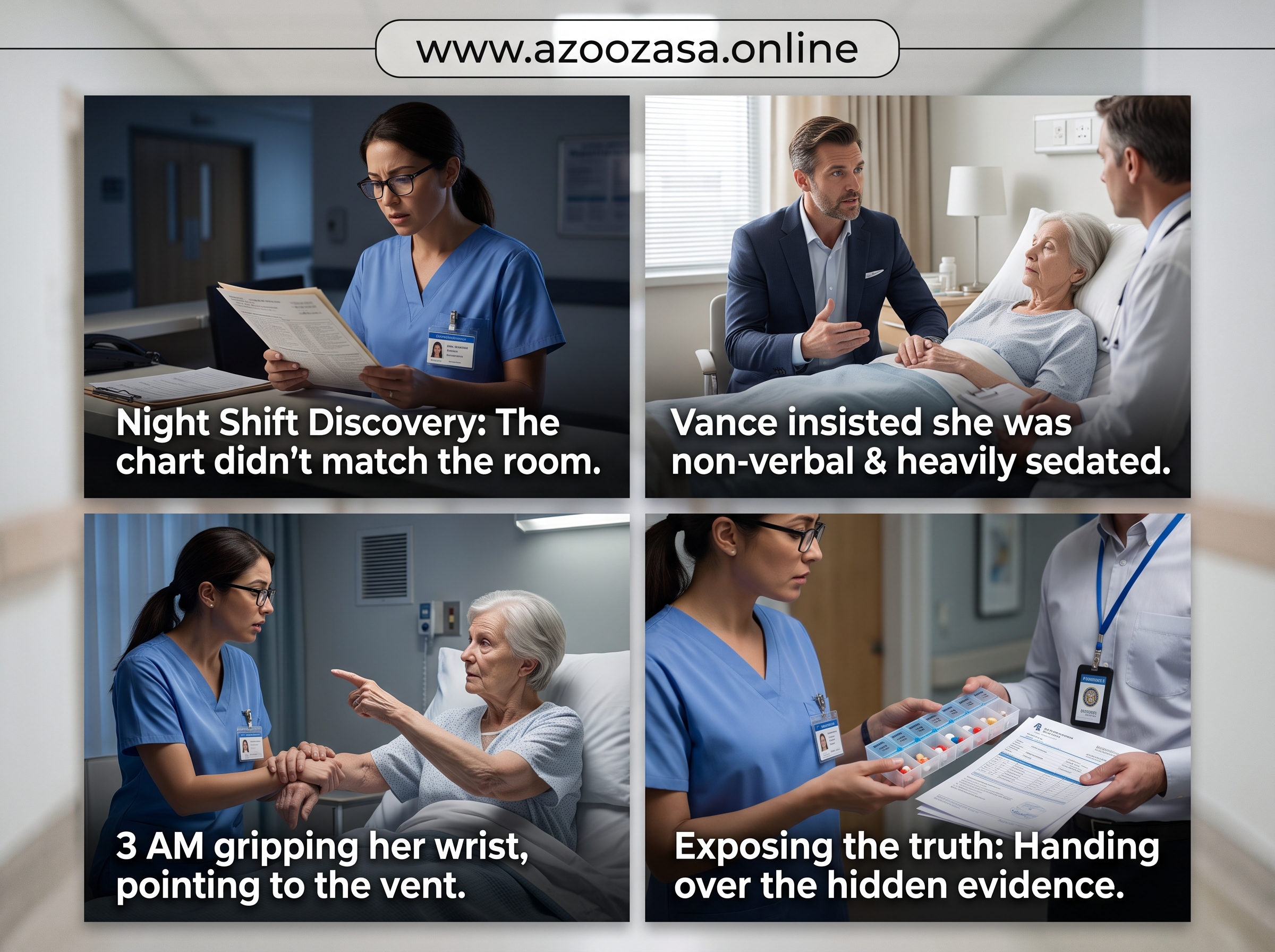
Mrs. Eleanor Gable was seventy-nine years old, a former professor of classical literature with a formidable reputation and an estate rumored to be worth millions. Her chart, however, painted the picture of a woman entirely lost to the void. Her admission paperwork, meticulously curated and legally enforced by her nephew, Vance, listed her as suffering from end-stage, rapid-onset dementia. She was categorized as completely non-verbal, highly agitated, and requiring heavy, constant sedation to remain manageable.
Vance was the architect of her prison. He was a man who wore custom-tailored Italian suits that cost more than my car and treated the nursing staff with the thinly veiled contempt of a Victorian lord addressing his scullery maids. Every Wednesday at exactly 5:00 PM, Vance strode through the double doors of the ward, carrying a briefcase and wearing an expression of practiced, tragic burden. He insisted on private, closed-door visits. He bullied the daytime attending physicians into maintaining her heavy prescriptions, citing her alleged violent outbursts at home as justification.
But I worked the graveyard shift, and the Mrs. Gable I observed in the desolate hours of the morning did not match the medical chart clipped to her door.
True end-stage dementia has a specific, chaotic rhythm. It is a terrifying, restless wandering of a fractured mind. Mrs. Gable didn’t wander. She lay perfectly still beneath her crisp white sheets, her breathing shallow, her skin a terrifying, translucent gray. But occasionally, when the heavy sedatives began to metabolize and wear off in the deep hours of the night, I would catch her looking at me. There was no vacant, hollow stare of cognitive collapse in those moments. Beneath the thick, chemical fog, her eyes were sharp, terrified, and screaming for help.
The dam broke at 3:12 AM on a rainy Tuesday.
The ward was completely silent, save for the rhythmic hum of oxygen concentrators. I was doing my final rounds, adjusting IV lines and checking vitals. I walked into Room 412, expecting to find Mrs. Gable in her usual catatonic state. Instead, she was awake.
The last dose of her prescribed daytime medication had worn off just enough to thin the fog. She was shivering, drenched in a cold, terrible sweat, her chest heaving as she fought against the gravitational pull of the narcotics in her bloodstream.
I rushed to her bedside, reaching for the call button to summon the on-duty doctor. “Mrs. Gable, it’s alright, I’m right here,” I whispered, reaching for her shoulder.
Before I could press the button, her hand shot out from beneath the blankets. Her bony, trembling fingers clamped around my wrist with astonishing, desperate strength. Her grip was a vice of pure survival. She couldn’t speak—her vocal cords were paralyzed by the dry-mouth side effects of the heavy sedatives—but she didn’t need to.
She pulled my arm downward, locking her terrified gaze with mine, and pointed a single, shaking finger toward the floorboard on the far wall.
I followed her trembling finger. She was pointing directly at the heavy metal grate of the room’s air return vent, located just inches above the linoleum floor.
I looked back at her. Tears were spilling over her lower lashes, tracing hot, desperate lines through the wrinkles of her cheeks. She squeezed my wrist one final time, a silent plea that carried the weight of her very life, before the exhaustion overtook her and her arm fell limply back onto the mattress.
My heart hammered a frantic rhythm against my ribs. I stepped away from the bed, walked over to the wall, and knelt beside the air vent. The screws holding the metal grate to the wall were loose. In fact, they had been entirely stripped, allowing the heavy iron cover to simply rest against the plaster.
I dug my fingernails under the edge of the grate and pulled. It came away with a soft metallic scrape.
I reached my hand into the dark, dusty cavity of the ventilation shaft. My fingers brushed against the cold, galvanized steel of the ductwork, and then, they hit something smooth and plastic.
I pulled it out into the dim light of the room. It was a large, heavy-duty pill organizer, the kind with seven daily compartments. It was completely wrapped in a layer of dark duct tape to camouflage it within the shadows of the vent.
I popped open the compartment marked for Wednesday.
Inside was a terrifying cocktail of unmarked, heavy-duty tranquilizers. They were completely unauthorized, off-the-record narcotics—the kind of synthetic sedatives used to chemically restrain large psychiatric patients, not a frail, seventy-nine-year-old woman.
The puzzle pieces snapped together with a violent, sickening clarity.
Vance wasn’t just a grieving nephew. He was a monster executing a slow, methodical chemical lobotomy. He was smuggling these pills into the facility every Wednesday at 5:00 PM during his private, closed-door visits. He was force-feeding them to his aunt, ensuring she remained completely catatonic, entirely non-verbal, and legally incompetent. As long as she was locked in this chemical prison, he retained absolute, unchecked medical and financial power of attorney over her massive estate. If she ever woke up, if she ever spoke to a doctor, his control would vanish, and the money would be cut off.
I didn’t put the box back. I slipped it into the deep pocket of my scrubs, replaced the vent cover, and walked out of the room.
I didn’t call the facility director. In luxury homes like Oakridge, management often preferred quiet internal investigations that protected their wealthy clients and their $9,500 monthly checks. Instead, I spent the rest of my shift pulling Mrs. Gable’s recent, legitimate lab work from the hospital database. Her baseline blood panels were completely clean of any neurological decay markers. Her liver and kidneys were simply drowning in unprescribed toxins.
At 8:00 AM, the moment my shift ended, I drove directly to the regional office of the State Medical Licensing Board and the Department of Health and Human Services. I didn’t leave the lobby until a senior inspector sat down with me.
Thirty-two hours later, Wednesday arrived.
At exactly 4:55 PM, Vance strode through the grand mahogany doors of Oakridge Manor. He wore a crisp charcoal suit, carrying his leather briefcase, exuding the arrogant confidence of a man who believed he was the smartest predator in the room. He walked past the baby grand piano, nodded to the receptionist, and headed straight for the elevators to the fourth floor.
He didn’t know that the floor had been entirely secured.
I was standing at the nurses’ station, my heart in my throat, alongside the facility director, who looked as though he were about to faint. Standing just inside the doorway of Room 412 were two plainclothes state investigators and a uniformed police officer.
Vance stepped off the elevator and walked down the hallway. He didn’t even knock on his aunt’s door; he simply turned the handle and pushed it open, stepping into the trap.
“What the hell is this?” Vance’s voice echoed sharply into the hallway.
I walked purposefully into the room, followed by the facility director. Vance was standing at the foot of the bed, his face flushed with sudden, defensive anger, glaring at the state investigators.
“Who authorized you people to be in my aunt’s private room?” Vance demanded, his hand gripping the handle of his briefcase so tightly his knuckles were white. “I have full medical power of attorney. I want this room cleared immediately, or I’m calling my legal team.”
The senior state inspector, a tall, imposing woman with eyes like chipped flint, didn’t flinch. She turned to me.
I stepped forward. I didn’t look at Vance; I looked directly at the inspector. I reached into my pocket and pulled out the duct-taped pill organizer, alongside the manila folder containing the blood panels I had printed.
I handed them directly to the state inspector, raising my voice so it carried clearly through the open door and out into the ward.
“This was hidden in the air vent beside the patient’s bed,” I stated, my voice ringing with absolute, unwavering authority. “These are unauthorized, unprescribed synthetic sedatives. And these are her official, clean hospital lab tests proving she has no biological markers for dementia.”
I finally turned my gaze to Vance. The arrogant color had completely drained from his face, leaving behind a sickly, terrified ash.
“Vance has been poisoning his aunt to keep her silent and maintain complete legal control over her estate,” I said.
The silence that followed was absolute. The grand, expensive illusion of Oakridge Manor completely shattered within the walls of Room 412. Vance opened his mouth to speak, to spin a web of legal threats and wealthy indignation, but the words died in his throat. He looked at the pill box in the inspector’s hand, realizing in a fraction of a second that his entire empire was built on a chemical lie, and the antidote had just been delivered.
“Vance Gable,” the uniformed officer said, stepping forward and unholstering his handcuffs. “You are under arrest for elder abuse, felony reckless endangerment, and conspiracy to commit medical fraud. Place your hands behind your back.”
Vance didn’t fight. The sheer speed of his downfall left him entirely breathless. He dropped his leather briefcase. It hit the linoleum floor with a heavy thud as the steel cuffs clicked shut around his wrists. He was escorted out of the room, out of the mahogany hallways, and out of his aunt’s life forever.
Within the hour, a medical team moved in to begin an emergency flush of Mrs. Gable’s system, carefully weaning her off the toxic cocktail that had held her captive for nearly a year.
It took two weeks for the fog to fully lift. I requested a transfer to the day shift just so I could be there to see it.
When I walked into Room 412 on a bright Friday morning, the curtains were thrown wide open, bathing the room in warm, golden sunlight. Mrs. Gable was sitting up in bed, wearing a vibrant blue reading shawl, a pair of reading glasses perched on her nose. She was holding a worn paperback copy of The Odyssey.
She looked up as I entered the room. The hollow, terrified grayness was entirely gone from her face. Her eyes were bright, sharp, and fiercely intelligent.
She carefully placed a bookmark in her novel, folded her hands in her lap, and offered me a smile that held the warmth of a thousand sunrises.
“I believe,” Mrs. Gable said, her voice raspy but carrying the unmistakable cadence of a formidable professor, “that I owe you a tremendous debt of gratitude, my dear. You listened when the rest of the world was entirely deaf.”
I walked over to her bedside, taking her warm, steady hand in mine, and knew that I had finally fulfilled the true purpose of the night watch.
Have you ever trusted your intuition to uncover a truth that everyone else was determined to ignore?



0 comments