

The Thursday Prescription
Working the night shift as an intake and floor nurse at St. Jude’s Medical Center, you develop a sixth sense for the subtle frequencies of the human mind. You learn to differentiate between the hazy, gentle drift of genuine Alzheimer’s and the erratic, chemical fog of something entirely different. When eighty-one-year-old Walter was admitted to our geriatric ward three weeks ago, his chart read like a textbook case of rapid-onset dementia. But every time I looked into his pale blue eyes, I didn’t see the hollow vacancy of a fading mind. I saw a man trapped behind a heavy, invisible curtain, desperately trying to claw his way out.
His son, Paul, was the architect of that narrative. Paul was a junior partner at a downtown law firm, a man who wore bespoke suits that cost more than my monthly rent and treated the nursing staff like the hired help at a country club he was forced to patronize. Every Thursday at exactly 4:00 PM, Paul strode through the double doors of the ward with a leather briefcase and an insulated steel thermos of chamomile tea. He was relentlessly pushing the attending physician, Dr. Aris, for an emergency medical discharge.
“Dad’s mind is completely gone, Doctor,” Paul would insist, his voice dripping with a practiced, sorrowful theatricality. “He’s a danger to himself here. I have an in-home care facility ready to take him, but I need full medical power of attorney signed today to release the funds from his estate to cover it. The house, the savings, all of it needs to be liquidated immediately to ensure his comfort.”
That estate was worth $340,000. It was the entirety of Walter’s life savings, earned through forty years of laying brick and mortar in the brutal summer heat.
Every Thursday afternoon, after Paul poured a cup of tea for his father and left, Walter would slip into a catatonic state. His breathing would grow shallow, his chin resting on his chest, unresponsive to verbal commands or physical stimuli. Dr. Aris, overworked and operating on four hours of sleep, accepted Paul’s narrative of aggressive sundowning and cognitive collapse. He had the discharge papers drawn up, awaiting the final legal clearance to hand Walter—and his entire life savings—over to his son.
But I knew. The math of Walter’s symptoms simply didn’t add up. Dementia doesn’t operate on a strictly scheduled weekly pendulum.
The confirmation of my darkest suspicions arrived at 3:15 AM on a quiet Tuesday.
The ward was dead silent, save for the rhythmic beeping of cardiac monitors and the low hum of the ventilation system. I was at the nurses’ station updating charts when the call light above Room 312 blinked. I walked down the dim linoleum hallway and pushed open the heavy wooden door.
Walter was awake. But he wasn’t just awake; the thick, cloudy haze that usually masked his eyes had completely evaporated. The last of whatever had been in his system from Thursday had finally burned off. He was shivering, drenched in a cold sweat, his frail chest heaving as he fought against the physical withdrawals of a potent chemical restraint.
I rushed to his bedside, reaching for the blood pressure cuff. “Walter, I’m here. Let me get you something for the chills.”
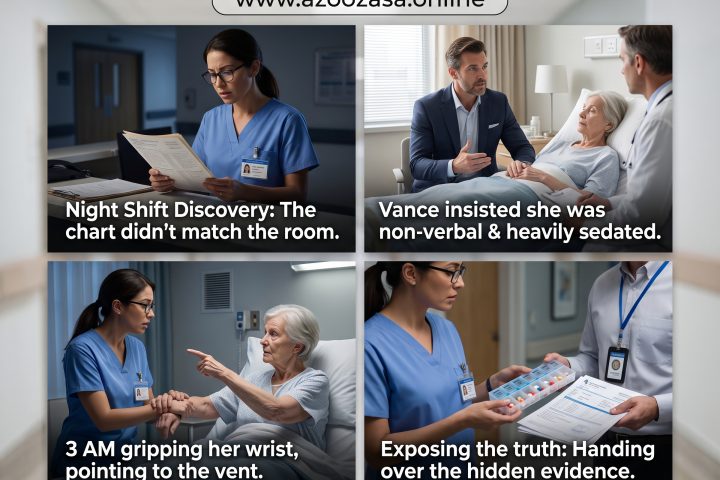
Before I could wrap the cuff around his arm, his hand shot out with astonishing speed. His bony, calloused fingers wrapped around my wrist like a steel vice. The grip was frantic, terrified, and entirely lucid.
He couldn’t speak—his vocal cords were too dry, his motor functions still compromised from the heavy sedation—but his eyes were wide with desperate urgency. He pulled my hand toward the edge of the bed, pointing a trembling, crooked finger toward the small metal closet in the corner of the room.
“Shoe,” he rasped, the word tearing at his dry throat. “Left… shoe.”
I stared at him for a second, my pulse quickening at the sheer clarity of his gaze. I gently untangled my wrist from his grip, walked over to the closet, and opened the narrow door. Sitting on the floor was the pair of worn, brown leather moccasin slippers Walter had arrived in. I picked up the left slipper. It felt perfectly ordinary. I ran my hand inside the fleece lining, feeling nothing.
Walter let out a frustrated, breathy groan from the bed. He mimicked a peeling motion with his hands.
My heart hammered against my ribs as I reached back into the slipper and dug my fingernails under the glued edge of the thick foam insole. I pulled upward, tearing the foam away from the rubber base. Hidden flat within the hollow cavity of the heel was a folded piece of heavy, watermarked paper.
I pulled it out and unfolded it under the harsh fluorescent light above the sink.
It was a printed receipt from an independent, private toxicology lab in the city. Attached to it with a rusty paperclip was a handwritten ledger. The handwriting belonged to Paul—I recognized the sharp, arrogant slant of the letters from the admission forms.
The ledger was a dosing schedule. It listed precise, escalating measurements of liquid Lorazepam and a heavy barbiturate, dated every Thursday afternoon for the past two months. The private lab receipt, dated weeks before Walter’s admission, showed blood test results for “W. Davis,” calculating how long the heavy sedation levels would remain active in his bloodstream.
The reality of the nightmare slammed into me, knocking the breath from my lungs. Paul hadn’t just been drugging his father. He had methodically calculated the exact half-life of the tranquilizers to ensure Walter appeared completely, hopelessly demented to the hospital staff while remaining just lucid enough at the beginning of the week to avoid falling into a permanent coma. Walter must have found the paper in Paul’s coat pocket during a moment of clarity at home, hiding it in his shoe as a desperate insurance policy before his son could institutionalize him entirely.
I looked back at Walter. Tears were streaming down his weathered cheeks. He knew exactly what his son was doing to him, and for three weeks, he had been trapped in a chemically induced prison, unable to scream for help.
“I’ve got you,” I whispered, holding the paper tightly to my chest. “I promise you, Walter, I’ve got you.”
I didn’t wait for morning. I immediately drew a fresh blood sample from Walter and sent it to our hospital lab with an emergency “STAT” order for a comprehensive toxicology screen, explicitly requesting a barbiturate and benzodiazepine panel. By 9:00 AM, the results hit the secure hospital server. They were undeniable. Walter’s blood was saturated with the lingering metabolites of the exact cocktail listed on Paul’s hidden ledger.
I took the results, along with the contents of the slipper, directly to the hospital’s chief of security and the local precinct. We laid a trap.
Thursday arrived with a suffocating tension. At 3:50 PM, the elevator doors chimed in the main lobby of St. Jude’s.
Paul stepped out, exuding his usual predatory confidence. He wore a crisp navy suit, holding his leather briefcase in one hand and the insulated silver thermos in the other. He walked toward the front desk, expecting Dr. Aris and a stack of lucrative discharge papers.
Instead, he found me standing in the center of the lobby, blocking his path to the geriatric wing.
“Excuse me, nurse,” Paul said, his tone dripping with condescension. “I’m here to see my father and finalize his transfer. Is Dr. Aris around? We have a lot of paperwork to get through today.”
“Dr. Aris isn’t coming, Paul,” I said, my voice steady, carrying clearly across the quiet lobby. “And Walter isn’t going anywhere.”
Paul stopped, his eyes narrowing. “I don’t think you understand your position here. I have a court order pending for medical power of attorney. My father is severely ill.”
“Your father is suffering from acute, systemic poisoning,” I replied, taking a step closer. I didn’t break eye contact as I reached into my scrub pocket. I pulled out a clear plastic evidence bag containing his handwritten dosing ledger and the private lab receipt, holding it up so the lobby lights caught the paperclip.
Paul’s arrogant smirk instantly vanished. The color drained from his face, leaving his skin a sickly, ashen gray. His eyes darted from the bag in my hand to my face, panic finally shattering his polished facade.
“He hid it under his shoe, Paul,” I said, my voice dropping to a cold, unforgiving register. “He knew what you were doing. And this morning, our lab confirmed every single milligram of it in his bloodstream.”
“You… you stole that,” Paul stammered, taking a clumsy step backward. His grip on the thermos loosened. “That’s inadmissible. You have no idea what you’re interfering with. I’m a lawyer, I’ll sue you and this hospital into the ground—”
“The police are on their way,” I said, cutting him off completely.
Right on cue, the heavy automatic sliding doors of the main entrance hissed open behind him. Two uniformed officers and a plainclothes detective stepped into the lobby.
Paul spun around, the silver thermos slipping from his fingers. It hit the polished tile floor with a heavy crash, the lid popping off and spilling a pool of chamomile tea across the white linoleum. It smelled faintly of vanilla and heavy, bitter chemicals.
“Paul Davis?” the detective asked, flashing his badge. “We have a warrant for your arrest on charges of elder abuse, felony reckless endangerment, and attempted medical fraud. Turn around and place your hands behind your back.”
Paul tried to speak, to weaponize his legal vocabulary, but the sheer speed of the ambush left him entirely breathless. He offered no resistance as the heavy steel handcuffs clicked securely around his wrists. As they led him away, his bespoke suit suddenly looked entirely too big for him, a hollow shell of a man being dragged out of the hospital he thought he could outsmart.
I watched the patrol car pull away from the curb, then turned and took the elevator up to the third floor.
When I walked into Room 312, Walter was sitting up in bed. We had placed him on a saline flush to help clear his kidneys, and the difference in his demeanor was miraculous. The chemical fog had lifted entirely. He looked older, exhausted, and deeply heartbroken by his son’s betrayal, but his eyes were sharp, intelligent, and fiercely alive.
I walked over to his bedside and placed a fresh cup of water on his tray table.
Walter looked at me, his calloused hand reaching out to gently squeeze my wrist once more. This time, there was no terror in his grip. Only an immense, profound gratitude.
“Thank you,” he said, his voice raspy but entirely clear.
“Just doing my job, Walter,” I smiled, pulling a chair up to his bed. “Now, how about we get you a real cup of tea?”

0 comments