
The Final Measure
My brother, Mark, always had the timing of a vulture. The dirt on our father’s grave hadn’t even settled before he was changing the locks on the old mid-century modern house we grew up in. By the time I arrived the morning after the funeral, Mark was already standing on the front porch, flanked by a rented dumpster, holding a clipboard like a hostile site manager. Dad’s house was paid off, a prime piece of suburban real estate appraised at a cool $320,000, and his bank accounts held decades of frugal saving. Mark claimed it all.
“Dad left no written will,” Mark stated flatly, blocking the doorway with his broad shoulders. He had a lawyer friend draft up the preliminary probate paperwork faster than I could process my own grief. “Intestate succession. As the older sibling and the one who actually lived in this state, I’m the primary executor. The estate goes into probate, and I’m liquidating the assets. You aren’t stepping foot in here to scavenge.”
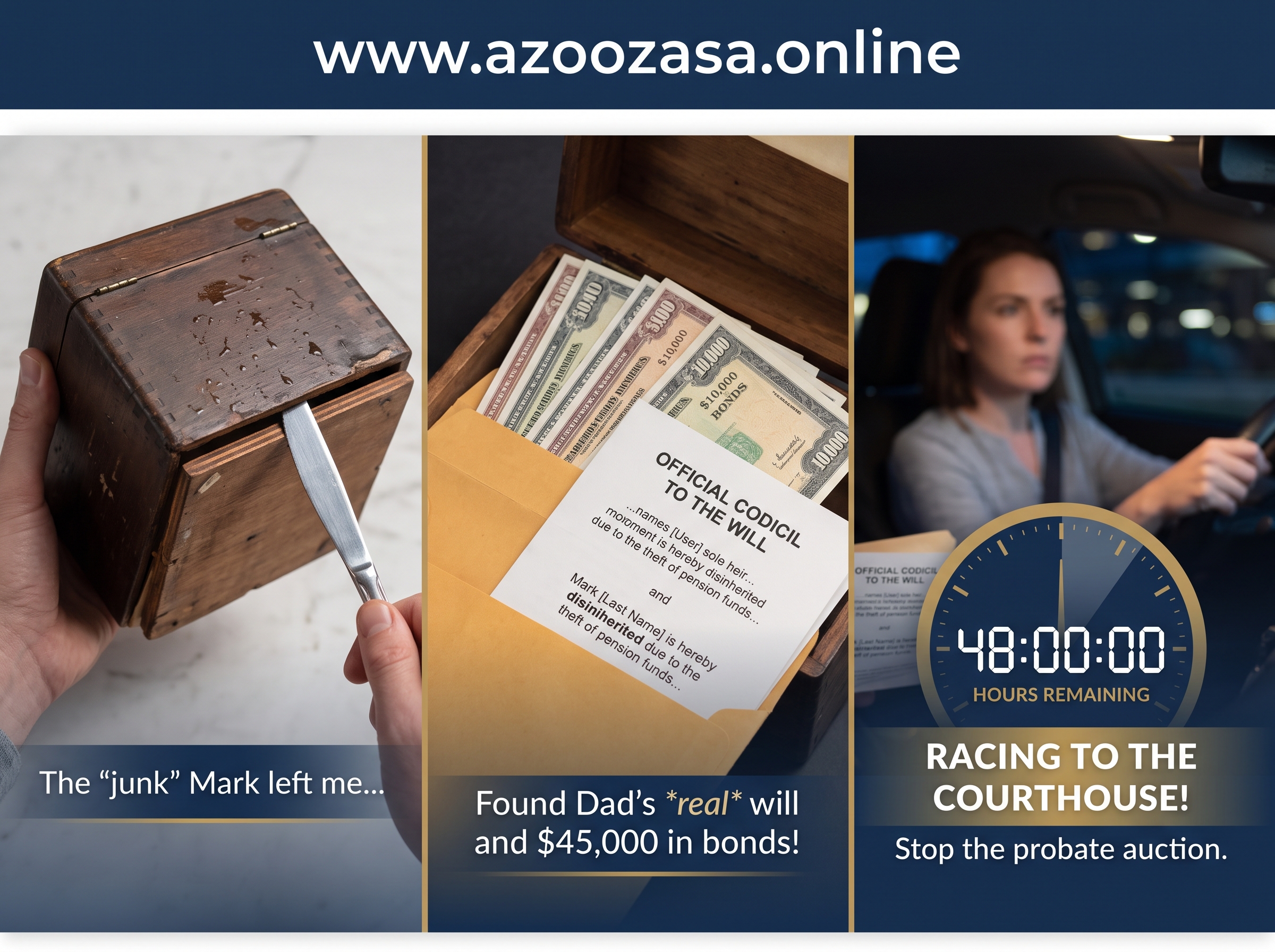
I stared at him, the sheer audacity of his greed paralyzing my vocal cords. Mark reached behind the doorframe, grabbed an object, and shoved it into my chest. It was an old, dented wooden recipe box from the kitchen pantry. The lid was warped, the brass hinges rusted shut, and the sides were caked in a thirty-year film of cooking grease and flour dust. It had been Mom’s, and after she passed, it sat untouched on the counter for a decade.
“You got the junk,” Mark sneered, his lips curling into a cruel, dismissive smile. “Now get lost. The probate auction to liquidate the estate finishes in forty-eight hours. I don’t need you complicating the sale.”
My teeth gritted together so hard my jaw ached. I wanted to scream, to swing at him, but the exhaustion of the past week anchored my feet to the concrete. I turned on my heel, clutching the greasy wooden box to my chest, and walked to my car. I loaded it into the passenger seat, the smell of rancid oil and old wood filling the cabin. I drove home in a blinding haze of tears and fury, mourning not just the loss of my father, but the total erasure of my family history.
Yesterday, the anger finally gave way to a cold, restless energy. I couldn’t sit still in my apartment knowing Mark was tearing apart Dad’s legacy for a quick payout. I needed to do something with my hands. I brought the wooden recipe box to my kitchen sink, turned the water as hot as I could stand it, and squirted a heavy dose of industrial dish soap onto a bristle brush.
If this was all I had left, I was going to strip away the grime and make it recognizable again.
I scrubbed the sides furiously, the soap cutting through the heavy layers of polymerized grease. As I applied pressure to the bottom panel to leverage the box against the sink basin, I felt something give. The solid oak base shifted with a sharp click, sliding a fraction of an inch to the right.
I stopped. I dried my hands on a towel and wiped down the wood. There was a hairline seam visible along the bottom edge that hadn’t been there a moment before. It wasn’t a solid block of wood; it was a false bottom.
My heart began to hammer against my ribs. I pulled a silver butter knife from the drying rack, wedged the flat edge into the newly exposed seam, and pried upward. The ancient wood groaned, the friction of decades holding it tight, until finally, the false bottom popped loose and clattered onto the counter.
Tucked perfectly inside the shallow compartment was a thick, sealed legal pouch.
I pulled it out, my hands shaking. I broke the wax seal on the envelope and poured the contents onto the kitchen island. A stack of ornate, heavy paper slid out. They were bearer bonds. I counted them, my breath catching in my throat as the numbers added up. Forty-five thousand dollars in untraceable, completely liquid bearer bonds.
But it was the document folded beneath them that made the air vanish from my lungs.
It was an official, typed codicil to a last will and testament, stamped with a heavy, embossed blue notary seal. I unfolded the crisp paper. The signature at the bottom was unmistakably Dad’s—that sharp, slanting cursive I had seen on a thousand birthday cards. I looked at the date. It was signed and notarized exactly two weeks before his fatal stroke.
My eyes flew across the legal jargon, landing on the heavily bolded declarations in the center of the page.
I, Arthur Thomas Vance, being of sound mind, do hereby revoke all prior wills. I name my younger child as the sole and exclusive heir to my entire estate, including the property at 421 Elm Street and all associated bank accounts.
Furthermore, I expressly and permanently disinherit my eldest son, Mark Vance. Over the past twelve months, I have uncovered irrefutable evidence that Mark has systematically embezzled $85,000 from my private pension funds through forged wire transfers. This codicil serves as his final reckoning. He is to receive nothing.
I sat heavily on a kitchen stool, the silence of my apartment deafening. Dad knew. He knew Mark was stealing from him, and he had quietly, methodically prepared a trap. He knew Mark would claim the house and the money, and he knew Mark’s arrogance would blind him to anything he considered “junk.” Dad had trusted me to value the sentimental over the financial. He had trusted me to take the recipe box.
I glanced up at the clock on the microwave. It was 9:00 AM on a Wednesday. The probate auction to liquidate the estate finished in exactly twenty-seven hours.
I didn’t bother changing out of my damp clothes. I grabbed the codicil, the bonds, and my car keys, and sprinted out the door. The drive to the county courthouse was a blur of aggressive lane changes and hyper-focused adrenaline. I parked in a loading zone, uncaring if the car got towed, and sprinted up the wide concrete steps of the judicial building.
I navigated the labyrinthine hallways, following the gold-lettered signs to the Probate Clerk’s office. I slammed my hands down on the mahogany counter, startling the clerk behind the glass.
“I need to file an emergency injunction on an active probate case,” I gasped, sliding the codicil beneath the glass partition. “The estate of Arthur Thomas Vance. The current executor is committing fraud.”
The clerk adjusted her glasses, highly skeptical of my frantic appearance, but as her eyes scanned the notarized document, her posture straightened. “This is dated two weeks ago. And it explicitly alleges felony embezzlement by the current petitioner.”
“I need it in front of the probate judge before the property auction clears tomorrow at noon.”
“I don’t need to wait until tomorrow,” a deep voice boomed from the doorway behind the counter.
Judge Harrison, a stern man in his late sixties who had known my father through the local rotary club, stepped into the clerk’s office. He took the document from the clerk, reading it over with a practiced, razor-sharp focus. I watched his jaw tighten as he read the paragraph detailing the stolen pension funds.
“Your brother filed an affidavit of intestacy on Monday morning,” Judge Harrison said, looking up at me over the rim of his glasses. “He swore under penalty of perjury that no will existed. And he petitioned for an expedited liquidation.” The judge handed the document back to the clerk. “File it. Issue an immediate freeze on the Vance estate. And contact the District Attorney’s office. If these embezzlement claims hold water, Mark Vance is looking at state time.”
Forty-eight hours later, the atmosphere on the front porch of Dad’s house was entirely different.
The rented dumpster was gone. The lockbox Mark had placed on the front door was shattered on the welcome mat, forcibly removed by the county sheriff’s deputies who had arrived at dawn.
I stood on the lawn, watching as Mark was escorted out of the front door in handcuffs. His smug, arrogant demeanor had completely vanished, replaced by a pale, sweat-drenched panic. The DA’s office had subpoenaed Dad’s bank records within hours of the injunction. The wire transfers were blatant, sloppy, and traced directly to an offshore account in Mark’s name. He wasn’t just losing the house; he was facing a decade in federal prison for wire fraud and elder exploitation.
As the deputies walked him past me toward the cruiser, Mark stopped, his eyes wide and uncomprehending.
“How?” he rasped, his voice cracking. “I scoured every drawer. I checked every safe. Where did you find it?”
I looked at him, feeling a deep, profound sense of peace settle over my shoulders for the first time since Dad’s funeral.
“You gave it to me, Mark,” I said softly. “You gave me the junk.”
I didn’t wait for his response. I turned my back on him and walked up the concrete steps, stepping over the broken lockbox. I unlocked the front door with the fresh set of keys the court had issued me and stepped into the quiet hallway. The air inside still smelled faintly of Dad’s pipe tobacco and old paper. I walked directly into the kitchen, set the polished, gleaming wooden recipe box in its rightful place on the center of the counter, and finally allowed myself to cry.
Have you ever discovered a hidden truth about a family member that completely changed how you viewed them?


0 comments