
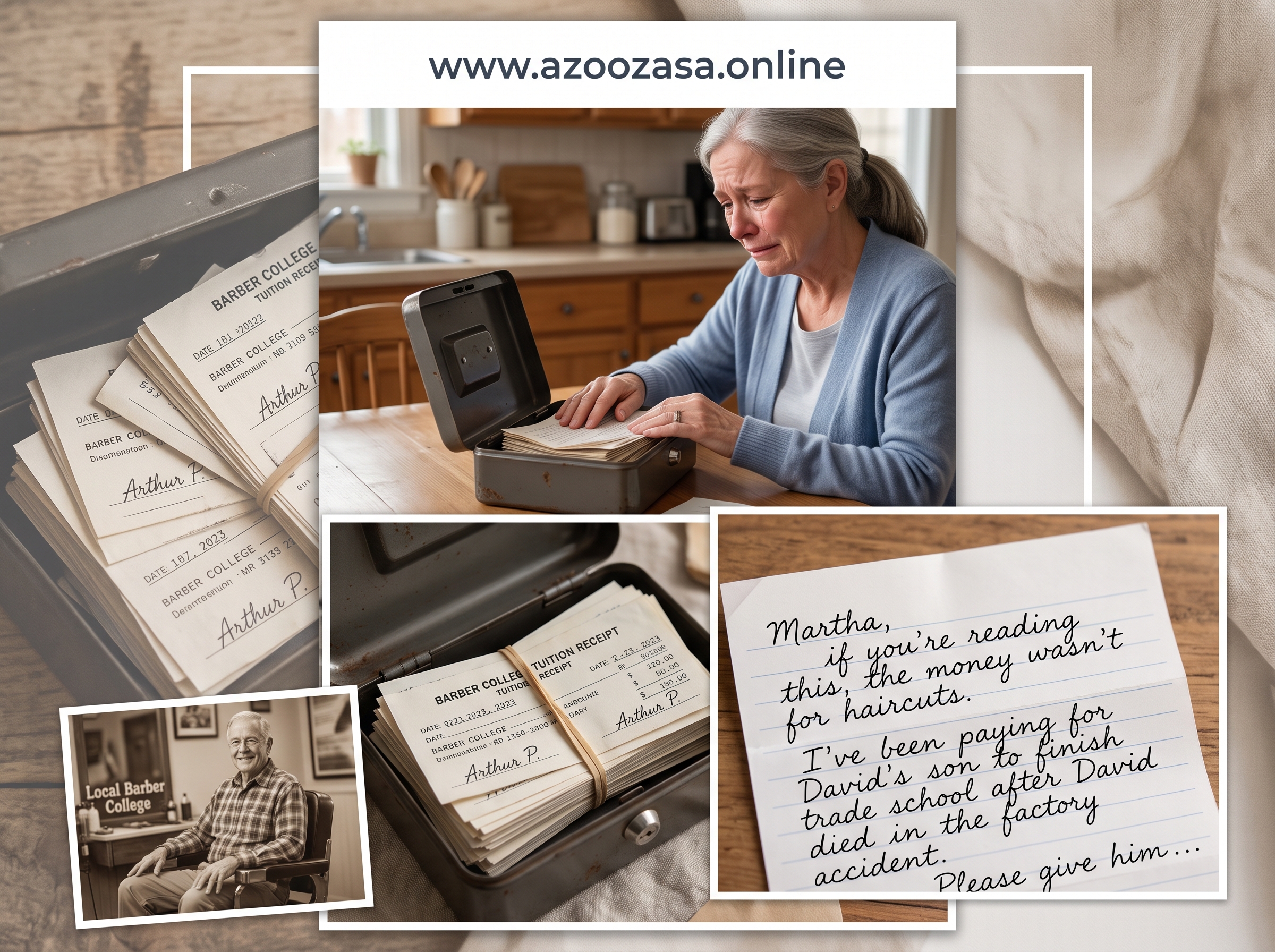
One Hundred and Eight Fridays
Every Friday afternoon for nine years, my husband, Arthur, went to the local barber college. He claimed he just liked the company and cheap haircuts. He would come home smelling faintly of sharp Barbicide, talcum powder, and peppermint shaving cream, whistling a low, tuneless melody as he hung his worn canvas jacket on the hall rack. For nearly a decade, it was the one unshakeable pillar of his weekly routine. I never questioned it. Arthur was a man of simple, predictable comforts, a shift foreman at the local steel stamping plant who believed in the sanctity of a well-swept porch and a neatly trimmed collar.
Arthur passed away in July. His heart, which had always been so remarkably steady, simply gave out in his sleep. The funeral was a blur of black umbrellas and casseroles delivered in aluminum foil by well-meaning neighbors. The weeks that followed were an agonizing masterclass in silence. The house felt cavernous, echoing with the absence of his heavy footsteps and his off-key whistling.
Yesterday, the heavy oak front door chimed. I pulled my cardigan tighter around my shoulders and opened it to find Sal, the owner of the downtown barber college, standing on my porch. He looked entirely out of place away from the checkered linoleum of his shop, his hands nervously gripping a scuffed, heavy metal lockbox.
“Arthur asked me to give you this when he passed,” he said softly, his dark eyes brimming with a profound, unspoken sorrow. He pressed the cold metal into my hands, offered a brief, tight-lipped nod of condolence, and walked back to his idling sedan before I could even formulate a question.
I carried the box into the kitchen and set it on the table, staring at it as if it might suddenly detonate. It was an old ammunition tin, the olive-green paint chipped away at the corners to reveal dull gray steel. The latch popped open with a dry metallic groan.
Inside, stacked with a meticulous, architectural precision, were dozens of small, carbon-copy slips of paper. They were 108 prepaid tuition receipts, stamped with the red seal of the vocational board, totaling exactly $16,200. Resting neatly on top of the final stack was a folded sheet of heavy ivory paper, covered in a script I would recognize in the dark.
My eyes filled with tears as I unfolded the paper. It read:
Martha, if you’re reading this, the money wasn’t for haircuts. I’ve been paying for David’s son to finish trade school after David died in the factory accident. Please give him the brass key taped to the bottom of this box, along with the envelope beneath these receipts. It holds the deed to my grandfather’s old detached garage on Elm Street. It’s zoned for commercial use now. He’s going to need a place to set up his own chair, and I know he’ll make us proud.
The paper trembled in my hands as the breath left my lungs in a ragged exhale.
David. The name pulled me violently back in time, nine years in the past. David had been Arthur’s line operator at the stamping plant, a vibrant, boisterous man twenty years Arthur’s junior, who always talked about his teenage son’s dream of opening a classic barbershop. Then came the horrific Tuesday morning when the safety rig on the heavy press failed. I remembered Arthur coming home that night, his face smeared with grease and his eyes hollowed out into dark, empty caverns. He sat at this very kitchen table for six hours without speaking a single word, staring at his calloused hands.
David’s widow had moved away shortly after, utterly broken by the grief and the crushing lack of a factory pension. We all assumed her son, Leo, had been swallowed up by the unforgiving machinery of a life suddenly derailed.
But Arthur hadn’t let him fall.
I looked down at the staggering sum of $16,200. My mind immediately raced through the past decade of our marriage, recontextualizing a thousand tiny moments I had completely misunderstood. I remembered Arthur working voluntary double shifts on holiday weekends, claiming he just wanted to stay busy. I remembered him repairing the leaky radiator in his rusted pickup truck with epoxy and duct tape for three consecutive winters instead of buying the new car we had saved for. I remembered the canceled anniversary trip to the coast, the skipped lunches, the threadbare winter coats he refused to replace.
I had occasionally resented him for it. I had accused him of becoming miserly in his old age, of prioritizing his stubborn frugality over our comfort. And every time I complained, Arthur would just offer a gentle, apologetic smile, kiss my forehead, and say, “We have enough, Martha. We have a good roof and each other. Some folks don’t even have that.”
He had carried the weight of another man’s family on his shoulders for nearly a decade, systematically bleeding away his own comforts to build a future for a boy who had lost everything. And he had done it in absolute, solitary silence, seeking no praise, no recognition, not even from me.
I tipped the metal box over. The receipts fluttered across the table like autumn leaves. Beneath them lay a thick manila envelope and a heavy, tarnished brass key secured with a piece of electrical tape. I grabbed my purse, scooped the envelope and the key into my pocket, and walked out to the car.
The drive to the barber college felt agonizingly slow. The autumn air was crisp, the sky a brilliant, unforgiving blue. I parked on the street and pushed through the glass door, immediately hit by the familiar wave of peppermint and talc that had lived on Arthur’s collar for nine years. The shop was alive with the hum of electric clippers and the low murmur of conversation.
“I’m looking for Leo,” I told the man at the front desk, my voice shaking.
He pointed toward the back of the room, to a vintage leather barber chair positioned near a wide, sunlit window. Standing there was a young man in a crisp white apron, carefully sweeping the floor around his station. He had David’s broad shoulders and dark, curly hair, but his quiet, focused demeanor was a mirror image of the man I had just buried.
I walked over to him, my heels clicking loudly against the linoleum. He looked up, his brow furrowing slightly, before his eyes widened in sudden, profound recognition. He had seen me in photographs. He knew exactly who I was.
“Mrs. Martha,” he whispered, dropping the broom. It clattered to the floor, entirely forgotten.
“Hello, Leo,” I managed to say, though my throat felt tight with unshed tears.
Leo took a step forward, his hands trembling as he reached out, hovering in the space between us as if unsure whether he was allowed to touch me. “I… I went to the funeral,” he confessed, his voice thick with emotion. “I stood in the back. I wanted to come up to you, to tell you everything he did for me. How he showed up at our apartment the month after my dad died and told my mom that my tuition was handled. How he sat in my chair every Friday for nine years, letting me practice on him when I was just a kid butchering his hairlines, talking to me about life, and teaching me how to be a man. But he swore me to secrecy. He told me it was our quiet pact.”
“He was incredibly good at keeping quiet,” I said, a tear finally escaping and tracing a hot path down my cheek. “But he left me a box yesterday. And he left you this.”
I pulled the thick manila envelope and the heavy brass key from my coat pocket and placed them into Leo’s large, steady hands. I watched as he opened the flap, pulling out the deed to the Elm Street property. His eyes scanned the legal document, the realization of what it meant slowly washing over his features. The final barrier broke, and the young man fell to his knees right there on the shop floor, clutching the heavy paper to his chest, sobbing with a raw, uninhibited gratitude that echoed above the hum of the clippers.
I knelt down beside him, wrapping my arms around his broad shoulders, holding him exactly the way Arthur must have wanted to so many times. We stayed like that for a long while, anchored to each other in the center of the bustling shop, two people profoundly changed by the quiet, unrelenting grace of an ordinary man.
When I finally drove home that afternoon, the house didn’t feel quite so empty anymore. It felt full of light, full of the immense, enduring legacy of a man who believed that the highest form of love was the kind you gave away in the dark, asking for nothing in return.
What unseen sacrifices do you think the people in your life have quietly made to help you get to where you are today?


0 comments