
The Cast-Iron Codicil: A Harvest of Justice
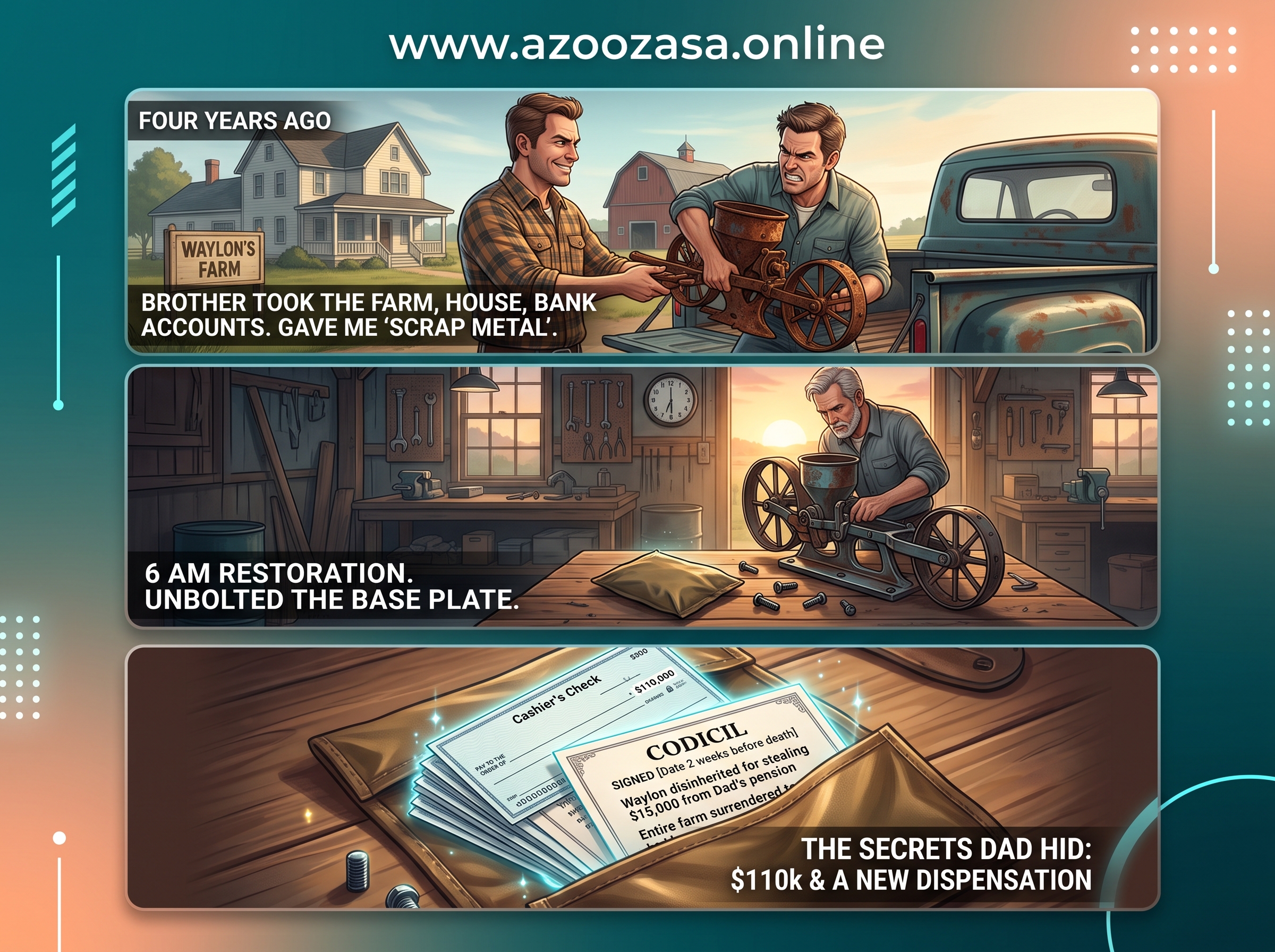
The sharp whine of the angle grinder drowned out the early morning static of the workshop radio. It was 6:00 AM on a crisp Tuesday, and I was buried in a cloud of orange iron dust. For four years, I had stared at the rusted cast-iron corn planter sitting in the corner of my garage. Every time I looked at it, I heard my older brother’s cruel laughter echoing in my ears. Today, I was finally going to tear it down, sandblast the decay away, and turn the ugly memory into something useful.
I wrenched a heavy socket onto the hexagonal bolt securing the seed hopper’s base plate. It was fused tight by decades of humidity and neglect. I leaned my entire body weight into it, my knuckles whitening, breathing in the familiar scent of WD-40 and old earth. With a violent crack that echoed off the cinderblock walls, the rust-welded thread finally gave way.
The heavy iron plate dropped heavily to the concrete floor, narrowly missing my steel-toed boots. I wiped the sweat from my forehead with the back of my arm, shining my drop-light into the newly exposed cavity beneath the hopper.
Something didn’t belong.
Tucked tight against the inner housing, coated in a thick layer of dried grease and dust, was a heavy pouch made of black oilcloth.
I frowned, setting the socket wrench aside. My hands were stained with black grease and orange rust, but I carefully wedged my fingers into the tight space and pulled the pouch free. It was surprisingly heavy, bound tight with a leather cord that crumbled into flakes as I picked at the knot.
Inside the oilcloth was a heavy, vacuum-sealed plastic bag. I grabbed my utility knife from the workbench and sliced it open.
My breath caught in my throat.
Neatly stacked inside were eleven cashier’s checks, each drawn from a bank in the next county over, made out to me in the amount of $10,000. Underneath the $110,000 in uncashed checks lay a stiff, cream-colored document bearing a gold foil notary seal.
I unfolded the thick paper with trembling hands. The heading, typed in a crisp, formal font, read: Last Will and Testament – Codicil of Revision. At the bottom of the page, dated just two weeks before a massive heart attack took his life, was my father’s unmistakable, jagged signature.
My eyes scanned the dense legal text, catching onto the vital clauses that made the concrete floor seem to spin beneath me.
…having discovered irrefutable proof that my eldest son, Waylon, systematically embezzled the sum of $15,000 from my carpenter’s pension over the last three years, I hereby revoke all previous bequeathals to him.
…Waylon is to be entirely disinherited from my estate.
…The entirety of the 140-acre farm, the homestead, and all remaining liquid assets are hereby transferred to my youngest son, who possesses the character to respect the soil. Should Waylon be in possession of said properties, they must be surrendered within thirty days of the presentation of this document.
I sat down hard on my rolling shop stool. The heavy iron planter, a cruel joke for the last four years, had just rewritten my life.
The memory of the funeral reception hit me like a physical blow. The air in the church basement had been thick with the smell of cheap coffee and wilting lilies. Waylon, wearing a tailored suit that cost more than my truck, had cornered me near the folding tables. He had already moved his things into Dad’s house. He had already claimed the bank accounts and the $290,000 property, brandishing an older will that named him the sole executor and beneficiary.
“It’s just the way the world works, little brother,” Waylon had sneered, swirling amber whiskey in a paper cup. He had handed me the heavy, rusted planter straight off the barn floor just before the service. “Dad knew who had the brains to run a modern operation. You? You got what you deserve—scrap metal. Put it in your garden. Maybe you can grow some ambition.”
My teeth had gritted together so hard I tasted copper. But without a lawyer, and with no proof to challenge the older will, I had no leg to stand on. I had loaded the heavy iron into my truck in the pouring rain, driving away from my childhood home with nothing but a rusted relic and a broken heart.
But Dad hadn’t abandoned me. He had hidden his true intent exactly where he knew only I would ever look. Waylon despised manual labor. He despised the old ways, the antique machinery, the grease, and the dirt. He had called it scrap metal because he lacked the vision to see its value. Dad knew I would eventually restore it, just as we had restored antique tractors together when I was a boy.
I looked at the clock on the garage wall. It was 6:45 AM. I carefully placed the cashier’s checks and the codicil into a clean manila envelope, rigorously scrubbed the grease from my hands, and grabbed my truck keys.
My first stop was the office of Elias Vance, the town’s oldest practicing attorney and a longtime friend of my father’s. Elias was already at his desk when I walked in, nursing a mug of black coffee. He listened in silence as I recounted the morning’s discovery, his bushy white eyebrows creeping steadily upward.
When I handed him the document, Elias pulled on his reading glasses and scrutinized it. He ran his thumb over the notary seal, checked the dates, and then leaned back in his worn leather chair. A slow, deeply satisfied smile spread across his weathered face.
“I’ll be damned,” Elias whispered. “He actually did it.”
“You knew about this?” I asked, my voice tight with emotion.
“I drafted the legal language for him,” Elias admitted, taking off his glasses. “But he insisted on finding his own notary a county over, and he flatly refused to tell me where he was keeping the original. He came into my office, shaking with rage over that stolen pension money. He was a proud man. He couldn’t bear the thought of a public spectacle while he was alive, but he wasn’t going to let a thief inherit the family legacy. He said to me, ‘Elias, Waylon thinks he’s outsmarted me. But I’m going to put my legacy inside something he thinks is entirely worthless.’ I never knew what it was. Until today.”
“Is it legally binding?”
“Ironclad,” Elias said, tapping the heavy paper. “The date supersedes the will Waylon filed in probate. And the statute of limitations on estate fraud hasn’t passed. We can file an emergency injunction by noon. Waylon will have a choice: hand over the keys to the property immediately, or face a criminal probe regarding the fifteen thousand he skimmed.”
By two o’clock that afternoon, I was pulling off the two-lane highway onto the long gravel driveway of the farm. The sight of the place made my stomach knot. The white paint on the farmhouse was peeling terribly, and the front pasture, once meticulously maintained by my father, was overgrown with tall weeds and thistles. Several of the outbuildings had sagging roofs. Waylon hadn’t maintained the property; he had merely coasted on its inherent value, bleeding it dry.
Waylon’s shiny new luxury pickup truck was parked carelessly near the porch. He stepped out of the front door as I approached, wearing a pair of expensive sunglasses and holding a half-empty beer bottle. He looked exactly as smug as he had at the funeral, though a bit softer around the middle.
“Well, well,” Waylon called out, leaning lazily against a porch pillar. “If it isn’t the scrap metal king. To what do I owe the pleasure? You didn’t come to beg for a loan, did you? Because cash is a little tight this quarter.”
I didn’t say a word. I walked up the wooden steps, the neglected boards creaking under my work boots. I stopped two feet from him and handed him a thick manila envelope.
“What’s this?” he scoffed, not making a move to take it.
“Mail,” I said evenly. “Open it.”
He rolled his eyes, snatching the envelope from my hand. “You always were overly dramatic.”
Waylon pulled out the copies Elias had made. He glanced at the first page, ready with a sarcastic quip, but the words died in his throat. I watched his eyes dart back and forth across the page. His face went pale, then flushed a furious, mottled red.
“This is a forgery!” he barked, his voice cracking. He ripped off his sunglasses. “Dad would never—he left everything to me! You cooked this up!”
“Elias Vance verified the signature this morning,” I replied, my voice remarkably steady, anchored by four years of quiet patience. “The notary in Marion County keeps a ledger. Dad signed it two weeks before he died. Look at the second page, Waylon. Read the part about the pension.”
Waylon’s eyes dropped to the second sheet. His mouth opened, but no sound came out. The bluster drained out of him entirely, replaced by a sudden, terrifying realization that his secret wasn’t a secret at all.
“Fifteen thousand dollars,” I said, stepping closer, refusing to let him look away. “He knew. He went over his bank statements and he knew you were bleeding him dry. Elias is filing the paperwork with the county courthouse right now. The judge will issue a formal eviction notice tomorrow morning.”
“You can’t do this to me,” Waylon whispered. The beer bottle slipped from his fingers, shattering loudly on the porch boards. “This is my house. I’ve lived here for four years. Where am I supposed to go?”
“That’s not my problem,” I said, feeling a profound, heavy calm settle over me. “The codicil gives you thirty days to surrender the property. But Elias made it clear: if you aren’t packed and gone by Friday, he’s taking the proof of the pension theft straight to the district attorney. You can leave the farm quietly, or you can go to jail. Your choice.”
Waylon stared at me, his jaw trembling. The arrogant bully who had handed me a rusted piece of farm equipment and laughed at my grief was entirely gone. In his place stood a hollow, cornered man. He looked at the peeling paint of the house, then at the overgrown fields, realizing in an instant that his stolen kingdom of dirt had just collapsed beneath his feet.
I turned my back on him and walked down the steps. I didn’t need to hear another word. The stunned silence behind me was the sweetest sound I had ever heard.
Six months later, the farm was unrecognizable from the decaying state Waylon had left it in. I had poured a portion of the $110,000 into repairing the roof, painting the siding, and bringing the soil back to life. The fields were tilled, the fences were mended, and the air smelled of fresh cut hay and turning seasons.
On the front porch, right next to the rocking chair where Dad used to sit, was a cast-iron corn planter.
It wasn’t rusted anymore. I had finished the restoration, sandblasting away the decay and painting it a brilliant, flawless John Deere green with bright yellow accents. I had polished the heavy base plate until it shone like a mirror in the afternoon sun.
Every morning, I sat on the porch with my coffee and looked at it. It was a beautiful piece of machinery, built to drop seeds into the dark earth so that something new could grow. Waylon had looked at it and seen only scrap metal, blind to the potential buried beneath the surface. Dad knew better. He knew that true value isn’t always shiny or obvious, and that justice, much like a good harvest, just requires the patience to dig deep and do the hard work.



0 comments