
The Phantom in the Ledger
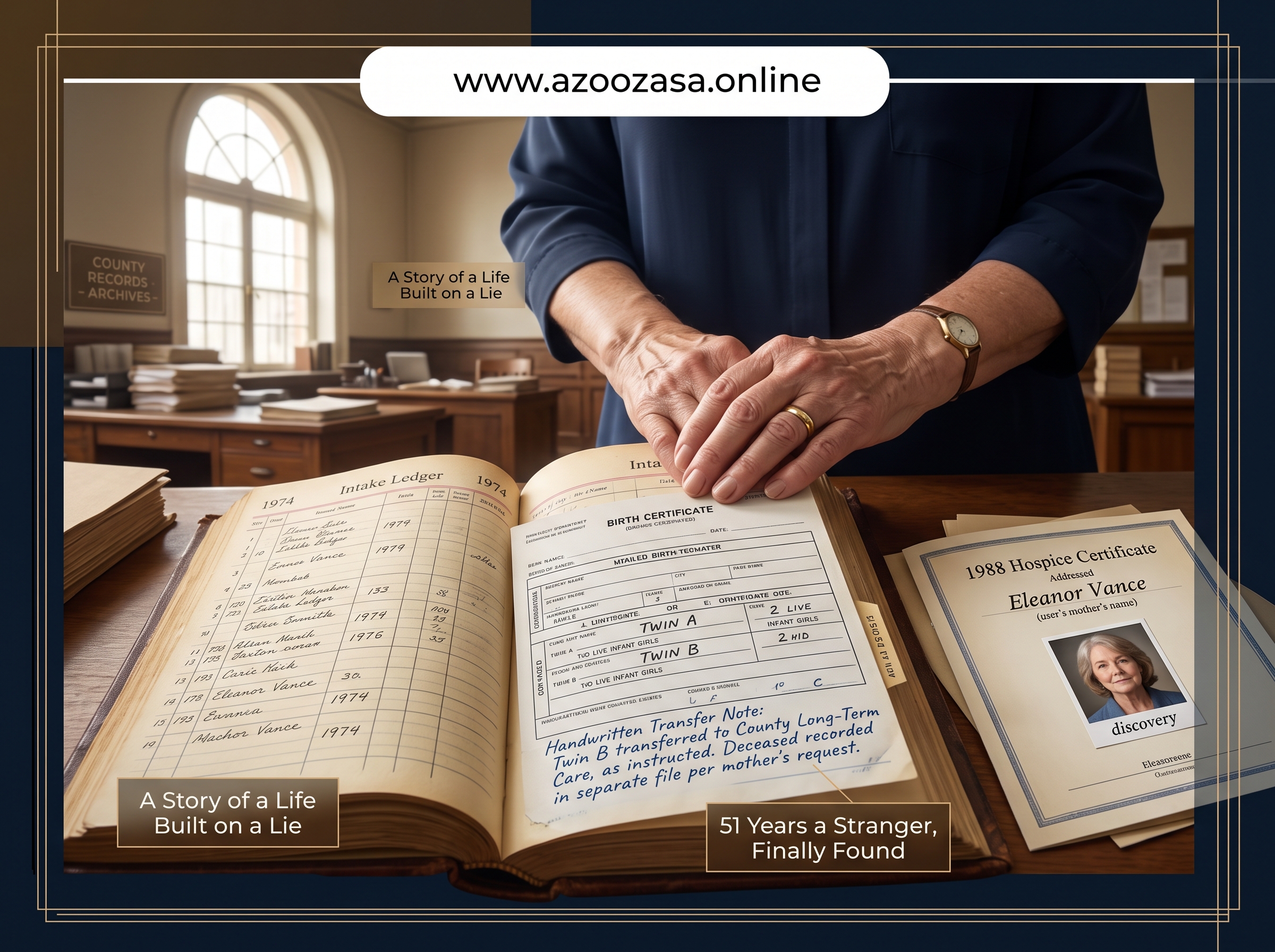
The air in the county clerk’s vault tasted like dust and kept secrets, heavy with the suffocating scent of decaying paper and old ink. I stood completely frozen under the harsh, buzzing fluorescent lights, the heavy, yellowed pages of the 1974 intake ledger pressing rough against my trembling palms. My mother’s voice echoed in the sterile room, a phantom repeating the same tragic mantra that had haunted every single one of my fifty-one birthdays: Your twin sister died three hours after birth, Clara.
For half a century, that lie had been the foundational myth of my entire existence. I had mourned a ghost. I had lived for two. But the truth was staring up at me from the bottom of the unfiled birth certificate, written in the sprawling, hurried cursive of a delivery room physician long since dead.
The handwritten transfer note read: Infant B, exhibiting signs of congenital hypotonia and a minor, correctable cleft palate, is to be immediately transferred to the St. Jude State Ward at the mother’s explicit demand. To preserve the family’s social standing and spare the father undue distress, Infant B will be recorded as deceased upon transfer.
My lungs forgot how to draw air. The betrayal hit me not as a singular realization, but as a violent, cascading collapse of everything I knew to be real.
I thought about my mother, Evelyn. A woman composed entirely of sharp angles, rigid starch, and a suffocating obsession with outward perfection. My childhood had been a carefully curated museum exhibit. I was the flawless daughter, the straight-A student, the perfect accessory to my father’s burgeoning legal career in our small, judgmental town. My father had died twenty years ago, taking his grief for his “lost” child to his grave. My mother had used that fictitious grief as a shield, a tragic backstory that made her socially untouchable. Every year on September 14th, she would bake a small, separate cupcake. “For your sister,” she would whisper, her eyes perfectly glassy, her performance worthy of a stage.
All while her other daughter was breathing, living, and growing up in a state ward just twenty miles away across the county line.
The pieces of the puzzle that had arrived in my mailbox last Tuesday finally locked into place with sickening clarity. It was a heavy manila envelope bearing the return address of St. Jude Long-Term Care. Inside was a crisp, untouched county hospice volunteer certificate dated 1988, awarded to Evelyn Vance for “Exceptional Dedication.” Tucked behind the certificate had been a Polaroid photograph. The woman in the photo was young—just fourteen years old, the exact age I had been in 1988. She was sitting in a wheelchair by a sunlit window, a hand-knitted blanket draped over her lap. But it was her face that had made my knees give out in my kitchen. She had my exact face. My deep-set hazel eyes, my sharp cheekbones, the identical curve of my jawline.
I gently closed the heavy ledger, handed it back to the terrified-looking county clerk, and walked out of the building. I didn’t go home. I got into my car, gripped the steering wheel until my knuckles turned absolute white, and drove straight toward the county line.
St. Jude had shed its grim, institutional past. It was now a modernized, sprawling care facility surrounded by manicured lawns and towering oak trees. I walked through the sliding glass doors, my heart hammering a frantic, violent rhythm against my ribs. I approached the reception desk and asked for anyone who had been on staff in the late eighties. The young receptionist made a phone call, and ten minutes later, I was sitting in the cramped, windowless office of the facility’s head archivist and former floor nurse, a woman named Martha Gable.
Martha was in her late seventies, with sharp, intelligent eyes behind thick silver frames. She walked into the office carrying a stack of files, stopped dead in her tracks, and dropped the folders onto the carpet.
“Dear God,” Martha breathed, her hand flying to her mouth. “Sarah?”
“No,” I said, my voice cracking under the impossible weight of the name. “My name is Clara. I’m Sarah’s twin sister.”
Martha slowly sank into the chair behind her desk, never taking her eyes off my face. “We just mailed those old certificates out last week. We were digitizing the 1980s archives and found a box of unclaimed volunteer awards and personal effects. We sent it to the last known address on file, assuming someone in the family would want it. We… we had no idea you didn’t know.”
“Tell me about her,” I demanded, the tears I had been fighting finally spilling over my lower lashes. “Please, Martha. I need to know who I was separated from. I need to know what my mother did.”
Martha sighed, a deep, sorrowful sound that seemed to carry the weight of a thousand forgotten patients. “Sarah was a bright, beautiful light, Clara. The doctors in the seventies were cold. They told your mother that Sarah would be a vegetable, a burden. It wasn’t true. She had mild cerebral palsy and a speech impediment, but her mind was entirely sharp. She was funny. She loved to paint. And she looked exactly like you.”
“My mother,” I choked out, staring at my trembling hands. “The certificate said she volunteered here.”
“Evelyn came every Tuesday evening,” Martha said, her tone hardening with a quiet, lingering anger. “For nearly twenty-five years. She would sit with Sarah, read to her, brush her hair. But she never claimed her. She registered herself as a community volunteer. She never allowed us to put her name on Sarah’s medical files as next of kin. She just acted as a generous stranger.”
“Did Sarah know?” I asked, the question tearing at my throat. “Did she know who Evelyn was?”
“Sarah wasn’t stupid,” Martha replied softly. “She felt the connection. But your mother maintained the boundary with terrifying discipline. She wanted to absolve her guilt without risking her perfect social standing. She wanted to be a savior without being a mother. It was the cruelest kind of love I have ever witnessed.”
“When did Sarah…” I couldn’t finish the sentence.
“She passed away in 1999, at the age of twenty-five,” Martha said gently. “It was a respiratory infection. Her lungs just weren’t strong enough. Evelyn was here holding her hand when she went. And then, your mother simply walked out the front doors and never came back. We buried Sarah in the county cemetery, under a stone paid for by an anonymous donor.”
Martha stood up, walked around her desk, and placed a warm, weathered hand on my shoulder. “There is something I think you need to see, Clara. Something we didn’t mail.”
She led me out of the office, down a long, brightly lit corridor, and into a small archival storage room. She pulled a heavy cardboard box from the bottom shelf, blew the dust off the lid, and set it on a metal table between us.
“These were Sarah’s personal belongings,” Martha explained. “Evelyn refused to take them when Sarah died. She said it would be ‘inappropriate’ for a volunteer to take a patient’s things. I couldn’t bring myself to throw them away.”
I reached into the box with shaking hands. There was a worn, velvet rabbit. A collection of smooth river stones she must have collected from the courtyard. And at the bottom of the box, a thick, spiral-bound sketchbook.
I opened the sketchbook. The pages were filled with vibrant, expressive watercolor paintings. Sunflowers leaning toward the sky, the heavy oak trees outside her window, the nurses in their white uniforms.
But as I turned to the middle of the book, my breath hitched.
It was a painting of two girls. They were standing side by side, holding hands in a field of tall, golden grass. One girl was seated in a wheelchair, the other standing tall beside her. They had the exact same face, the exact same hazel eyes, the exact same smile. At the bottom of the page, written in shaky, deliberate cursive, were the words: Me and My Shadow.
She knew. Even locked away in a state ward, hidden behind a fortress of lies and suffocating pride, my sister had known I existed. The invisible thread that bound us together had never been severed, not by distance, not by a doctor’s sterile note, and certainly not by our mother’s blinding arrogance.
I closed the sketchbook and pressed it flat against my chest, right over my pounding heart.
“Where is the cemetery, Martha?” I asked, wiping my face and standing up straight. The confusion and shock were gone, replaced by an absolute, unbreakable resolve. “Where did my mother leave her?”
An hour later, I stood in the quiet, rolling hills of the St. Jude County Cemetery. The autumn wind pulled at my coat as I walked down the rows of modest, flat granite markers. I found her near the edge of the property, resting beneath the shade of a massive weeping willow.
The stone was unbearably cold and impersonal. It read only: Sarah. 1974 – 1999. A Gentle Soul.
No last name. No family. Just a phantom erased from the world to protect an illusion.
I knelt in the damp grass, placing the sketchbook gently against the granite marker. For fifty-one years, I had blown out candles for a ghost, completely unaware that my other half was watching the exact same moon, drawing my face from a memory she shouldn’t have possessed. My mother had stolen our childhood, our shared laughter, our arguments, and our grief. She had spent a lifetime demanding perfect balance while actively destroying the only scale that mattered.
“I’m here, Sarah,” I whispered, pressing my fingers against the cold stone, feeling the reality of her for the very first time. “I’m so sorry it took me this long. But I’m here.”
I stood up, the wind drying the tears on my face. The lie was over. Tomorrow, I would call a stonemason. I would order a new marker, carved from the heaviest, most permanent marble I could find. And I would carve her true name into the earth, deep enough that no one could ever erase it again.
Sarah Vance. Beloved Daughter. Beloved Sister.


0 comments