
The Heat of the Ledger
The scent of proofing yeast and caramelized sugar used to be my sanctuary. For twelve years, I arrived at Miller’s Artisan Bakeshop at three in the morning, trading the quiet darkness of the city for the blistering, flour-choked heat of the commercial ovens. I kneaded, scored, and baked until the sun crested the skyline and the display cases gleamed with golden brioche and rustic sourdough. At sixty years old, the damp chill of the morning settled deep into my joints, but I worked the double shifts without complaint. I had rent to pay, and the world had little patience for an aging widow with flour perpetually dusting her hair.
My loyalty was rewarded with contempt. The owner, Mr. Miller, was a man whose ambition was entirely decoupled from his work ethic. He was forty-two, drove a leased European sports car, and spent his mornings pacing the front of the shop in tailored suits, accepting praise from wealthy customers for pastries he had never once touched.
Three days ago, I finally found the courage to corner him in the narrow corridor outside his office. My paycheck was short by fourteen hours—fourteen grueling hours of overtime spent covering the holiday rush.
“Mr. Miller, excuse me,” I had said, holding out the thin paper envelope. “The math is wrong again. I worked sixty-two hours this week, but I was only paid for forty-eight.”
He didn’t even look up from his phone. He simply let out a sharp, dismissive sigh, adjusting the cuffs of his expensive shirt. “The math is exactly what the budget allows, Martha.”
“The law requires time-and-a-half for overtime,” I pressed, my voice trembling despite my best efforts to keep it steady. “I need that money to make rent.”
Miller finally looked at me, a cold, predatory sneer twisting his features. He leaned in, the cloying scent of his designer cologne masking the honest smell of the bakery. “You’re sixty, Martha. Your hands shake when you pipe the eclairs, and you move like molasses. You should be down on your knees thanking me that I even give a washed-up baker a shift. If you don’t like the pay, there’s the door. I can replace you with a culinary student tomorrow for half the price.”
I swallowed my pride, lowered my eyes, and walked back to the ovens. I knew he was lying. Culinary students quit after three days of his verbal abuse. The backbone of Miller’s Artisan Bakeshop consisted of me and five other older workers—Elías, who had bad knees; Beatrice, who was deaf in one ear; and three others who were equally tethered to this job by age and circumstance. We were reliable, we were skilled, and most importantly to Miller, we were vulnerable. We all knew he was skimming our wages, reporting our overtime as untaxed cash bonuses that never materialized, but we lacked the proof to challenge him.
The universe, however, has a peculiar way of balancing its accounts.
The reckoning arrived on a rainy Tuesday morning in the form of State Health Inspector Vance. Vance was a local legend in the restaurant industry, a towering, uncompromising man with a clipboard who had shuttered three prominent diners in the past month alone. He walked through the front doors unannounced, bypassing the protests of the front-of-house staff, and marched directly into the kitchen.
The kitchen descended into immediate, silent chaos. Elías frantically began scrubbing the prep tables, while Beatrice double-checked the dating labels on the walk-in refrigerator. I was stationed at the heavy deck ovens, rotating three dozen loaves of sourdough.
Miller burst out of his office, his face a pale, sweating mask of absolute panic. He wasn’t panicked about the cleanliness of the kitchen—we kept it spotless. He was panicked because he was carrying something. I caught a glimpse of it just as Inspector Vance rounded the corner toward the dish pit. It was a small, worn leather notebook.
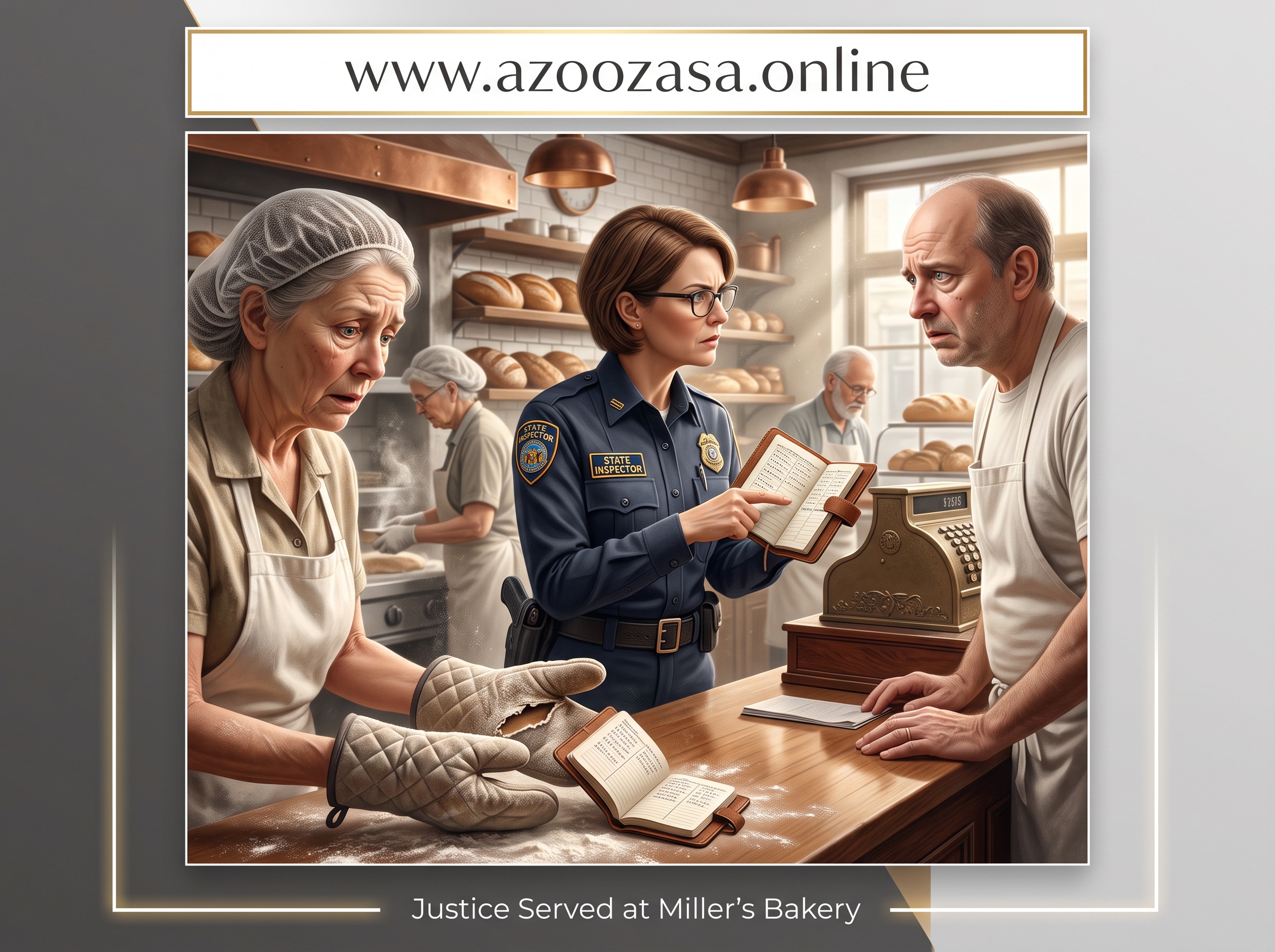
Miller’s eyes darted wildly around the kitchen. He lunged toward my station, grabbed one of the oversized, heavy-duty Kevlar oven mitts hanging on the wall hook, shoved the notebook deep into the thick thermal lining, and tossed the mitt carelessly onto the stainless steel prep counter. He immediately spun around, pasting a wide, frantic smile onto his face just as Vance approached.
“Inspector Vance! What a pleasant surprise,” Miller practically chirped, his voice an octave too high. “Please, check anything you like. We pride ourselves on absolute compliance.”
Vance didn’t smile. He clicked his pen. “We’ll see about that, Mr. Miller. Stand aside.”
For twenty minutes, the inspection dragged on with agonizing slowness. Vance checked the internal temperatures of the coolers, swabbed the floor drains, and inspected the ventilation hoods. Miller hovered behind him, nervously dabbing his forehead with a handkerchief.
“I need those sourdough loaves out, Martha,” Elías whispered urgently. “The crust is getting too dark.”
I nodded, turning back to the blistering heat of the deck ovens. I grabbed the nearest pair of oven mitts—the heavy Kevlar ones Miller had just tossed on the counter. I slipped my hands inside. My right hand hit something stiff and unyielding deep in the cotton batting, but I didn’t have time to investigate. The bread was seconds away from burning.
I grabbed the searing hot aluminum tray rack and yanked it backward.
As I pulled, the heavy fabric of the right mitt caught violently on a sharp, exposed wire joint on the side of the cooling rack. I twisted my wrist to free it, but the momentum was too strong. The reinforced seam of the Kevlar mitt ripped open with a loud, distinct tearing sound.
I staggered back, the tray rattling dangerously. As I lowered the bread to the counter, the torn lining of the mitt gaped open, and a small, black leather notebook tumbled out. It hit the flour-dusted floorboards with a heavy thud, sliding directly across the aisle to stop at the polished steel toes of Inspector Vance’s boots.
The entire kitchen went dead silent. The only sound was the low roar of the gas burners.
Miller let out a strangled gasp, lunging forward with a desperate, uncoordinated scramble. “That’s trash!” he yelled, his voice cracking. “Just an old recipe book, don’t worry about it!”
But Vance was faster. He bent down and scooped the notebook off the floor, holding it out of Miller’s frantic reach. The leather cover had popped open upon impact, revealing pages tightly packed with neat, meticulously hand-drawn columns of numbers.
“A recipe book?” Vance asked, his voice a low, dangerous rumble. He adjusted his glasses, his eyes scanning the open page.
I stood frozen, staring at the book. Even from five feet away, I could see my own name written in red ink at the top of a column. Below it were two sets of numbers. One column was labeled Actual Hours. The other was labeled Reported Hours.
It wasn’t a recipe book. It was a secondary ledger. It was the physical manifestation of twelve years of theft.
Vance’s expression darkened with every second that passed. He slowly turned the page. Elías’s name. Beatrice’s name. The names of every single older worker in the bakery, followed by years of documented wage theft, fake tax deductions, and systematic fraud. Miller, in his supreme arrogance, had kept a meticulous record of exactly how much he was stealing to track his own illegal profits.
Miller was hyperventilating, backing away toward the swinging kitchen doors. “Listen, Inspector, that’s just a rough draft of a budget proposal. It means nothing. I can explain everything in my office. Let me write you a check for the health department’s charitable fund—”
“Shut up,” Vance commanded, the words snapping through the air like a whip.
He snapped the leather notebook shut and slid it safely into the deep pocket of his state-issued jacket. He turned to Miller, his eyes cold and unyielding, holding the full weight of state authority.
“Mr. Miller, step away from the register,” Vance said, his voice echoing off the stainless steel walls. “You are officially under investigation for aggravated wage theft, tax fraud, and falsifying state employment records. I am shutting this facility down immediately pending a full audit by the Department of Labor, and I am calling the police.”
Miller collapsed against the prep table, the color draining entirely from his face. The slick, arrogant facade crumbled, leaving behind nothing but a terrified, pathetic man who had finally been caught in his own trap. He looked at me, a desperate plea forming on his lips, but I just stared back at him, feeling the heavy, suffocating weight of the past twelve years lifting from my shoulders.
Within twenty minutes, two squad cars were parked out front, their red and blue lights pulsing brightly against the rain-slicked windows of the bakery. The wealthy customers had fled, leaving behind half-eaten pastries. Elías, Beatrice, and I stood on the sidewalk under an awning, wrapped in our coats, watching as Miller was escorted out in handcuffs, his expensive suit ruined by the damp morning air.
Inspector Vance walked out a few minutes later, pausing by the door to slap a bright red “CLOSED BY ORDER OF THE STATE” sticker onto the glass. He walked over to us, his stern expression softening just a fraction.
“The Department of Labor will be contacting all of you,” Vance said quietly. “Based on what I saw in that ledger, the state will be liquidating his assets to pay back every single cent of the stolen wages, with interest, plus punitive damages. You’re going to get your money, Martha. All of it.”
I nodded, pulling my coat tighter around myself, a slow, deep smile spreading across my face.
Six months later, Miller’s Artisan Bakeshop went up for public auction to satisfy the massive judgments against him. He was serving a three-year sentence in a state penitentiary, utterly bankrupt.
Elías, Beatrice, and I didn’t just attend the auction. We pooled our recovered back-pay, formed a partnership, and bought the equipment outright. We stripped Miller’s name off the sign and reopened the doors under a new banner: The Golden Crust Cooperative. We paid our staff fairly, we worked the hours we chose, and the bread had never tasted sweeter.
And hanging on the wall by the ovens, framed behind glass like a museum artifact, was a single, heavily scorched Kevlar oven mitt, split perfectly down the seam.



0 comments