
The Price of Salt
The air in the Oakwood Cardiac Rehabilitation Center always smelled faintly of bleach and impending grief, a sterile purgatory where fragile lives hung in a delicate balance. My eighty-three-year-old father, Arthur Henderson, lay in Room 214, fighting a terrifying war against congestive heart failure. His heart was a tired, overworked engine, struggling to pump fluid through his system. The absolute cornerstone of his recovery was a strict, zero-sodium diet; even a minor influx of salt could cause his body to violently retain water, drowning his lungs and placing catastrophic pressure on his weakened cardiovascular system. We all knew the rules. Or, at least, I thought we did.
My older sister, Sheila, had always been the golden child, a master manipulator masked in cashmere cardigans and a perpetual aura of self-sacrifice. She arrived every evening at exactly six o’clock, carrying a heavy, insulated stainless-steel Thermos. She would breeze past the nurses’ station with a dazzling, weary smile, distributing baked goods to the staff before settling into the vinyl chair beside our father’s bed.
“Dad only likes my cooking,” she would say, her voice dripping with practiced, honeyed devotion as she poured a steaming cup of dark amber liquid. “Hospital food is just too miserable for him. This is my special homemade bone broth. It’s full of love.”
The nurses adored her. They saw a fiercely dedicated daughter bringing comfort to a dying man. But I saw something entirely different. Every single night, about three hours after Sheila kissed our father’s forehead and walked out the double glass doors of the ward, the alarms in Room 214 would begin to shriek.
It was a horrifying, cyclical nightmare. My father’s blood pressure would suddenly skyrocket to stroke-level numbers. His breathing would become shallow and ragged, and his ankles would swell violently, the skin pulling taut and shiny over the accumulating fluid. The night staff would rush in with intravenous diuretics, fighting frantically to drain the sudden, inexplicable flood from his lungs. By morning, he would be a weak, trembling ghost of himself, completely drained from the medical trauma.
The cardiologists were utterly baffled. According to his chart, he was receiving zero dietary sodium. Yet, his body was reacting as if he were swallowing seawater.
The true depth of the nightmare revealed itself in the quiet, hushed conversations Sheila had with the lead physician in the sterile corridors. I stood out of sight near the ice machine, listening as she pressed a tissue to her dry eyes.
“He’s losing the battle, Dr. Evans,” she sighed, her voice trembling with manufactured sorrow. “His heart just can’t take it anymore. The edema is getting worse despite everything you’re doing. I think we need to start preparing for the end. I’ve spoken to my lawyer, and I need full medical and financial power of attorney over his accounts before he slips away into a coma. We need to secure his estate.”
My gut twisted into a cold, hard knot. Our father had spent forty years working as a civil engineer, quietly amassing a retirement account worth $420,000. Sheila had spent the last decade drowning in credit card debt and failed business ventures. She didn’t want him to recover. She was actively preparing for his funeral, positioning herself to intercept every single penny the moment his heart finally gave out.
The pieces fell into place the very next afternoon.
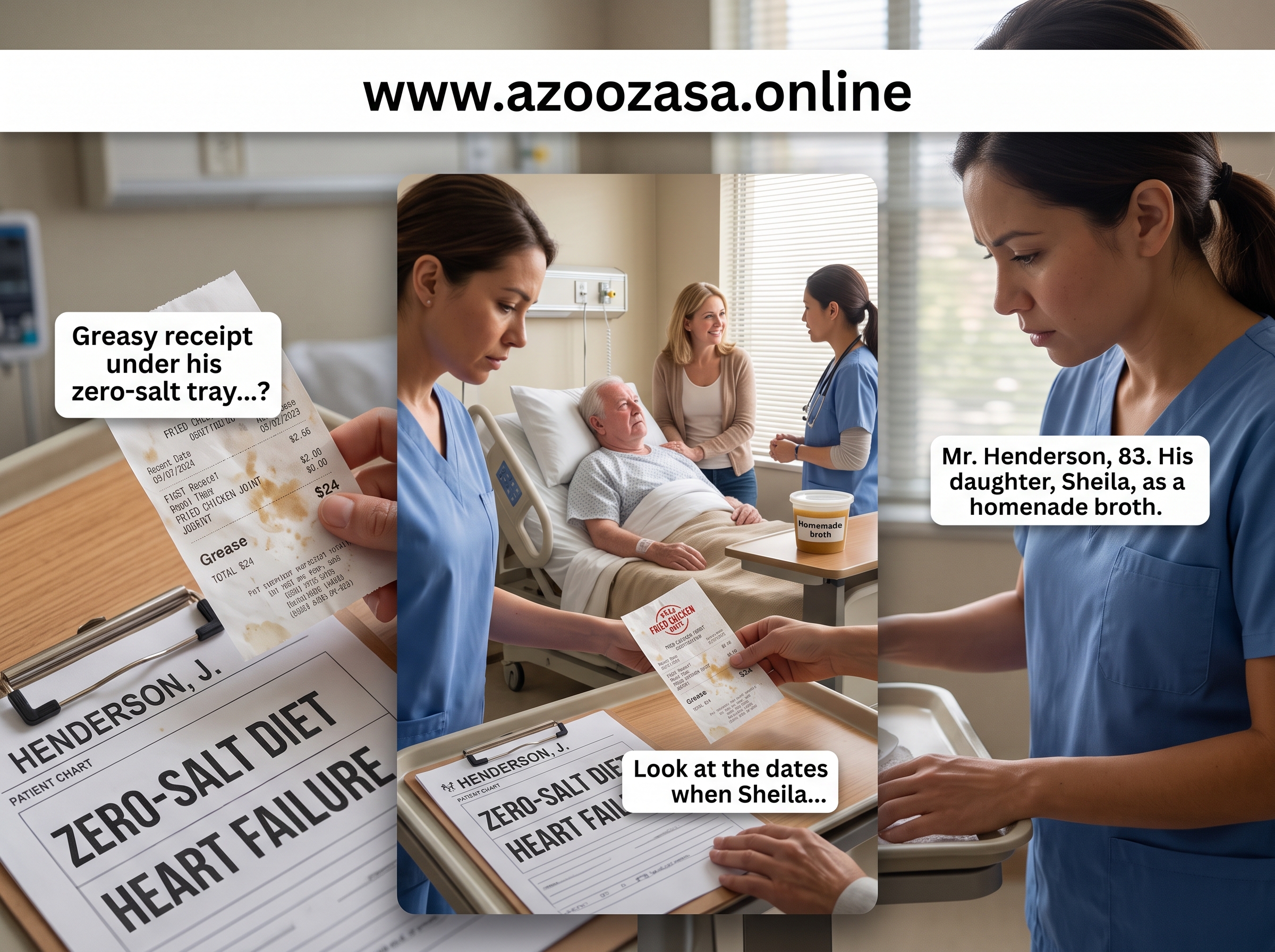
I was sitting by my father’s bedside while he slept, quietly clearing the clutter from his rolling over-bed tray. Sheila had left in a hurry the night before, rushing out to take a phone call. As I lifted the damp, white paper liner on the plastic tray to throw it in the trash, a crumpled piece of thermal paper fluttered to the linoleum floor.
I picked it up. It was a receipt from a greasy, late-night fried chicken joint located three blocks from Sheila’s apartment. The total was $24.00. The order, timestamped at 5:15 PM the previous evening—just forty-five minutes before she arrived at the hospital—read: Family Style Crispy Chicken. Extra MSG Seasoning Salt. Large Side of Pan Gravy.
I stared at the receipt, a sickening, terrifying realization washing over me. I looked at the insulated Thermos sitting cleanly washed on the windowsill. I looked at my father’s brutally swollen ankles.
She wasn’t feeding him bone broth.
I grabbed the receipt, marched directly to the nurses’ station, and pulled my father’s thick medical chart from the rolling rack. The floor supervisor, Nurse Ramirez, a sharp-eyed veteran with twenty years of cardiac experience, looked up from her computer with a stern frown.
“Helen, you know you aren’t supposed to handle the physical charts,” Ramirez warned softly.
I slid the chart across the high counter, placing the greasy, crumpled receipt directly on top of his zero-salt dietary order. I leaned in close, my heart hammering against my ribs, and whispered, “Look at the dates, Ramirez. Look at the dates when Sheila visits, and look at the timestamps on his blood pressure spikes.”
Ramirez sighed, clearly ready to dismiss me as a paranoid, grieving daughter, but her professional curiosity won out. She opened the chart, tracing her pen down the column of my father’s vitals. Her eyes flicked to the receipt. Then back to the chart. She flipped a page back, checking the previous week’s nursing notes.
I watched the exact moment the realization hit her. The color drained entirely from Ramirez’s face. The correlation wasn’t just a coincidence; it was a perfect, deadly timeline.
“My sister is heavily in debt,” I whispered, the words tasting like ash in my mouth. “And my father has nearly half a million dollars in liquid assets. She’s petitioning for power of attorney tomorrow morning because she claims he’s naturally failing. Ramirez, what happens to a man with severe congestive heart failure if you feed him liquefied, highly concentrated fried chicken gravy and extra seasoning salt every single night?”
“It throws him into acute fluid overload,” Ramirez breathed, her eyes wide with horror. “It forces the heart to work against an impossible pressure gradient. It’s… it’s basically an invisible poison.”
Ramirez didn’t hesitate. She didn’t call security, and she didn’t call the doctor just yet. She was a woman of science, and she needed irrefutable proof.
“When does she usually arrive?” Ramirez asked, her voice dropping into a hardened, tactical register.
“Six o’clock,” I replied, glancing at the wall clock. It was five-thirty.
“Go back to the room,” Ramirez commanded. “Act completely normal. When she pours that broth, you need to find an excuse to leave the room. Leave the rest to me.”
At exactly six o’clock, the heavy ward doors swung open, and Sheila breezed in, radiating her usual tragic martyr energy. She kissed my cheek, set her heavy purse on the floor, and unscrewed the lid of the stainless-steel Thermos. The rich, savory smell of dark broth instantly filled the small room.
“Here we go, Dad,” she cooed, pouring the steaming liquid into a plastic hospital cup. “Your favorite. It’ll make you feel so much better.”
My father, weak and trusting, managed a faint, grateful smile. “Thank you, sweetheart.”
My hands were shaking so badly I had to shove them into the pockets of my jeans. “I’m going to run down to the cafeteria for a coffee,” I choked out, practically fleeing the room.
I stood in the hallway, pressing my back against the cold cinderblock wall. Less than thirty seconds later, Nurse Ramirez marched into Room 214, flanked by two burly male orderlies.
“Excuse me, Sheila,” Ramirez’s voice rang out, sharp and authoritative, carrying easily through the open door. “We need to pause for a moment. Mr. Henderson’s latest blood labs just came back, and we are initiating a strict fluid input protocol. I need to take this liquid down to the lab for a complete nutritional analysis before he can drink it.”
“What?” Sheila’s voice spiked in panic. “No, that’s ridiculous! It’s just homemade bone broth. He needs the nutrients. Give that back to me.”
I peeked around the doorframe. Sheila was on her feet, reaching aggressively for the plastic cup. One of the orderlies stepped smoothly between her and the bed, a silent, immovable wall. Ramirez picked up both the cup and the Thermos.
“If it’s just bone broth, Sheila, you have absolutely nothing to worry about,” Ramirez said coldly. “The lab will clear it in ten minutes. Please wait here.”
Ramirez walked out of the room, locking eyes with me for a fraction of a second as she headed straight for the elevators. The next fifteen minutes stretched into an eternity. Inside the room, Sheila paced like a caged animal. She checked her watch frantically, muttered about the incompetence of the hospital staff, and entirely ignored our father, who watched her with mounting, silent confusion.
When the elevator doors finally chimed, Ramirez didn’t return alone. She stepped onto the ward accompanied by Dr. Evans, the hospital administrator, and two uniformed police officers.
Sheila froze as they entered the room. The color vanished from her perfectly manicured face.
Dr. Evans held a printed lab slip in his trembling hand. He looked at Sheila, a man who had been duped, and the betrayal radiated from him in waves.
“The sodium content in this Thermos is over four thousand milligrams,” Dr. Evans stated, his voice echoing in the dead silence of the room. “That is more than double the maximum daily allowance for a healthy adult, concentrated into a single cup. You haven’t been comforting him, Sheila. You have been systematically inducing acute cardiac failure.”
“That’s a lie!” Sheila shrieked, backing away toward the window. “It’s a mistake! Helen made it! Helen brought it in!”
“We have the receipt from the restaurant, ma’am,” one of the officers said, stepping forward and unclipping a pair of handcuffs from his belt. “And we have security footage of you transferring the contents in your car in the parking garage. Place your hands behind your back.”
Our father watched in stunned, heartbroken silence as his golden child was placed in irons and marched out of the room, her screams of denial echoing down the sterile hallway until the heavy ward doors finally swung shut.
It took three days for the massive influx of sodium to fully clear my father’s system. Without the nightly dose of poison, the transformation was nothing short of miraculous. The horrific swelling in his ankles completely vanished. His blood pressure stabilized to healthy, baseline levels, and the rattle in his lungs faded into clear, deep breaths.
Two weeks later, Arthur Henderson walked out of the Oakwood Cardiac Rehabilitation Center under his own power, leaning lightly on a cane, with me by his side. The $420,000 remained safe in his retirement account, completely untouched by the daughter who was currently awaiting trial for attempted murder and elder abuse. We never spoke of the broth again, but every Sunday, when I cook dinner for him at his house, I leave the salt shaker firmly locked inside the pantry.


0 comments