
The Friday Night Penance
For two agonizing years, the rhythm of my marriage had been dictated by the setting of the Friday sun. Every week, like clockwork, my husband Arthur would come home from his shift at the lumber yard, shower the sawdust from his skin, apply a fresh splash of aftershave, and tell me he was heading to the parish council meeting at St. Jude’s. He would kiss my cheek, a fleeting brush of dry lips, and walk out the door. And every Friday, I would stand at the kitchen window, watching the red taillights of his Ford truck bleed into the twilight, desperately trying to ignore the suffocating, insidious voice in my head that whispered he was never going to a church.
I tried to trust him. Arthur was a good man, a quiet man who paid the bills on time and fixed the neighbor’s plumbing for free. But the distance between us had grown vast and cold. The definitive crack in the ice came on a brisk Tuesday morning. We had just finished a community clothing drive, and I was emptying the pockets of his heavy winter coat before dropping it at the dry cleaners. My fingers brushed against a crumpled piece of paper deep in the lining. It was a receipt. The ink was faded, but the bold, purple lettering at the top was unmistakable: Route 18 Motel. Beneath it, a charge of $95 for a weekly extended-stay rate, dated the previous Friday.
My hands went entirely cold. The kitchen around me seemed to tilt on its axis. A motel on the edge of the county line. Ninety-five dollars. It was the textbook clichè of a ruined marriage, printed on cheap thermal paper.
The following Friday, I didn’t stay in the kitchen. When Arthur pulled out of the driveway, I grabbed my keys, slipped into my sedan, and followed him at a safe distance, the headlights turned off until I reached the main highway. My heart hammered against my ribs like a trapped bird. I rehearsed the confrontation a hundred times in the span of a twenty-minute drive. I imagined the young woman. I imagined the screaming, the tears, the sheer, righteous fury of a wife who had devoted twenty years to a man only to be discarded for a cheap thrill in a roadside room.
The Route 18 Motel was a decaying strip of cinderblock rooms huddled beneath a buzzing, half-lit neon sign. I watched from the shadows of the adjacent gas station as Arthur parked his truck, walked up to Room 112, and let himself in with a brass key. He didn’t look over his shoulder. He didn’t knock. He just walked in like he belonged there.
I gave it five minutes. Let them get comfortable, I thought, a bitter, acidic taste rising in my throat. I marched across the cracked asphalt, the cold wind biting at my face, my hands clenched into tight fists. I reached the door of Room 112. I didn’t bother knocking. I planted my hand flat against the cheap laminate wood, turned the handle, and pushed it open with all the strength my fury could muster, ready to scream the walls down.
The scream died in my throat.
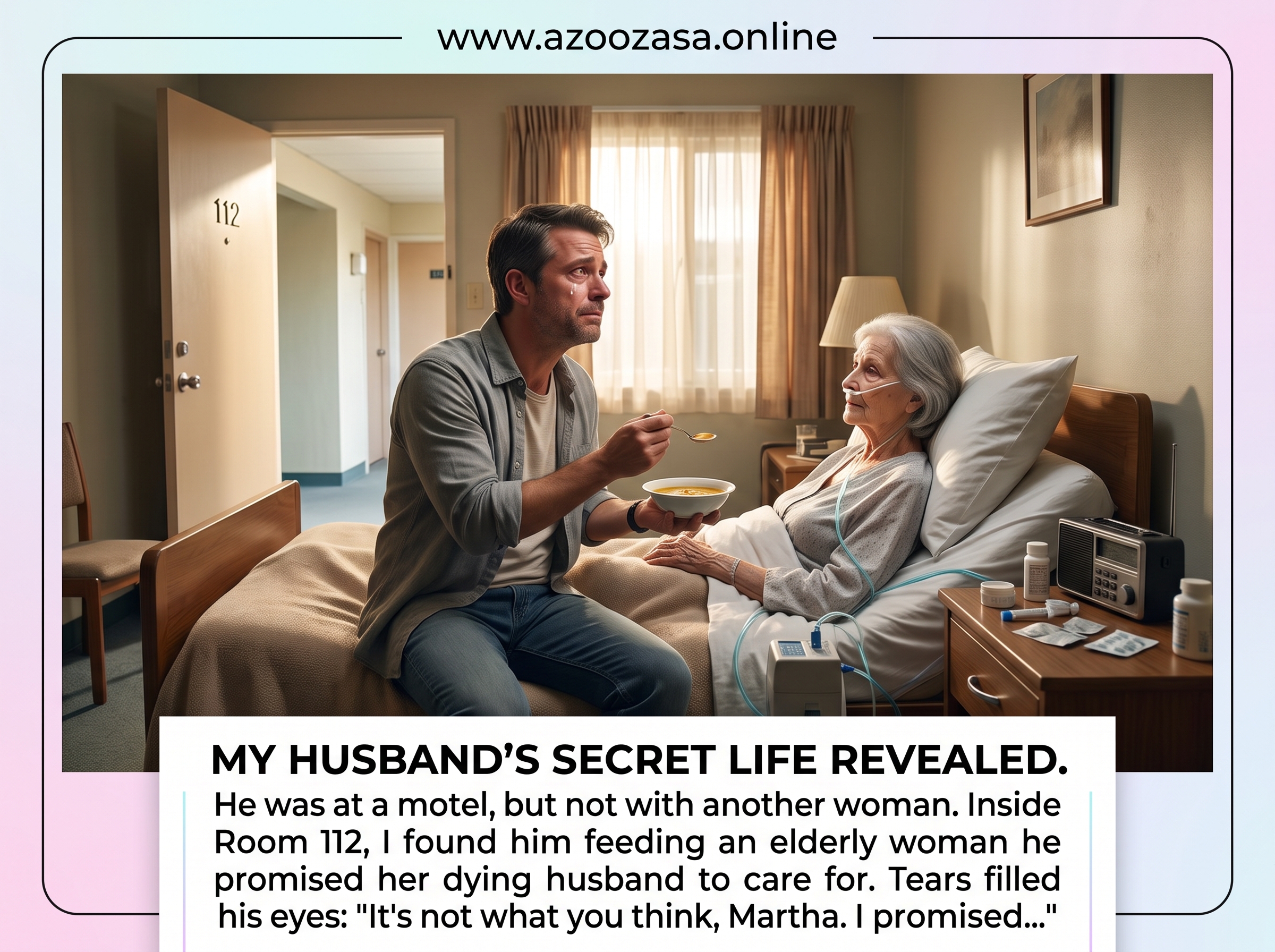
The room smelled fiercely of medical-grade antiseptic and warm chicken broth, a jarring contrast to the stale cigarette smoke I had anticipated. There was no dim, romantic lighting. The harsh overhead fluorescent bulb illuminated a small, depressing space dominated by a heavy, mechanical hospital bed.
Inside the bed was a frail, elderly woman. Her skin was the color of old parchment, drawn tight over fragile bones, and a clear plastic cannula rested under her nose, connected to a humming green oxygen concentrator in the corner.
And sitting on a cheap plastic chair beside the bed was my husband.
Arthur was holding a small plastic bowl, carefully blowing on a spoonful of broth before raising it to the old woman’s trembling lips. He froze as the door banged against the wall, the spoon hovering in mid-air. He looked at me, his face drained of all color, the exhaustion of the past two years etched deeply into the lines around his mouth.
Arthur looked up, his eyes filling with tears, and said, “It’s not what you think, Martha. This is Mrs. Jennings. Before her husband died in the mine accident, I promised him I’d never let her end up alone in a state ward.”
I stood paralyzed in the doorway, the cold wind rushing past my shoulders, struggling to reconcile the sordid affair I had built in my mind with the heartbreaking reality unfolding in front of me. I closed the door slowly, sealing us inside the quiet, rhythmic hum of the oxygen machine.
“The Blackwood collapse?” I whispered, my voice trembling. “Arthur, that was ten years ago.”
Arthur lowered the spoon back into the bowl and set it on the nightstand. He reached out and gently patted Mrs. Jennings’ frail, bruised hand. She looked at me with cloudy, cataract-veiled eyes, offering a weak, confused smile before her heavy eyelids fluttered shut and she drifted back into a medicated sleep.
“Ten years, four months, and twelve days,” Arthur said, his voice thick with an ancient, unhealed grief. He stood up, wiping his hands on his denim jeans, and gestured toward the two faded armchairs by the window.
I sat down, my legs practically giving out beneath me. Arthur took the seat opposite me, burying his face in his large, calloused hands. When he finally looked up, the defensive walls he had built over the last two years completely shattered.
“Thomas Jennings was my foreman,” Arthur began, his voice barely above a whisper. “He was a good man. When the support beams gave way in shaft four, the ceiling came down in a wave of slate and iron. I was pinned. Thomas was clear. He could have run, Martha. He had a clear path to the lift. But he came back for me. He wedged a steel pry bar under the rock crushing my leg and heaved.”
Arthur took a shuddering breath, his eyes staring at a point on the stained carpet that only he could see. “He got me out. But the secondary collapse caught him. A beam shattered his spine. I sat with him in the dark for six hours waiting for the rescue crew. He knew he wasn’t going to make it. And all he talked about was his Mary.”
He looked over at the sleeping woman in the hospital bed. “The company fought the payout. You know how it is in this country. If there’s a loophole to avoid paying a widow her rightful pension or covering her healthcare, the corporations will find it. They claimed Thomas violated a safety protocol by going back into an unstable zone. They denied her his life insurance. They took back the company house.”
The pieces began to fall into place, a devastating mosaic of American retirement stripped bare and a guilt too heavy for one man to carry.
“Why didn’t you tell me, Arthur?” I asked, the anger entirely gone, replaced by a profound, aching sorrow. “Why lie to me about the church?”
“Because of the cost, Martha,” he confessed, tears finally spilling over his lower lashes, tracking through the sawdust still clinging to his cheeks. “When Mary’s health started failing two years ago, she couldn’t afford the in-home care she desperately needed. The state was going to move her to the county facility. I’ve seen that place. It’s where they send the forgotten to die in the dark. I made a vow to a dying man who gave me my life, and I couldn’t break it.”
He leaned forward, his hands clasped so tightly his knuckles were white. “The ninety-five dollars for the room. The cost of the oxygen tanks, her medications, the day nurse I pay under the table from Monday to Thursday—it takes almost half my paycheck. I’ve been working double shifts at the yard just to keep our own mortgage afloat. I didn’t tell you because I knew it was financial ruin. I knew it wasn’t fair to ask you to sacrifice our future, our retirement, to pay my blood debt. So I took the Friday night shift to give her nurse a break, and I lied.”
I looked at my husband. I looked at the dark circles under his eyes, the graying hair at his temples, the fraying cuffs of his flannel shirt. For two years, I had thought he was stealing time away from our marriage to give to someone else. In reality, he had been breaking his own back to carry a burden he thought would crush me. He had isolated himself in his own honor.
The silence in the room stretched, punctuated only by the steady hiss-click of the oxygen concentrator. I stood up, walked across the small gap between us, and knelt on the cheap motel carpet in front of him. I took his large, trembling hands in mine.
“Arthur,” I said softly, forcing him to meet my eyes. “When we stood at the altar, I promised to share your life. All of it. Not just the joyful parts, and not just the easy parts. You survived the dark that day. But you brought the darkness home with you, and you’ve been sitting in it alone ever since.”
I squeezed his hands, feeling the rough callouses that had worked so hard to keep everyone around him afloat. “Thomas saved you. That means Thomas saved us. This isn’t just your debt. It’s ours.”
Arthur let out a ragged sob, collapsing forward, resting his forehead against my shoulder. I wrapped my arms around his broad back, holding him tightly as two years of solitary terror and exhaustion finally poured out of him. We stayed like that for a long time, kneeling on the floor of a roadside motel, holding each other while the old woman slept peacefully nearby.
The next morning, we didn’t go to the dry cleaners. We brought my sedan and Arthur’s truck to the Route 18 Motel. We carefully packed Mrs. Jennings’ meager belongings into cardboard boxes. We unhooked the oxygen concentrator and loaded the heavy hospital bed into the bed of the Ford.
We brought Mary Jennings home. We set her up in the spare bedroom on the first floor, the one with the large bay window that looked out over my flower garden. We navigated the labyrinth of elder-care legalities together, finding the right specialists and finally demanding the proper medical support she had been denied.
Arthur never went to another phantom parish council meeting. Our Friday evenings are now spent together, sitting in the warm light of our own living room, listening to Mary recount stories of her youth. The secret of Room 112 was gone, and in its place, the true foundation of our marriage was finally laid bare—built not just on trust, but on the quiet, unbreakable grace of shared burdens.



0 comments