
The Fifty-Dollar Foundation
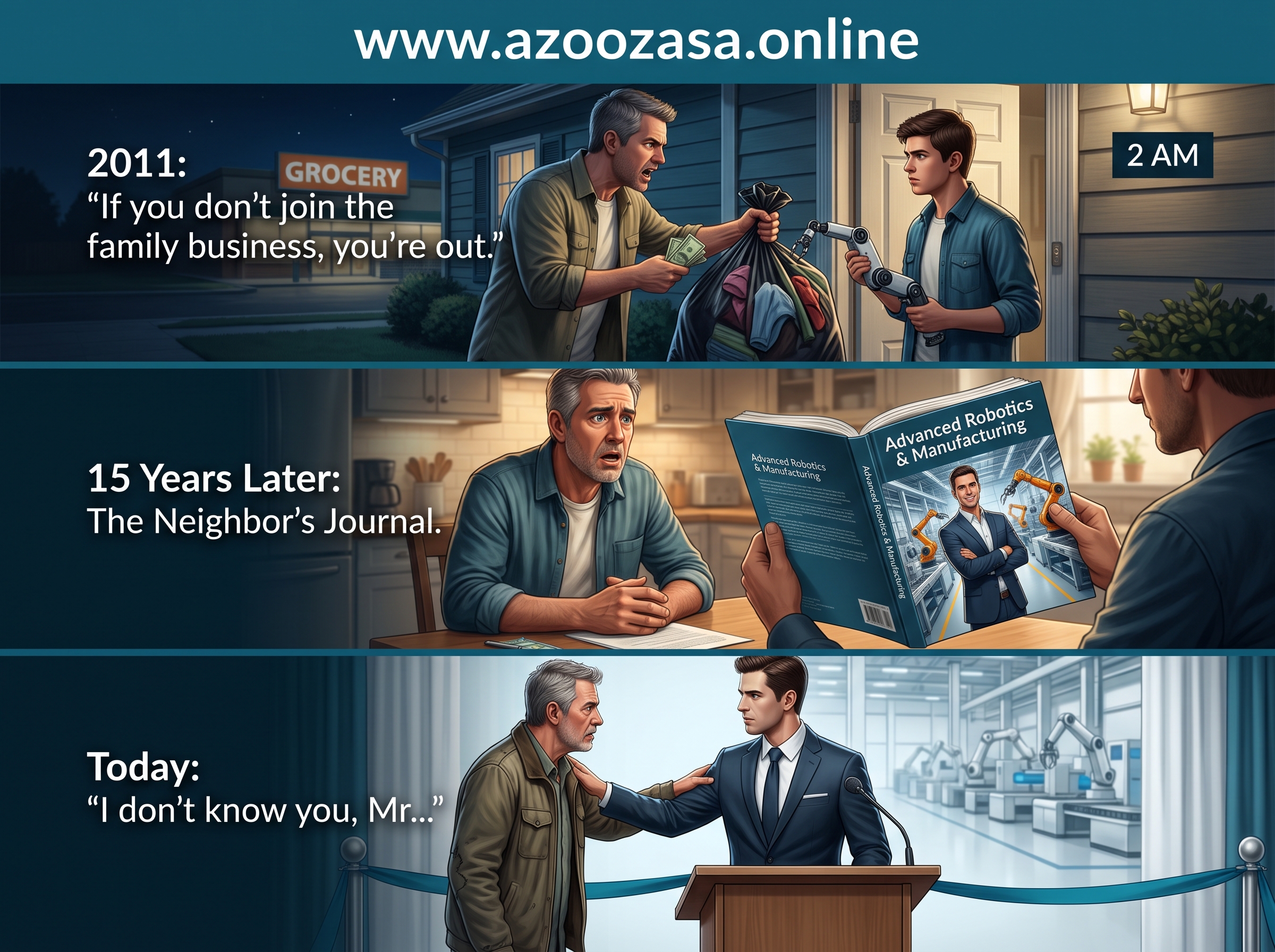
The glossy pages of the American Engineering journal felt impossibly heavy in my calloused hands. The cover featured a man in a tailored charcoal suit, standing confidently before a sprawling, gleaming complex of glass and steel. He had the same sharp jawline as my late wife, the same dark, calculating eyes. But the face was older, hardened by time and forged by a fire I had lit. It was Derrick. Beneath his photograph, bold white lettering spelled out his triumph: The $3.4 Million Automated Empire: Derrick Vance’s Blueprint for the Future.
Mrs. Gable from down the street had dropped the journal on my front porch that morning, her eyes wide with a mix of awe and thinly veiled pity. I had skimmed the dense technical jargon about robotic assembly lines and proprietary algorithms until my eyes slammed into a pull-quote halfway down the page, printed in stark, unforgiving black ink.
“I learned early that when your own father throws you out, you build your own future. You learn to assemble a life the same way you assemble a machine—piece by piece, leaving no room for weak components.”
Fifteen years vanished in a heartbeat, dragging me back to a sweltering Tuesday night in August of 2011. The air in our cramped apartment above the storefront had tasted like stale coffee and bitter pride. I had stood before him, a petty king defending a meager, fading kingdom of canned goods and produce aisles. Derrick had just laid his university acceptance letter for an engineering program on the linoleum table, quietly declining the full-time manager position I had spent my entire life carving out for him at the store.
“If you don’t join the family grocery business, you’re dead to me,” I had roared, my voice echoing off the thin walls.
He hadn’t yelled back. He hadn’t pleaded. He had just looked at me with a quiet, terrifying clarity, realizing the man who raised him viewed his independence as a betrayal. I had dragged two black plastic garbage bags from the pantry, storming into his room to sweep his entire life into them—sweaters, jeans, a few books, and the intricate little motorized gadgets he spent hours building at his desk. I threw the bags onto the sidewalk at two in the morning, the streetlights buzzing overhead like an angry swarm. I shoved a crumpled fifty-dollar bill into his chest, told him it was the last thing he’d ever get from me, and changed the deadbolt before he had even picked up his bags.
For fifteen years, the silence that followed was absolute.
I told myself, as I stared at the magazine, that I was going to apologize. I told myself that a decade and a half was long enough to pay for a moment of blind, stubborn rage. But beneath the suffocating guilt, a toxic, insidious sliver of paternal entitlement still festered. I was his father. Blood was blood. Surely, seeing my face, seeing the deep lines of age carved around my mouth and the white in my hair, would bridge the chasm I had created. He had proven his point. He had won. Now, it was time to come home.
The address listed in the back of the journal led me to the outer edge of the city, to a newly developed industrial park that looked like a mirage of polished glass and brushed aluminum. The sign at the entrance of the massive facility read Vance Robotics in sleek, illuminated lettering. The parking lot was filled with luxury sedans and news vans. It was the grand opening of his new manufacturing plant, a facility that the article boasted would revolutionize automated supply chains across the globe.
I parked my rusting, fifteen-year-old delivery van a block away, suddenly painfully aware of my faded corduroy jacket and scuffed work boots. The air around the plant smelled of ozone, fresh asphalt, and expensive cologne. It was a sterile, perfect world, a universe away from the smell of overripe bananas and bleach that permanently clung to my skin.
I slipped through the massive double glass doors, losing myself in the dense crowd of local politicians, tech investors, and journalists. At the far end of the sprawling, pristine production floor, beneath the shadow of massive, dormant robotic arms, a temporary stage had been erected.
There he was.
Derrick stood at a sleek acrylic podium, bathed in the brilliant white glare of camera flashes. He looked magnificent. He spoke with a calm, magnetic authority about innovation, resilience, and the future of American manufacturing. Every eye in the room was locked onto him, captivated by the rhythm of his voice and the sheer scale of his ambition.
My heart hammered against my ribs like a trapped bird. The quiet arrogance I had brought with me began to evaporate, replaced by a sudden, desperate panic. This man didn’t need me. This man had built a literal empire out of thin air, garbage bags, and fifty dollars. I needed him to acknowledge me, to validate my existence, to prove that I hadn’t entirely erased myself from his story.
When the polite applause rippled through the crowd signaling the end of his speech, Derrick stepped down from the podium, moving toward a velvet rope line to shake hands and answer questions. The crowd parted slightly as he moved, and I saw my opening. I pushed forward, ignoring the annoyed glares of the men in expensive suits I shoved past.
“Derrick,” I choked out, my voice cracking under the weight of fifteen years of unspoken words.
He didn’t hear me over the din of the crowd. I reached the velvet rope just as he turned in my direction to greet a city councilman. Desperation took the wheel. I reached out over the crimson barrier and clamped my heavy, trembling hand onto his tailored forearm.
He froze.
The gentle, professional smile he had been offering the councilman vanished instantly. He looked down at my weathered hand gripping his sleeve, the grease embedded in my knuckles staining the fine wool of his suit. Then, his eyes traveled slowly up my arm, stopping at my face.
I expected shock. I expected a sudden intake of breath. I expected the raw, fiery resentment of a son confronting the man who had discarded him into the night.
What I saw was infinitely worse.
His dark eyes were utterly vacant. There was no flicker of recognition, no spark of long-buried pain, no anger to be reasoned with. It was the calculated, sterile gaze of an engineer analyzing a minor, unexpected defect on an assembly line. The silence between us seemed to stretch out into an eternity, drowning out the chatter of the crowd and the clicking of the cameras.
“Derrick,” I whispered again, tears finally spilling over my lower lashes, cutting hot tracks through the dust on my cheeks. “It’s me. I saw the article. I’m… I’m so proud of you, son. I’m sorry.”
Derrick didn’t flinch. He didn’t blink. He gently but firmly reached over and peeled my fingers off his jacket, dropping my hand back to my side as if I were a stranger who had lost his balance in the crush of the crowd. He adjusted his cuff, his posture perfectly rigid.
“I don’t know you, Mr. …”
He let the question hang in the air, a devastatingly polite inquiry directed at a total stranger. He didn’t wait for an answer. He didn’t look back. He simply turned around, seamlessly picking up a conversation with a silver-haired investor as if the interruption had never occurred.
Two private security guards materialized from the periphery, their hands resting firmly on my shoulders, guiding me backward. They pulled me away from the rope, away from the brilliant lights, away from the son I had effectively murdered fifteen years ago.
I stumbled out into the blinding afternoon sun, the heavy glass doors sliding shut behind me with a decisive, airtight hiss. The walk back to my rusted van felt like a march to the gallows. I climbed into the driver’s seat and stared at my hands resting on the cracked steering wheel. They were just hands—hands that knew how to stack cans, sweep floors, and lock doors against the people who mattered most.
Derrick hadn’t been acting. He hadn’t been trying to hurt me or teach me a lesson. He had simply stated a biological and structural fact. The father he had known died on a sidewalk at two in the morning in 2011, taking his pride and his grocery store with him. What was left was just a ghost, haunting an empire of steel and silicon where it no longer belonged.
I turned the ignition, the engine sputtering and coughing to life, and drove back to my empty store, carrying the terrifying knowledge that some machines, once shattered by their makers, can never be rebuilt.


0 comments