
The $4,500 Secret: The Twin Who Never Died
The attic smelled of dry rot, desiccated lavender, and fifty-two years of suffocating silence.
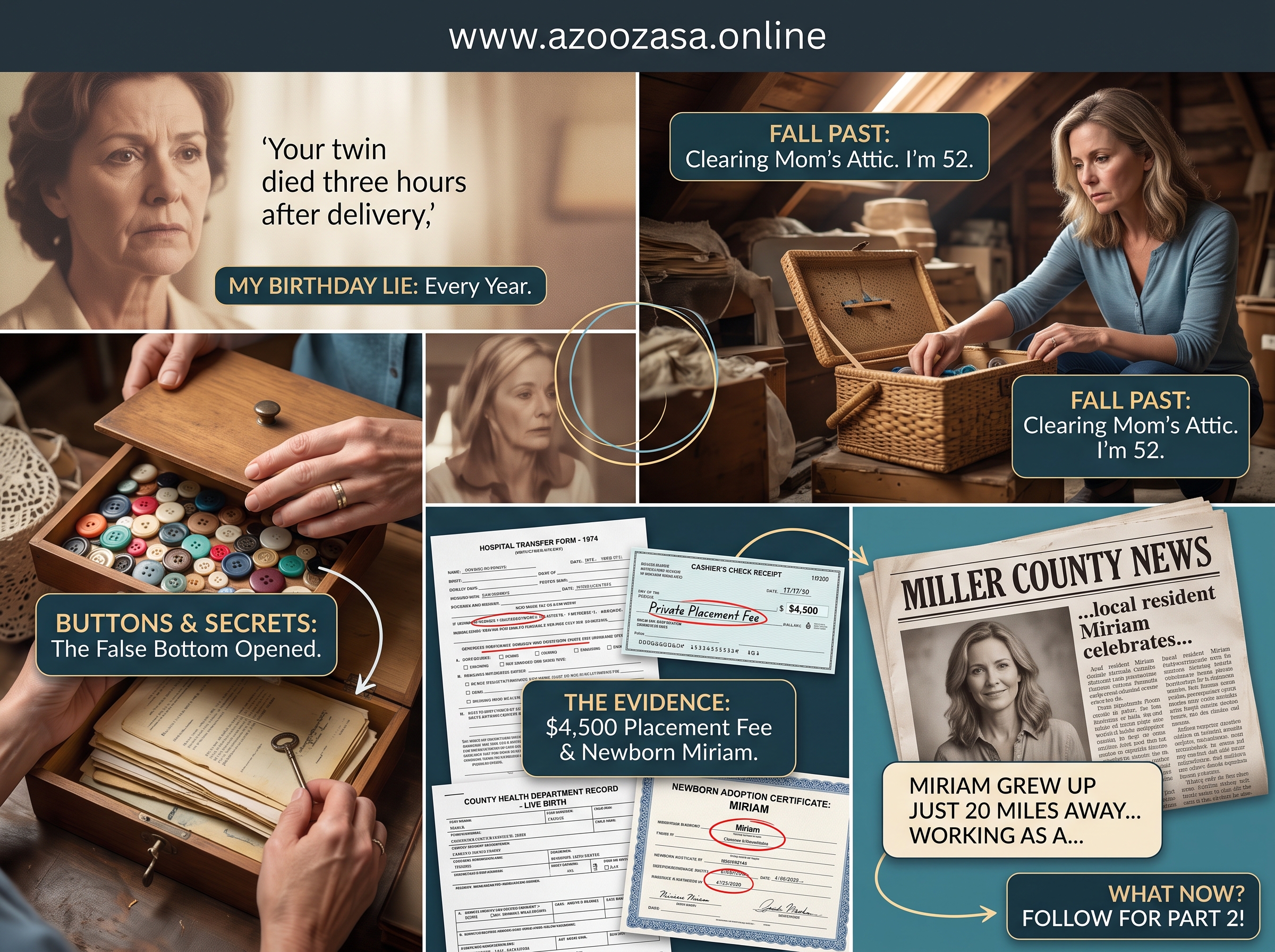
“Your twin sister died three hours after delivery,” my mother told me every year on my birthday. It was a ritualistic mourning, delivered with a hollow, practiced grief that I was never allowed to question. She would light a single white candle on the kitchen counter, stare into the flame, and tell me how my sister’s lungs had simply been too fragile for this world. For over five decades, I carried the phantom weight of a ghost I had shared a womb with, a biological echo I mourned every time I looked in the mirror and wondered what it would be like to not be alone.
My mother passed away last fall, a quiet, stoic woman taking her secrets to a frozen plot in the county cemetery. She left me her modest, paid-off Victorian house and a lifetime of accumulated clutter.
Yesterday afternoon, I sat on the splintering floorboards of the attic, sorting through the remnants of her life. Between boxes of moth-eaten sweaters and chipped porcelain teacups sat her prized possession: a massive, intricately carved mahogany sewing box. My mother had been a master seamstress, making her living hemming gowns for the wealthy women of the next county over. I opened the brass latch, intending to salvage the antique spools of silk thread.
As I pulled out a heavy velvet pincushion, my thumb pressed hard against a wooden divider. A sharp, mechanical click echoed in the dusty air.
The entire bottom panel of the wooden box sprang upward on a concealed hinge.
I set the box down, my heart suddenly hammering a frantic, terrifying rhythm against my ribs. Tucked inside the shallow, hidden cavity was a stack of brittle, yellowed documents wrapped tightly in a faded silk ribbon. I pulled the ribbon loose. The paper was dry and fragile, crackling loudly in the suffocating quiet of the attic.
The first document was a hospital transfer form dated October 14, 1974—the day I was born. But it wasn’t a death certificate.
Paired directly beneath it was a carbon-copy receipt for a cashier’s check in the amount of $4,500. The memo line, written in the unmistakable, rigid cursive of the attending physician, read: Private Placement Fee.
My hands began to shake uncontrollably. I peeled back the receipt to reveal a county health department record. It listed a live birth, double delivery. Both infants healthy. Attached to it was a newborn adoption certificate, officially transferring custody of Baby B to a wealthy, childless couple in the neighboring district. The name they had given her was Miriam.
My mother hadn’t lost a child. She had sold one.
In 1974, four thousand, five hundred dollars was a staggering sum of money for a single, destitute woman about to be evicted from a rented apartment. It was enough, I realized with a violent, sickening wave of nausea, to put a massive down payment on the very house I was currently sitting in. My entire life—my childhood bedroom, the roof over my head, the stability I had always taken for granted—was entirely financed by the exile of my own sister. I had been the kept one. Miriam had been the currency.
Tucked at the very bottom of the hidden compartment was a newspaper clipping from a local Miller County gazette, dated just three years ago. The headline read: Local Nurse Celebrates 25 Years of Saving Tiny Lives.
There, smiling back at me in grainy black-and-white ink, was my own face.
The woman in the photograph had my exact jawline, my deep-set eyes, and the same slight, inherited crook in her nose. But where my hair was kept short and practical, hers fell in long, loose waves over shoulders clad in medical scrubs. The article stated that Miriam Hayes, a senior neonatal intensive care nurse, had spent her entire career at Miller County General—a hospital located exactly twenty miles down the interstate.
Twenty miles. We had grown up twenty miles apart. We could have crossed paths in a grocery store aisle, sat in the same movie theater, or passed each other on the highway, entirely blind to the fact that our souls had been violently cleaved in half for a down payment on a Victorian house.
I didn’t scream, and I didn’t cry. The absolute magnitude of the betrayal bypassed sorrow entirely and hardened into a cold, terrifying purpose. I grabbed my car keys, left the attic light burning, and walked out the front door.
The drive down Interstate 9 was a blur of asphalt and autumn leaves. My mind raced, trying to process the magnitude of the calcified lie I had been fed for fifty-two years. My mother had looked me in the eye, lit a candle for a dead infant, and then walked down the hall of a house purchased with her blood money.
I pulled into the sprawling parking lot of Miller County General just as the afternoon sun began to dip below the horizon. The hospital lobby smelled sharply of industrial antiseptic and stale cafeteria coffee. I approached the front desk, my pulse roaring in my ears, and asked for Miriam Hayes.
“Miriam just clocked out of the NICU,” the receptionist said, offering a tired smile. “She usually grabs a tea at the cafe across the street before heading home. You might catch her there.”
I crossed the bustling four-lane street, pushing open the glass door of the small, warmly lit cafe. The bell chimed overhead. I scanned the room.
She was sitting in a corner booth by the window, reading a paperback novel, a steaming mug of chamomile tea resting in front of her. She was wearing a heavy knit cardigan over her blue scrubs.
I stood frozen in the center of the cafe. Seeing a photograph was one thing; seeing her in the flesh was a visceral, reality-shattering shock. It was like looking into a temporal mirror. I watched the way she absentmindedly tucked a strand of hair behind her ear—a nervous tic I had possessed my entire life.
I forced my legs to move. I walked across the scuffed linoleum floor and came to a stop directly beside her table.
Miriam didn’t look up immediately. “Just a minute, I’m almost finished,” she murmured, assuming I was a waitress clearing tables.
“Miriam,” I said.
My voice was hoarse, stripped of all its normal cadence. It sounded like a stranger’s voice.
She marked her page, closed the book, and looked up.
The absolute, profound silence that fell between us seemed to suck the oxygen out of the room. The ambient noise of the espresso machines and chattering patrons faded into total nothingness. Miriam’s eyes widened, the color draining instantly from her face. Her hand trembled, knocking her spoon against the ceramic mug with a sharp clink.
She stared at my eyes. She stared at the shape of my mouth. She was a medical professional; she understood human biology better than anyone, and her brain was rapidly, terrifyingly putting the pieces together.
“Who…” she choked out, her voice barely a whisper. “Who are you?”
I didn’t introduce myself. I didn’t offer a gentle preamble. I reached into my coat pocket, pulled out the brittle, yellowed hospital transfer form and the $4,500 cashier’s check receipt, and slid them across the polished wooden table.
Miriam looked down at the papers. She picked up the transfer form, her trained eyes scanning the medical codes and the birth weights. When she saw the words Private Placement Fee, she let out a short, ragged gasp, covering her mouth with her hand.
“My name is Helen,” I said quietly, sliding into the booth across from her. “I am fifty-two years old. And until three hours ago, I believed that you died because your lungs were too weak to take your first breath.”
Tears instantly spilled over Miriam’s lower lashes, tracking silently down her cheeks. “I always knew I was adopted,” she wept, her voice shaking violently. “My parents were wonderful to me. They told me my birth mother was just a frightened, impoverished teenager who wanted me to have a better life. They never said anything about a twin. They never said I was bought.”
“Our mother was a seamstress,” I replied, the bitterness tasting like ash on my tongue. “She wasn’t a teenager. She was twenty-eight. And she didn’t want you to have a better life. She wanted a house. She kept me, she sold you, and she lied to both of us until the day she died.”
Miriam reached out across the table. Her hand, so agonizingly identical to mine, trembled in the space between us. I reached out and took it. Her skin was warm, calloused from years of washing her hands in harsh hospital soap. The physical contact sent a jolt of profound, undeniable recognition straight through my chest.
For the first time in my entire life, the phantom weight I had carried was gone. I was no longer an echo.
“I lit a candle for you every year on our birthday,” I whispered, the tears finally breaking free, blurring my vision. “She made me mourn you.”
Miriam squeezed my hand with a fierce, desperate strength. “I’m here, Helen,” she cried, a broken, beautiful laugh escaping her lips. “I’m right here. My lungs are perfectly fine.”
We sat in that corner booth for hours as the cafe emptied out and the streetlights flickered on outside the rain-streaked window. We talked about everything and nothing. We talked about the adoptive parents who had loved her, the mother who had betrayed us, and the fifty-two years of stolen time that we could never, ever get back.
My mother had built her life, and my childhood, entirely upon a monstrous, unforgivable transaction. She had taken our shared beginning and carved it in two, hiding the evidence beneath the false bottom of a box meant to mend torn fabrics. But sitting across from the sister who had spent her entire life saving the fragile lives of newborns, I realized that my mother’s ultimate lie had failed.
She had sold a child, but she had not destroyed us. We were bruised, betrayed, and robbed of a lifetime of shared memories. But as Miriam and I finally walked out of the cafe together, stepping out into the cool, dark evening of Miller County, we were finally, undeniably whole.

0 comments