
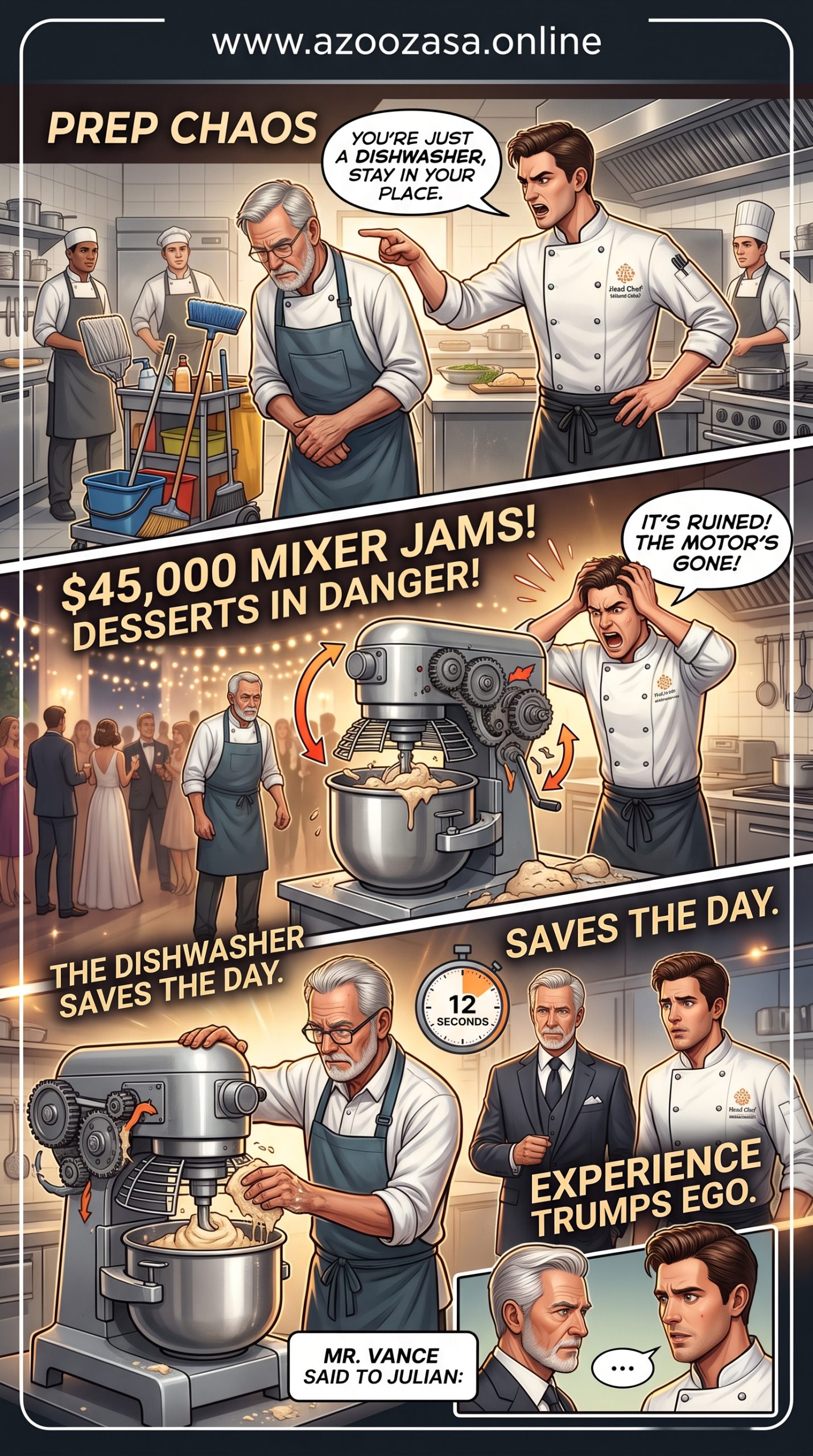
The $45,000 Silence: A Dishwasher’s Twelve-Second Masterclass in Humility
The scalding water of the commercial dish pit was the only thing keeping the arthritis in my hands at bay. At sixty-three, you feel the damp, frantic chill of a high-end restaurant kitchen deep in your marrow. I stood over the stainless-steel sink, scrubbing a scorched copper sauté pan with the rhythmic, mindless precision of a man who had nothing left to prove and everything left to lose.
Four years ago, I was a senior mechanical engineer overseeing turbine assembly lines. Then, a spectacular corporate bankruptcy swallowed my pension whole, leaving my wife and me staring at a mailbox full of final notices. That was how I ended up here, at The Rosewood Estate—a sprawling, ivy-covered venue catering to the ultra-rich—wearing a heavy rubber apron and answering to “Hey, old man.”
The kitchen was a war zone, and its commanding officer was Julian.
Julian was a thirty-two-year-old culinary prodigy whose ego was vastly larger than his Michelin-starred resume. He was a tyrant in a starched white coat, prone to throwing perfectly seared scallops at the wall if the plating wasn’t geometrically flawless. He ruled through terror, treating the line cooks like unruly children and treating me like I was part of the plumbing.
The trouble started during the dinner prep for the Van Der Bilt wedding—a two-hundred-guest affair that had the entire staff on edge. The air was thick with the scent of reduced veal stock, truffle oil, and raw panic. I was pushing my heavy, loaded cleaning cart past the pastry station to restock the line with clean porcelain. It was a tight squeeze.
Julian was screaming at a sous-chef about the consistency of a purée when he spun around, blind with rage, and slammed right into my cart. A stack of expensive side plates rattled dangerously.
Instead of apologizing, Julian’s face flushed a violent crimson. He shoved the cart backward with both hands, sending it crashing against the stainless-steel prep table. My ribs caught the handle, knocking the wind out of me.
The kitchen went dead silent. The hissing of the grills and the hum of the ventilation hoods suddenly sounded deafening. A dozen pairs of eyes darted from Julian to me.
“Watch where you’re going, you clumsy old fool,” Julian spat, straightening his coat. He stepped into my space, lowering his voice into a venomous sneer. “You are just a dishwasher. You have zero value here. Stay in your place, or I’ll have you thrown out on the street tonight.”
I felt the familiar, hot prickle of pride rising in my chest. Decades ago, I would have laid him out on the slip-resistant floor. But anger is a luxury of the financially secure. I thought of my mortgage. I thought of my wife’s medication.
I looked at Julian, my face an unreadable mask. I didn’t nod. I didn’t apologize. I just gripped the handle of my cart, pulled it back into my lane, and silently walked back to the dish pit. Behind me, Julian scoffed, loudly declaring to the line cooks that “some people need to be reminded of their rank.”
I kept my head down. I washed the dishes.
Two hours later, the dinner rush had peaked, and the kitchen was transitioning into the most critical phase of the evening: the dessert service. For this particular wedding, the bride had ordered a complex, multi-tiered entremet that required a massive amount of freshly whipped, temperature-controlled meringue and spun sugar.
To handle the volume, the venue had recently purchased a state-of-the-art, custom-built commercial planetary mixer. It was a $45,000 beast of gleaming Italian engineering, capable of mixing fifty quarts of dense dough without breaking a sweat. It was the crown jewel of the kitchen, and Julian guarded it jealously.
I was loading a rack of crystal wine glasses when I heard the sound.
It wasn’t a normal mechanical hum. It was a high-pitched, grinding shriek—the sickening sound of metal tearing into metal, followed by a violent shudder that vibrated through the floorboards. Then, a terrifying CRACK, and the massive machine ground to a dead, smoking halt.
The timing couldn’t have been worse. The dessert service was scheduled to begin in exactly twenty minutes. Without the mixer, the meringue would collapse, the entremets would be ruined, and the climax of a quarter-million-dollar wedding would end in disaster.
Chaos erupted. Julian sprinted to the pastry station, his face entirely drained of color. He slammed his hand against the machine’s digital control panel. Nothing. He yanked the heavy power cord out of the wall and shoved it back in. The machine emitted a pathetic clicking sound, but the paddle wouldn’t turn.
“Get it moving!” Julian screamed at his pastry chef, his voice cracking with hysteria. “Manually whisk it! Do something!”
“Chef, it’s fifty quarts! By the time we whisk it by hand, the stabilizers will fail!” the pastry chef cried back, near tears.
“The motor is destroyed! It’s burned out!” Julian wailed, gripping his hair in a full-blown panic attack. He was hyperventilating, staring at the ruined centerpiece of his menu. The great, arrogant dictator was crumbling before our eyes, entirely powerless. “It’s over. We’re ruined. Call maintenance! Call someone!”
“Maintenance went home at five, Chef,” a line cook whispered.
From my station at the back of the room, I wiped the soapy water from my hands using a clean towel. I stepped out of the dish pit.
The line cooks parted for me instinctively as I walked toward the pastry station. I didn’t look at Julian. I kept my eyes locked on the smoking $45,000 Italian mixer. As I approached, I could smell the distinct odor of burning ozone and heated gear oil. It wasn’t the motor. A motor that size doesn’t burn out instantly without tripping the main breaker; it stalls. The grinding noise, the sudden halt, the clicking… it was the safety interlock on the manual clutch. The torque had knocked the planetary gear out of alignment, engaging the fail-safe brake.
“What are you doing?” Julian hissed, stepping in my path as I reached the prep table. “Get back to the pit!”
I didn’t say a word. I simply stepped past him, treating him with the exact same weight and consequence he had given me earlier: zero.
I reached around the back of the massive machine. My fingers, calloused and thick with arthritis, found the heavy steel casing of the transmission box. I traced the edge until I felt the recessed manual override lever—a tiny, unmarked notch that only a mechanic would know to look for.
I pressed my thumb into the notch, engaging the release pin, and with my other hand, I grabbed the heavy mixing bowl. I gave the bowl a sharp, violent twist to the left, and then a hard, upward jerk to the right.
Clack.
The heavy steel gears snapped back into their proper alignment. The fail-safe disengaged.
I reached over and flicked the main power toggle.
With a deep, powerful purr, the $45,000 beast roared back to life. The massive paddle began whipping the meringue in a smooth, perfect, rhythmic orbit. No smoke. No grinding. Just the beautiful hum of synchronized machinery.
Twelve seconds. That was all it took.
I wiped my hands on my apron, turned around, and began walking back to my dish pit.
“Wait.”
The voice didn’t belong to Julian. It was calm, deep, and carried the effortless authority of a man who wrote the checks. I stopped and turned.
Mr. Vance, the owner of The Rosewood Estate, had been standing in the shadows near the swinging doors of the dining room. He was a silver-haired man in a bespoke tuxedo, and he had been watching the entire spectacle unfold. How long he had been there, I didn’t know, but the look in his eyes suggested he had seen enough.
He walked slowly past the stunned line cooks, past the humming mixer, and came to a stop directly in front of Julian. The head chef was trembling, caught somewhere between profound relief and absolute humiliation.
“Mr. Vance,” Julian stammered, sweat pouring down his forehead. “I… we had a slight malfunction, but it’s under control now. The dessert service will be flawless.”
Mr. Vance didn’t look at the machine. He didn’t look at the meringue. He looked down at Julian, his expression colder than the walk-in freezer.
“Julian,” Mr. Vance said quietly, his voice cutting through the ambient noise of the kitchen like a scalpel. “The only malfunction I saw in this kitchen tonight was your leadership.”
Julian opened his mouth to speak, but Mr. Vance raised a single finger, silencing him instantly.
“A chef’s title,” Vance continued, his tone measured and devastating, “is earned through respect and grace under pressure. You just lost your mind over a jammed clutch, and you were prepared to let a quarter-million-dollar event fail. You know who saved this kitchen? A man you physically shoved and verbally degraded two hours ago.”
Julian swallowed hard, his eyes dropping to the floor.
Mr. Vance turned his gaze to me. His eyes softened, and he gave a slow, respectful nod. He looked back at his head chef.
“When service is over tonight, Julian, you will strip off that coat, and you will clean the grease traps. You will scrub the floors. And then, you will stand in front of this entire crew and apologize to that gentleman. If you utter a single word of complaint, you can leave your knives on the desk and never return. Do we understand each other?”
“Yes, Mr. Vance,” Julian whispered, thoroughly broken.
“Good,” Vance said. He turned and adjusted his cuffs. “Now finish the plating. The guests are waiting.”
As the kitchen exploded back into frantic motion, Julian stood frozen for a long moment, staring at the humming machine that had nearly ended his career. He finally looked up and met my eyes across the room. There was no arrogance left. Only a heavy, silent realization of his own smallness.
I didn’t gloat. I didn’t smile. I just turned back to my sink, picked up a sponge, and went back to work. I wasn’t just a dishwasher, and Julian finally knew it. But right now, there were plates to clean, and I intended to make them shine.




0 comments