
The Tuesday Ledger
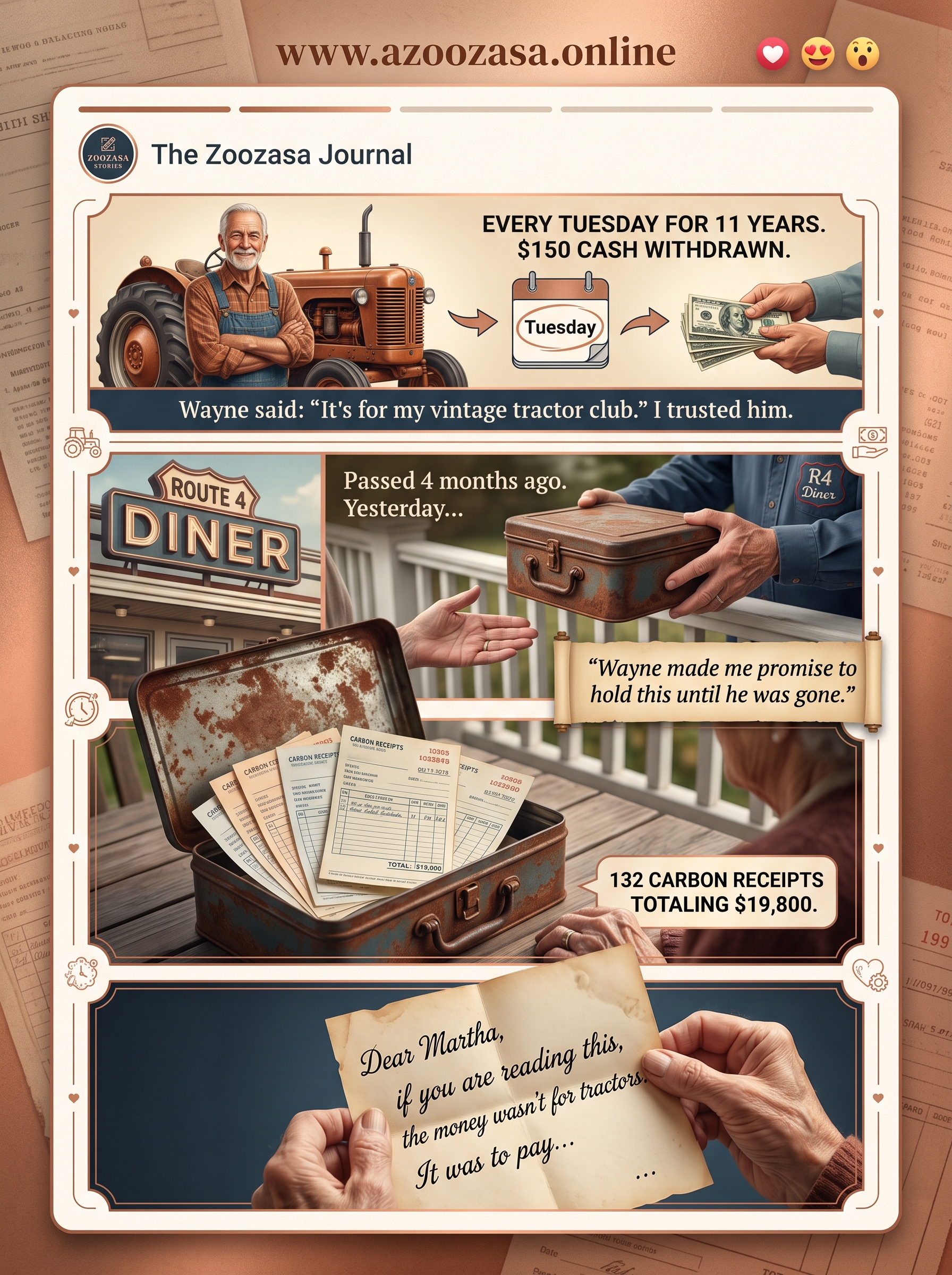
Every Tuesday afternoon for eleven years, my husband, Wayne, withdrew exactly $150 in cash from our joint savings account. He told me it was for his vintage tractor restoration club, a small group of retired men who spent their afternoons bringing rusted-out farm equipment back to life. I trusted him without question. I used to wash his denim overalls, inhaling the scent of engine grease and aged metal, completely oblivious to the fact that it was all an elaborate theater. We were married for thirty-two years. He was the bedrock of my existence.
Wayne passed away four months ago from a sudden, massive coronary. The grief had been a heavy, suffocating blanket, until yesterday morning.
I was on the front porch, sweeping away the autumn leaves, when an old silver pickup truck idled at the base of my driveway. Arthur Vance, the retired owner of the local Route 4 Diner, stepped out. He was a quiet, stoic man who walked with a heavy limp. He climbed the porch steps slowly, cradling a rusted, rectangular tin box against his chest like it was a fragile infant.
He didn’t offer a polite greeting. He just sat heavily on the wooden porch swing, handed me the cold metal box, and looked away toward the treeline. “Wayne made me promise to hold this until he was gone, Martha,” Arthur said, his voice rough like coarse sandpaper. “I’m sorry it took me four months. I had to find the courage.”
Inside the box were 132 carbon receipt slips, bundled neatly with rubber bands, totaling $19,800. Beneath them lay a piece of lined notebook paper, folded in half. It was written in Wayne’s unmistakable, meticulous cursive.
I opened the note with shaking hands. The ink was slightly faded, dated nearly three years ago.
Dear Martha,
If you are reading this, I am gone, and Arthur has finally kept his word. I need you to know immediately that I never lied about loving you. But I lied about everything else on Tuesday afternoons. The money wasn’t for tractors. It was to pay for your brother’s life.
My breath trapped in my throat. I looked up at Arthur, who was staring fixedly at the floorboards, before my eyes snapped back to the page.
Eleven years ago, you thought David abandoned us. You thought he finally let the addiction swallow him whole and ran off to the West Coast to escape his debts. That wasn’t true. David didn’t run. He was hunted.
He had racked up an $85,000 gambling debt with a very dangerous syndicate operating out of the county line. The night he disappeared, they cornered him behind Arthur’s diner. They were going to kill him, Martha. And worse, they knew where we lived. They knew your routine. They promised David they would visit our house and make you pay the price if he couldn’t.
I got there just in time. Arthur helped me drag David inside, bleeding and broken. I sat across a diner booth from a man who had a loaded revolver sitting on the laminate table, and I made a deal. I told him I didn’t have eighty-five grand. But I had a pension, a steady job, and unwavering reliability. I promised him $150 a week, every single week, until the debt was cleared with interest. But I had one condition: David had to leave the state, get clean, and never contact you. If you knew, you would have tried to save him yourself, and those men would have destroyed you.
For the first eight years, I paid them directly. The 132 receipts in this box are from the last two and a half years, after the original collector went to prison. Arthur acted as the middleman to keep the new collectors away from our property. I scrubbed my hands with motor oil every Tuesday before coming home so you wouldn’t smell the cigarette smoke from the drop-off.
The debt was finally paid off last month. David is free. You are safe. I carried this secret because your heart is too pure to bear the weight of their violence. Forgive me for the deception. I love you, eternally.
Yours,
Wayne.
I read the letter three times, the cursive loops blurring beneath a sudden, hot rush of tears. Eleven years. Every Tuesday. Eighty-five thousand dollars quietly siphoned away to buy my brother’s life and my blissful ignorance.
“Is this true, Arthur?” I whispered, my voice trembling so violently the words barely formed.
Arthur slowly removed his weathered baseball cap, turning it over in his large, calloused hands. “Every word of it, Martha. Wayne was a terrifyingly stubborn man when it came to protecting you. He walked into my diner that night, looked at a man who had just broken three of David’s ribs with a tire iron, and calmly negotiated a payment plan. He never missed a single Tuesday. Not through blizzards, not when he had the flu, not ever.”
“Where is David now?” I asked, a fierce, burning desperation rising in my chest. For over a decade, I had mourned a brother I thought didn’t care enough to stay. I had cursed his name at family holidays and wept for him in the quiet hours of the night.
Arthur reached into the breast pocket of his flannel jacket and pulled out a small, white envelope. He slid it across the porch swing. “Wayne kept tabs on him. Made sure he stayed clean. He’s running a small hardware store in Vermont. The address is in there. Wayne wanted you to have it once the debt was clear and it was safe.”
I didn’t wait. The shock of Wayne’s death had paralyzed me for months, but the revelation of his profound, staggering sacrifice acted like a sudden jolt of electricity. I packed a small overnight bag, locked the house, and got into my car.
The drive to Vermont took seven hours. The changing autumn leaves blurred into streaks of amber and crimson along the highway, mirroring the chaotic whirlwind of my emotions. I was furious at Wayne for lying, furious at David for his recklessness, and yet, overwhelmingly crushed by the sheer magnitude of my husband’s love. He had traded his peace of mind, his retirement savings, and his Tuesdays to act as a silent guardian against a darkness I never even knew existed.
I pulled into a sleepy, picturesque town nestled in the Green Mountains just as the sun began to dip below the horizon. The address led me to a charming brick storefront on the main street: Oakhaven Hardware & Supply.
The bell above the heavy wooden door chimed cheerfully as I stepped inside. The store smelled of cut pine and metal polish. Behind the counter stood a man in his late fifties, carefully organizing a display of brass hinges. His hair was heavily graying, his face lined with the passage of time, but his eyes—bright and familiar—were undeniably the same.
David looked up at the sound of the bell.
For a long, agonizing second, the air left the room. The brass hinge in his hand clattered loudly against the glass countertop. He stared at me, his mouth parting slightly, the blood draining entirely from his face.
“Martha?” he breathed, his voice cracking.
I closed the distance between us, the anger I thought I felt instantly dissolving into profound, desperate relief. I walked behind the counter and threw my arms around his neck, holding onto him with the strength of eleven lost years. He collapsed against me, burying his face in my shoulder, his broad frame shaking with heavy, ragged sobs.
“I’m sorry,” he kept repeating, his tears soaking the fabric of my coat. “I am so, so sorry, Martha. I wanted to call you a thousand times. But Wayne made me swear. He told me if I truly loved you, I would stay away until it was over.”
When we finally pulled apart, David led me to a small office in the back of the store. He made us bitter, over-steeped tea, and we sat in the quiet glow of a desk lamp, piecing together the fractured timeline of our lives.
David was ten years sober. He had built a quiet, respectable life, heavily supported by the letters Wayne secretly sent him every Christmas—letters containing photographs of my garden, updates on my health, and stern reminders to stay on the right path.
“He saved my life, Martha,” David said, looking down at his scarred knuckles. “But he didn’t do it for me. He did it because he couldn’t stand the thought of you burying your little brother. Every time he called me from a payphone, the only thing he ever asked was, ‘Are you making her sacrifice worth it?'”
I stayed in Vermont for four days. We walked by the lake, we ate terrible diner food, and we talked until our voices were hoarse, carefully repairing the bridge that had been violently burned over a decade ago. It was a messy, painful reunion, but it was honest.
When I finally drove back home, the house felt fundamentally different. The crippling silence that had haunted the hallways since Wayne’s funeral was gone, replaced by a lingering sense of immense, protective warmth.
I walked into his garage, the air still thick with the scent of motor oil and sawdust. I found his heavy denim overalls hanging on their usual peg. I pressed my face into the fabric, breathing in the scent of his perfectly executed lie.
I took the rusted tin box and placed it on the mantle above the fireplace, right next to Wayne’s urn. It was no longer a container of secrets or a ledger of stolen money. It was a monument to the quietest, most extraordinary act of devotion I had ever known. Wayne had spent his life meticulously repairing broken things—and in the end, the greatest restoration he ever completed was my family.


0 comments