
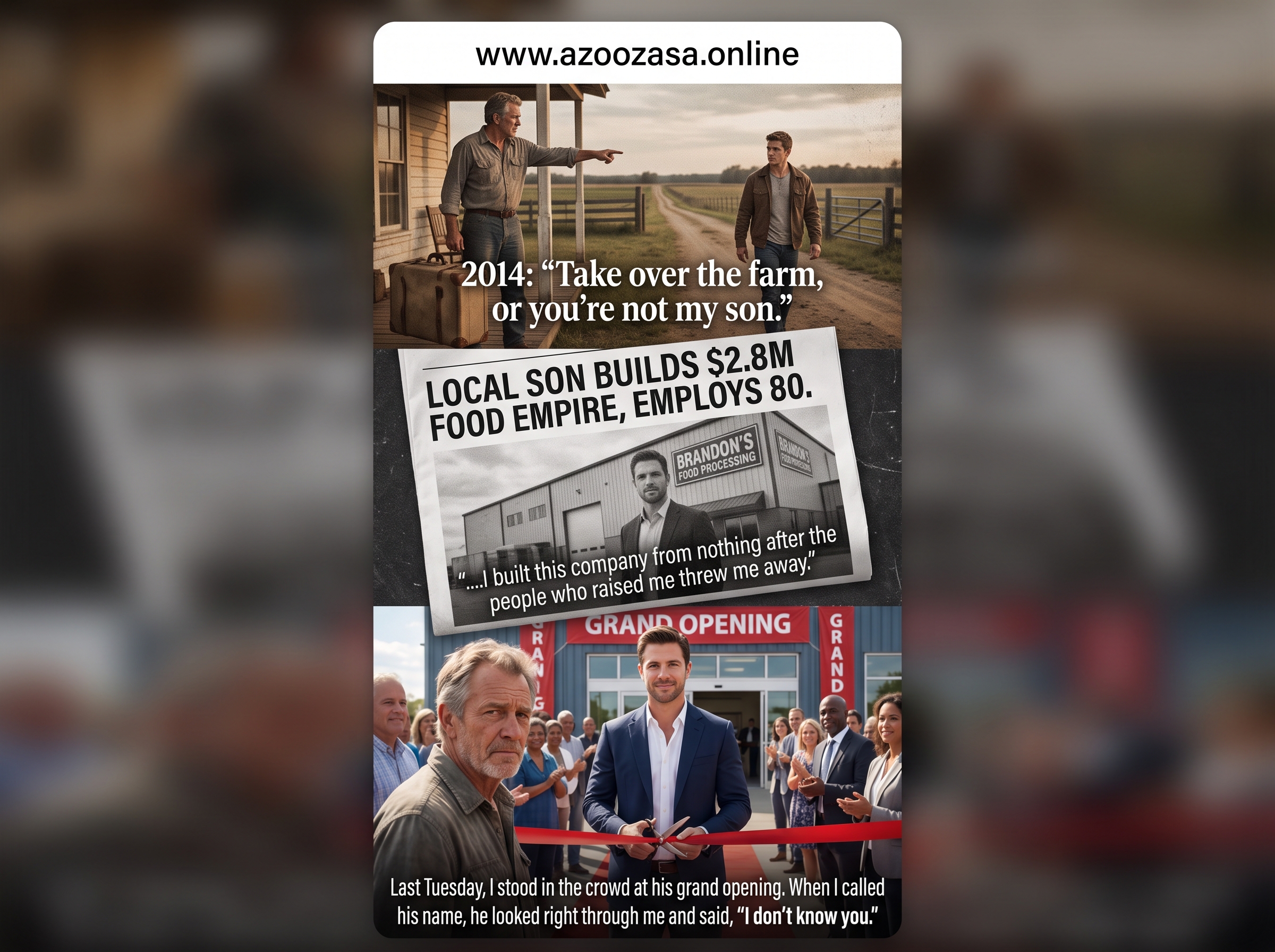
The Bitter Harvest of a Locked Gate
The county newspaper hit my kitchen table with a dull, heavy slap. Elias, whose property bordered mine to the south, didn’t say a word when he dropped it there. He just took off his sweat-stained cap, offered a tight, sympathetic grimace that looked more like a wince, and walked back out the screen door. The spring on the hinge whined, followed by the familiar wooden thwack as it shut, leaving me alone in the oppressive quiet of the farmhouse.
I looked down at the front page. The world stopped spinning.
There he was. Brandon.
The boy I had banished was staring back at me from beneath a bold, black headline: LOCAL CHEF TURNED MOGUL OPENS $2.8M PROCESSING FACILITY, BRINGS 80 JOBS TO THE COUNTY.
He looked older, of course. The soft, uncertain features of the nineteen-year-old kid I once knew had hardened into the sharp, confident jawline of a man who had fought the world and won. He was wearing a tailored charcoal suit that probably cost more than my last three soybean harvests combined, standing proudly in front of a sprawling, gleaming complex of corrugated steel and glass.
My eyes drifted down to the pull quote, printed in large italics right beneath the photograph.
“I built this company from nothing after the people who raised me threw me away.”
The words felt like a physical blow, a heavy fist driven straight into my ribs. I sank into the worn oak chair, the air suddenly thick and hard to breathe. The memory of that night in 2014, a memory I had spent a decade desperately trying to bury under long hours and tractor grease, surged to the surface with terrifying clarity.
It had been raining. A cold, relentless autumn downpour that turned the driveway into a river of mud. Brandon had stood in the kitchen, clutching a glossy brochure for a culinary institute in Chicago. He had tried to explain his vision—how he wanted to take the raw ingredients we grew and turn them into something greater, how he loved the science and art of food, not the brutal, endless labor of dragging it from the dirt.
I didn’t listen. To my rigid, calloused mind, a man who didn’t work the land he inherited was a coward. I saw a betrayal of my blood, a rejection of the generations of men who had broken their backs on this acreage.
“If you don’t take over the family farm, you aren’t my son,” I had barked, my voice echoing off the linoleum.
He had looked at me, tears mixing with a sudden, fiery defiance. I didn’t wait for his answer. I marched up to his room, threw his clothes into a canvas duffel bag, hauled it down the stairs, and tossed it onto the porch. I shoved him out into the cold rain, pulled the heavy oak door shut, and walked down to the perimeter fence to lock the iron gate.
Twelve years of total silence followed. No phone calls. No letters. No holidays. My pride had been an iron fortress, but as the years bled by, the fortress became a prison. The farm struggled. The equipment rusted. The massive dining room table felt like a mocking monument to my isolation. I had kept the land, but I had lost my legacy.
Staring at the newspaper, a desperate, foolish spark ignited in my chest. He was just in the next town over. He had built an empire. And deep down, in the fractured, hopeful part of my heart, I told myself that maybe, just maybe, this was a cry for my attention. A son proving his worth to his father. If I went there, if I showed up and swallowed my pride, perhaps we could bridge the chasm I had carved between us.
I spent an hour scrubbing the grease from beneath my fingernails with a wire brush. I dug into the back of my closet and pulled out the dark navy suit I hadn’t worn since my wife’s funeral. It smelled faintly of cedar and dust, and the jacket hung a little loose on my aging frame, but it was the best I had. I drove my beat-up Ford truck toward the neighboring town, my pulse drumming a frantic rhythm against my temples.
The facility was massive. “Horizon Culinary Processors,” read the sleek, backlit sign. The parking lot was jammed with luxury sedans, local news vans, and a small army of delivery trucks. A large white tent had been set up on the manicured lawn for the grand opening, buzzing with local politicians, business leaders, and the eighty new employees wearing crisp, matching uniforms.
I parked at the very edge of the gravel overflow lot and walked toward the crowd, feeling like a ghost trespassing in a world that had moved on without me.
Through the sea of heads, I saw him. Brandon was standing on a raised wooden dais, holding a pair of oversized ceremonial scissors. He was speaking into a microphone, his voice rich, steady, and commanding. He spoke about community, about the importance of sourcing local ingredients, and about resilience. The crowd hung on his every word. He was a king in his castle, surrounded by people who admired and respected him.
The mayor stepped up, shook Brandon’s hand, and they cut the thick red ribbon together. The crowd erupted into applause. A brass band started playing, and waiters emerged from the facility carrying silver trays of exquisite hors d’oeuvres.
The formal ceremony was over, and the crowd began to mingle. Brandon stepped down from the dais, immediately surrounded by well-wishers and journalists.
My heart hammered against my ribs like a trapped bird. This was it. There was no going back. I pushed my way through the throngs of people. I ignored the strange looks from the men in thousand-dollar suits as they took in my weathered face and outdated clothes. I just kept my eyes locked on him.
I stopped about ten feet away. He was laughing at something a reporter had just said, a genuine, warm laugh that I hadn’t heard since he was a little boy.
“Brandon,” I said.
My voice was hoarse, choked with twelve years of dust and regret. It wasn’t loud, but in the slight lull of the conversation around him, the sound carried.
The laughter died on his lips. He stiffened. The people immediately around him sensed the sudden shift in the atmosphere and fell silent, stepping back slightly to clear a path between us.
Brandon turned slowly.
His eyes, the same pale blue as my own, met mine. For one agonizing, suspended second, time froze. I looked into those eyes searching for anything—a flicker of the terrified boy on the porch, a spark of anger, a sliver of vindication, or even a microscopic glint of forgiveness. I was ready to fall to my knees. I was ready to beg in front of the mayor, the press, and the entire county. I opened my mouth to speak, to say I was sorry, to say I was wrong, to say I was so incredibly proud of the man he had become.
But Brandon’s expression didn’t change into anger. It didn’t twist into sorrow.
It went entirely, terrifyingly blank.
It was the look you give a slightly annoying stranger who has accidentally bumped into you at the grocery store. It was a look of complete, unblemished indifference. The fire of his youth was gone, replaced by a cold, impenetrable composure that was vastly more devastating than any screaming match could ever be.
He looked right through me.
“Excuse me,” Brandon said, his voice smooth, polite, and perfectly modulated for the crowd. He turned to the heavy-set security guard standing a few feet away. “Frank, I think this gentleman is lost. He seems a bit disoriented. Could you please help him find his vehicle?”
“Brandon, wait—” I stepped forward, reaching out a trembling hand. “Son, it’s me. I just want—”
Brandon didn’t even look back. He turned his body slightly, presenting his shoulder to me, and smoothly re-engaged the reporter. “As I was saying, our primary goal for the next quarter is expanding our supply chain to the northern counties…”
The heavy hand of the security guard clamped down gently but firmly on my shoulder. “Come on now, sir. Let’s get you back to your car. This is a private event.”
“He’s my son,” I whispered, the words tasting like ash in my mouth.
The guard offered a pitying, patronizing smile. “Sure thing, buddy. Let’s go.”
I didn’t fight. All the strength had drained from my legs. I let the guard guide me through the parting crowd. I felt the weight of a hundred eyes on my back, but the only gaze that mattered was already looking away.
I walked back to the overflow lot, the crunch of the gravel under my boots sounding deafening in my ears. I climbed into the cab of my rusty Ford, shut the door, and gripped the cracked leather steering wheel. I sat there for a long time, listening to the faint, joyous sounds of the brass band drifting across the parking lot.
I had locked the gate twelve years ago to protect my farm. I had demanded that he choose my earth over his own soul. Now, looking at my calloused hands resting on the wheel, I finally understood the terrifying reality of what I had done.
A farmer knows that you reap exactly what you sow. I had planted silence, stubbornness, and rejection. Now, the harvest had finally come in, and I would have to consume it alone, down to the very last bitter bite.


0 comments