
The Price of the Iron Door
The late August storm tore through the valley with a violent, screaming ferocity, turning the afternoon sky the color of a bruised plum. The wind howled like a wounded animal, violently ripping the ancient oak tree in our backyard straight from its rotting roots. When the massive trunk finally gave way, it crashed down against the stone masonry of our summer kitchen with a deafening, earth-shaking thud.
I waited out the tempest in the main house, watching through the rain-streaked glass. I am a pragmatic person, shaped by a lifetime of rigid rules, but as the storm cleared and I walked out into the damp, ozone-scented air to assess the damage, a deep, primal knot of dread tightened in my stomach. The oak tree had completely shattered the limestone framing of the summer kitchen’s rear wall. And in doing so, it had exposed the heavy iron door.
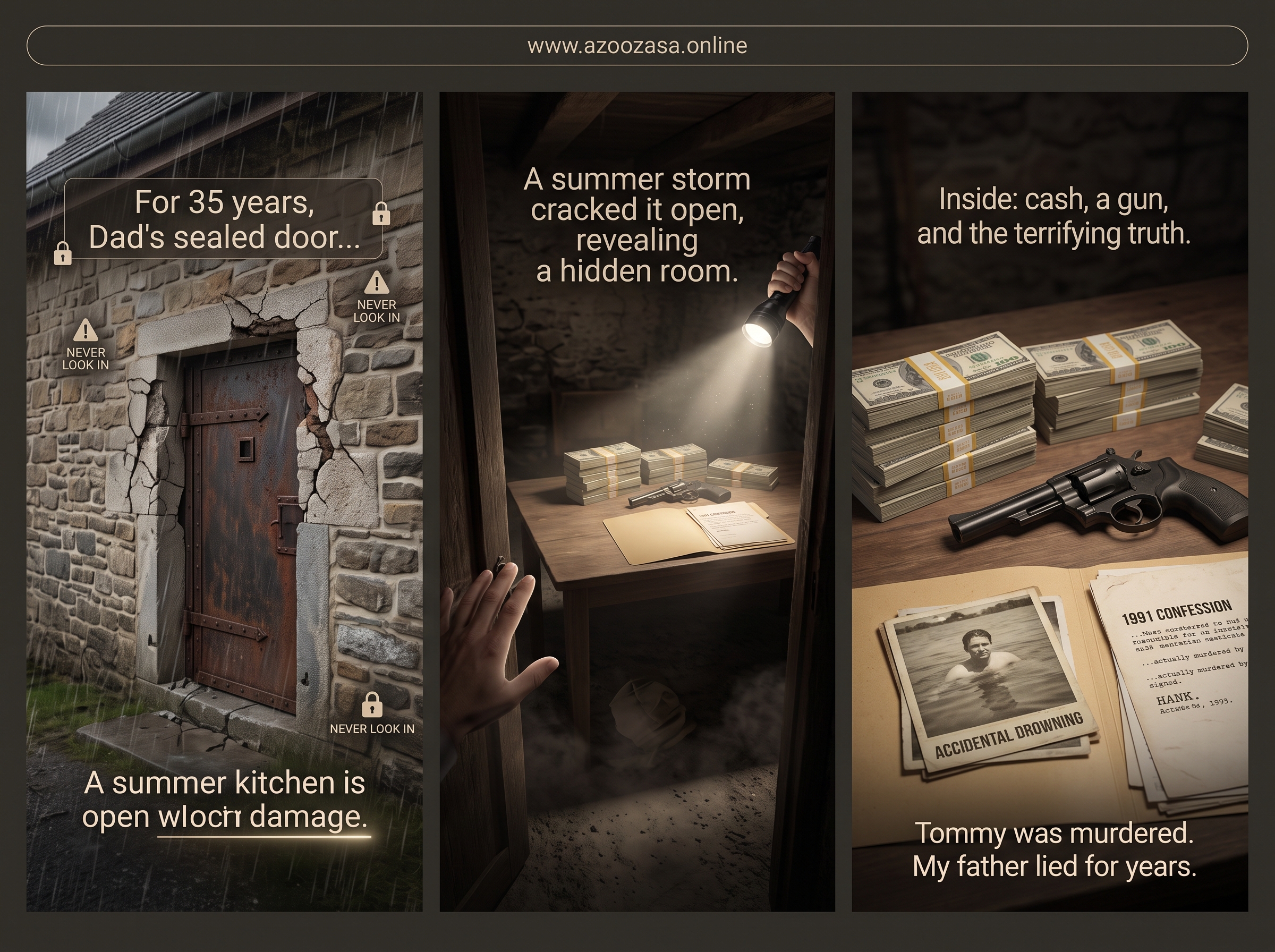
For thirty-five years, that door had been the singular, unshakeable law of our household. It was a slab of rusted, windowless iron, secured to the surrounding stone with three heavy-duty Master padlocks. My father, Hank Brown, was a man of quiet authority and calloused hands, but whenever he caught my brother or me wandering too close to the summer kitchen, a terrifying darkness would eclipse his eyes.
“Dee, you listen to me,” Hank would say, gripping my shoulders with a desperate, bruising strength. “Never look in there if you want this family safe. You forget that door exists.”
We obeyed. We obeyed because Hank’s fear was the only thing in the world larger than he was.
Hank passed away last fall, taking the keys to the padlocks and the ghosts of his paranoia to the grave. But now, nature had done what I had never dared to do. The impact of the fallen oak had fractured the stone so violently that the iron hinges had torn free from the mortar. The rusted latch securing the three padlocks was completely buckled. The door hung slightly ajar, exhaling a breath of cold, stagnant air into the humid summer afternoon.
My knees turned to jelly as I stepped over the splintered oak branches. The air around the opening smelled of wet concrete, old paper, and the distinct, coppery tang of gun oil. I placed my hands flat against the cold iron and pushed. The metal shrieked against the concrete floor, a terrible, grating sound that seemed to awaken the decades of silence trapped within.
I stepped into the dark cellar.
The only light came from the narrow shaft of daylight spilling through the open doorway, illuminating dancing motes of dust. There were no cobwebs, no discarded farming tools, no boxes of forgotten Christmas ornaments. The room was chillingly barren, save for a single, heavy wooden table positioned perfectly in the center of the concrete floor.
I moved closer, my pulse hammering a frantic, deafening rhythm in my ears.
Arranged on the table with clinical, terrifying precision were three items. On the left sat a towering stack of banded currency. The bands were stamped by a bank that hadn’t existed in two decades. They were all hundred-dollar bills, the old series with the small portraits. I didn’t need to count it to know it was a fortune—one hundred and forty thousand dollars in cash, sitting in a room while my father spent his life wearing boots with holes in the soles.
In the center of the table rested a Smith & Wesson .38 caliber revolver. It was meticulously oiled, the blued steel gleaming in the pale light, its cylinder fully loaded.
But it was the item on the right that made the breath completely leave my lungs.
It was a thick manila folder, the edges soft and worn from years of being handled. Written across the front in my father’s unmistakable, blocky handwriting was a single year: 1991.
-
The year the music stopped in our house. The year my older brother, Tommy, disappeared on a sweltering July night, only to be pulled from the muddy depths of Oakhaven Lake three days later. The coroner had ruled it a tragic, accidental drowning. The town mourned, my mother shattered into a million irreparable pieces, and my father built an iron door.
My hands trembled so violently I could barely open the folder.
The first things I saw were the photographs. They were official police crime scene polaroids, stark and unsparing. But they weren’t photos of a boy who had simply slipped beneath the water. I pressed my hand over my mouth to stifle a sob as I looked at the undeniable, purple bruising around Tommy’s neck. I saw the defensive lacerations on his forearms, the unmistakable finger marks pressed deep into his throat. Tommy hadn’t drowned. He had been held under.
Beneath the photographs was a single sheet of heavy, watermarked paper. It was a typed confession, signed at the bottom in blue ink by Hank Brown, notarized and stamped.
I pulled the page into the shaft of sunlight and began to read.
To my dearest Dee,
If you are reading this, I am dead, and I pray to God you are finally safe. For thirty-five years, I have carried a coward’s burden, and I have paid for it every time I looked into your eyes. I lied to you. I lied to your mother. I lied to the world.
Tommy didn’t drown. Tommy was murdered.
On the night of July 14th, your brother went down to the old boathouse. He was in the wrong place at the wrong time. He walked in on an illicit cargo drop moving through our lake—narcotics brought in from across the state line. He saw the faces of the men moving it. And he saw the man being paid to look the other way.
Tommy was murdered by Deputy Elias Thorne.
The name hit me with the force of a physical blow. Elias Thorne. The man who had stood at my brother’s funeral in his dress uniform, his head bowed in mock sorrow. The man who had eventually become the sitting Sheriff of Oakhaven County, a beloved pillar of the community who handed out stickers to children at the autumn festival and dined at the country club.
I gripped the paper, my knuckles turning white, and continued reading.
Thorne came to me the night after they pulled Tommy from the water. He didn’t come to comfort me. He came to my workshop, took his service weapon out of its holster, and laid it on my workbench. He told me exactly what he had done to my firstborn son. And then, he told me what he would do to you and your mother if I ever breathed a word of it to the state investigators.
He handed me a duffel bag containing one hundred and forty thousand dollars. It was his share of the drug run. He told me it was the price of my silence, the price of my remaining family’s lives. He said if I spent it, he would know I accepted the deal. If I went to the police, he would slaughter you both before they ever issued a warrant.
I was not a brave man, Dee. I was a terrified father. I took the money. I took the shame. I let the man who murdered my son become the king of this town so that you could grow up. But I never spent a single dime of his blood money. I locked it in this cellar. I bought the revolver, and I promised myself that the day Thorne ever looked at you twice, I would march into his office and put him down myself.
But the years passed, and the cowardice set in like rot in my bones. I am leaving this to you, my final, terrible inheritance. The money is yours to burn. The truth is yours to tell. I am so profoundly sorry, Dee. Forgive me.
Dad.
A tear slipped from my eyelashes, splashing against the faded blue ink of my father’s signature. I stood in the suffocating silence of the cellar, surrounded by the ghosts of 1991.
I looked at the stacks of banded cash. It wasn’t wealth. It was thirty-five years of my father’s silent, agonizing torture. It was the price of my life, bought with my brother’s blood.
I carefully placed the photographs and the confession back into the manila folder. I tucked it under my arm, pressing the heavy weight of the truth against my ribs. Then, I reached out and picked up the Smith & Wesson revolver. The steel was cold, heavy, and perfectly balanced.
I didn’t touch the money. I left it sitting in the dark, exactly where it belonged.
I walked out of the cellar and stepped back into the humid, clearing air of the August afternoon. The storm had passed, leaving behind a profound, ringing stillness in the valley. I looked down the long dirt driveway that led toward the town of Oakhaven, toward the sheriff’s station where an old man with a silver star on his chest was sitting comfortably at a mahogany desk.
My father had built an iron door to keep the monsters out. But as I slid the revolver into the pocket of my jacket, I realized Hank’s greatest mistake. You don’t lock the door and hide in the dark.
You open it, and you let the monsters see you coming.


0 comments