
The Ghost at the Christmas Table
The china plates were rimmed in faded gold, a wedding gift that had survived three decades, two moves, and the shattering of my entire world. Every year since 2008, I set three places at the mahogany dining table. One for me. One for our nineteen-year-old son, Julian, whose laughter was stolen by black ice and a twisting country road. And one for David.
The third plate wasn’t set out of love. It was set out of a stubborn, calcified spite. It was a monument to a coward.
When the state troopers knocked on our door that freezing January night, my knees had instantly given way. I collapsed onto the hardwood foyer, my screams tearing the quiet suburban air to shreds. David did not fall. He did not cry. He stood perfectly still, his face carved from unyielding granite, thanking the officers in a hollow, even tone that I would learn to despise.
At Julian’s funeral, while I had to be physically held upright by my sisters, David stood beside the casket with his hands clasped behind his back, his eyes dry and fixed on the horizon. He didn’t offer a shoulder. He didn’t whisper a word of comfort. Six months later, as the suffocating blanket of summer humidity settled over the house, I came home from a grief support group to find his closet empty. There was no argument, no tearful goodbye, just a set of house keys left on the kitchen island and a void where my husband used to be.
For sixteen years, I hated him. I hated him with a fierce, burning purity that kept me warm when the grief threatened to freeze me solid. The anger became my fuel. It was the reason I got out of bed, the reason I kept the house immaculate, the reason I forced myself to keep breathing. I will not let his weakness destroy me too, I would tell myself. I survived the loss of my child by leaning on the absolute certainty of my husband’s heartlessness.
David passed away last week. I felt nothing when I heard the news—only a dull, distant echo, like a stone dropping into a bottomless well.
But yesterday afternoon, the fragile architecture of my survival came violently crashing down.
The autumn air was crisp, carrying the scent of burning leaves and damp earth. I was sweeping the front porch when a silver sedan pulled slowly into the driveway. The driver’s side door opened, and David’s younger sister, Celia, stepped out. She looked older, her hair entirely silver, her shoulders bowed beneath an invisible weight. We hadn’t spoken since the year David left. She had always taken his side, entirely complicit in his vanishing act, or so I had believed.
I didn’t invite her inside. I simply leaned against the wooden railing, the broom handle tight in my grip.
“Lillian,” Celia said, her voice trembling, laced with an exhaustion that seemed to radiate from her bones. She didn’t offer empty condolences. She just stood at the bottom of the steps, looking up at me with red-rimmed eyes.
“What do you want, Celia?” I asked, my tone as cold and unyielding as the frost gathering on the lawn.
She reached into her heavy wool cardigan and pulled out a thick, manila envelope. It was sealed with heavy tape, the edges slightly frayed as if it had been handled a thousand times.
“He told me to wait until he was gone,” Celia whispered, her hand shaking as she held it out. “He made me swear on my life, Lillian. He wouldn’t let me give this to you a second sooner.”
My jaw tightened. I wanted to tell her to leave, to take her brother’s final apologies and bury them with him. But something in her expression—a profound, devastating sorrow—paralyzed my pride. I lowered the broom. I sat down right there on the top step of the porch, the cold wood biting through my jeans, and took the envelope.
It was heavy. I tore through the tape, my fingers clumsy and numb.
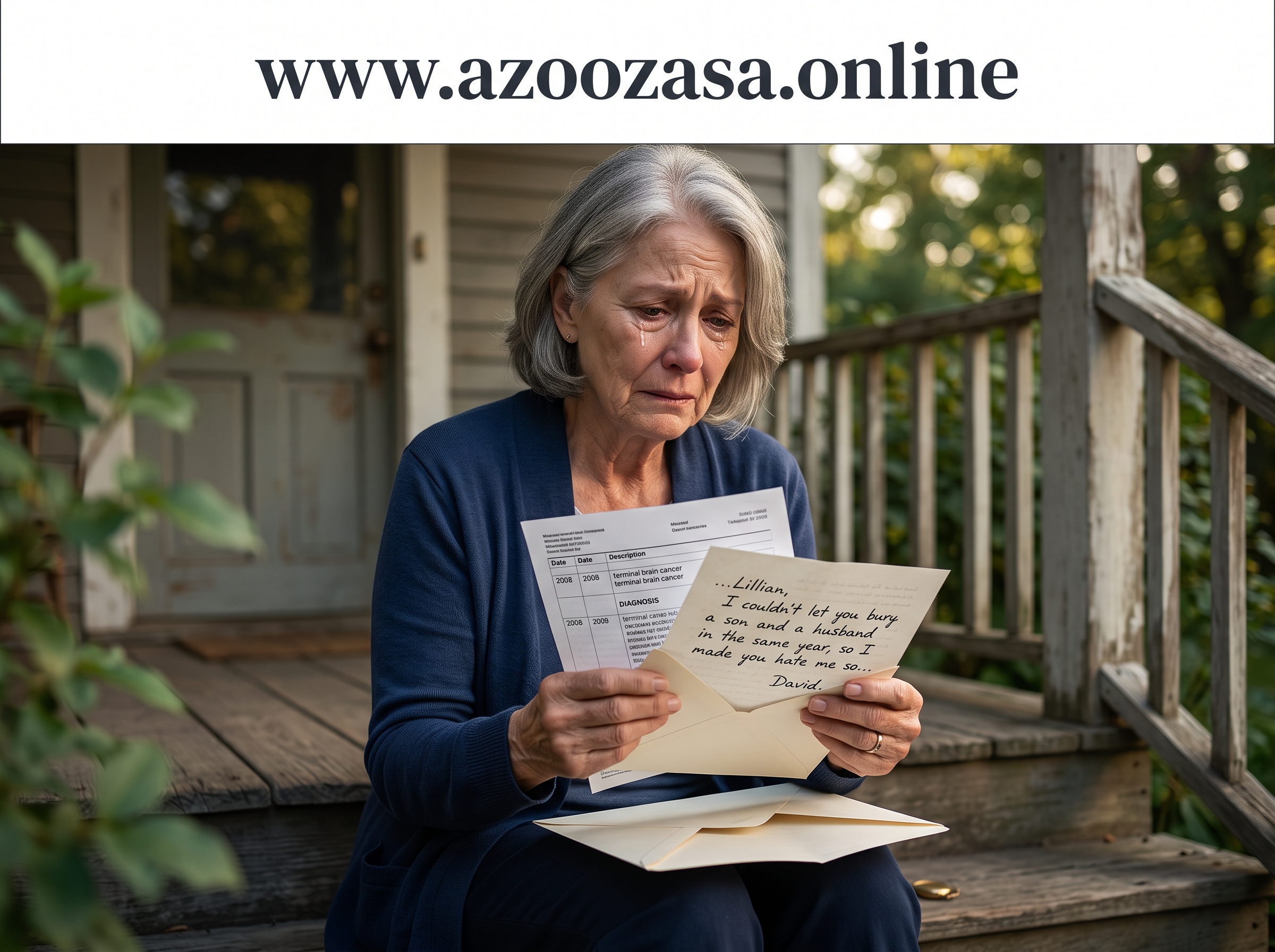
The first thing I pulled out was a stack of medical records. The letterhead belonged to the oncology department at Mount Sinai Hospital. The dates stamped across the top right corner stopped the breath in my throat. November 2007. Two months before Julian’s car crash.
I stared at the diagnostic codes, at the terrifying, clinical language mapping out a death sentence. Glioblastoma multiforme. Stage IV. Inoperable. Aggressive. The prognosis was scrawled at the bottom of a consultation note by a neurologist: Six to twelve months.
My ears began to ring. The sound was a high, metallic pitch that completely drowned out the rustling wind in the oak trees. David hadn’t just been sick. He had been dying while we were picking out Christmas presents for Julian. He had been dying while he stood like a stone statue at our son’s funeral.
Tucked beneath the heavy stack of medical charts was a single piece of stationary, folded neatly into thirds. I recognized the sharp, slanted strokes of his handwriting instantly. The ink was slightly smeared in places, as if the hand that held the pen had been trembling, or crying.
I unfolded the paper.
My dearest Lillian,
If Celia has kept her promise, I have finally left this world, and you are sitting somewhere reading this, probably hating me more than ever for keeping another secret. I am so sorry, my love. I am so profoundly, agonizingly sorry for everything I put you through.
By the time you read this, you will have seen the medical files. I found out about the tumor right after Thanksgiving. I was going to tell you both after the holidays. I was trying to figure out how to break your hearts, how to tell my wife and my beautiful boy that I was leaving them behind.
And then, the ice storm came. And the police knocked on our door.
When we lost Julian, I watched your soul completely shatter on that foyer floor. I watched the light go out in your eyes, and I knew in that exact second that if I told you I was dying too, the grief would literally kill you. You were drowning, Lillian. I couldn’t let you bury a son and a husband in the same year. I couldn’t let you sit in hospital waiting rooms, watching me wither away, carrying the weight of a double tragedy that no mother, no wife, should ever have to bear.
You needed a reason to live. You needed a fire to keep you warm when the cold of Julian’s death set in. And I knew that anger burns much hotter and much longer than sorrow.
Lillian, I couldn’t let you bury a son and a husband in the same year, so I made you hate me so you could survive.
I swallowed every tear. I locked my breaking heart in a cage. I stood at our boy’s grave and played the monster because I knew that hating a monster would give you the strength to stand up every morning. When I left six months later, it was the hardest, most excruciating walk of my life. I moved into a hospice facility two states away under Celia’s care. I spent my final months looking at a photograph of you and Julian, praying that my cruelty was enough to save your life.
I am writing this from a hospital bed, knowing I will never see your face again. But I can go into the dark knowing you are alive. You are fierce, Lillian. You survived me, and you will survive this.
Forgive me for the lie. Forgive me for the silence. I loved you enough to let you despise me.
Yours, always,
David.
The paper slipped from my trembling fingers, fluttering onto the porch steps like a broken wing.
The air rushed out of my lungs in a ragged, tearing sob. It wasn’t the delicate weeping of a grieving widow; it was a visceral, agonizing wail that came from the absolute marrow of my bones. Sixteen years of calcified anger, the heavy armor I had worn every single day to protect myself from the world, violently shattered.
I had spent over a decade cursing his name in the dark. I had looked at that empty chair at Christmas and felt nothing but righteous vindication. I thought he had abandoned me to the wolves.
He hadn’t abandoned me. He had thrown himself to the wolves so I could escape.
Celia sank down onto the wooden steps beside me, wrapping her arms tightly around my shaking shoulders. We sat on the porch for hours, two women weeping for a man who had orchestrated the most devastating, beautiful sacrifice a human heart could endure. He had authored his own villainy to protect my sanity. He had taken all of my hatred, all of my venom, and carried it with him into the grave so I wouldn’t have to carry another casket.
The weeks that followed were a blur of unearthing memories I had intentionally buried. I remembered the way David used to hold my hand in the car. I remembered the sound of his laugh before the cancer and the tragedy silenced it. The anger that had fueled me for so long evaporated, leaving behind a terrifying, beautiful void that I finally had to fill with genuine, unadulterated mourning.
I grieved him. I finally grieved the husband I had lost in 2008.
Christmas arrived two months later. The snow was falling in thick, heavy drifts outside the dining room window, blanketing the world in a quiet, forgiving white. The house smelled of roasted turkey and cinnamon, a warmth I hadn’t allowed myself to truly feel in almost two decades.
I walked into the dining room. The china plates with the faded gold rims were stacked on the sideboard.
I pulled out the chair at the head of the mahogany table. I set down the placemat. I arranged the silver forks, polished the crystal goblet, and centered the beautiful gold-rimmed plate. I moved to the side of the table and set a second place for Julian, my fingers grazing the porcelain with a soft, melancholic smile.
And then, I set my own.
There were three places at the table again. But this year, the third plate was not a monument to a coward. It was a shrine to a hero. It was an acknowledgment of a love so profound, so terrifyingly deep, that it was willing to be despised just to ensure my survival.
I sat down at the table, looking at the two empty chairs. The silence in the house wasn’t oppressive anymore. It was peaceful. I raised my water glass to the empty seat at the head of the table, a tear slipping down my cheek, catching the warm light of the chandelier.
“I forgive you, David,” I whispered into the quiet room, the words lifting a sixteen-year-old weight from my soul. “I am alive. And I love you.”


0 comments