
The Golden Emulsion
The commercial dish pit of L’Etoile was a punishing, windowless cavern of scalding steam, industrial bleach, and deafening noise. For eight hours a day, I stood over the stainless-steel basin, my hands pruned and aching inside heavy rubber gloves, scrubbing the remnants of exorbitant wealth off fine bone china. I was sixty-one years old. Most women my age were planning retirements or spoiling their grandchildren. I was working double shifts just to keep the lights on in a quiet, empty house after my husband’s sudden passing left me drowning in an ocean of medical debt.
The kitchen was my hiding place. I had spent forty years running a highly successful boutique catering company alongside him. When his heart failed, my passion for food died with him. The thought of picking up a chef’s knife felt like a betrayal, so I retreated to the lowest rung of the culinary ladder, where the world ignored me, and I could simply survive in the steam.
But the head chef, Julian, made survival extraordinarily difficult.
Julian was twenty-eight, armed with a degree from a prestigious culinary institute in Paris, and possessed an ego so fragile and massive it required a dedicated zip code. He viewed the kitchen staff not as humans, but as easily replaceable cogs in the machinery of his own impending stardom.
The incident happened just before the dinner rush. I had noticed him struggling with a heavy, bitter reduction for the evening’s venison special. Driven by a fleeting, foolish moment of culinary instinct, I had quickly scribbled a note on a prep card—a simple adjustment using a touch of blackberry preserve to balance the tannins—and placed it on his stainless-steel pass.
Julian had picked it up with a pair of plating tweezers as if it were radioactive. He read it, let out a sharp, derisive bark of laughter, and crumpled it into a tight ball. He tossed it into the trash bin without breaking stride.
As he strutted past the dish pit, he didn’t even turn his head. “You’re just a dishwasher, Dee,” he sneered, his voice dripping with absolute contempt. “Stay in your place.”
My spine went rigid. The hot water rushing over my gloved hands felt entirely numb. I bit the inside of my cheek until I tasted copper, forcing myself to look down at a stack of greasy ramekins. Stay in your place. The words echoed in my ears, awakening a quiet, dormant fury that I hadn’t felt since the day I buried my husband. I didn’t say a word. I just went back to scrubbing.
Two hours later, the kitchen descended into the absolute chaos of a Friday night service. The ticket printer chattered endlessly, a relentless mechanical insect demanding perfection. The air was thick with the smell of seared meat, garlic, and frantic adrenaline.
Then, the ticket arrived.
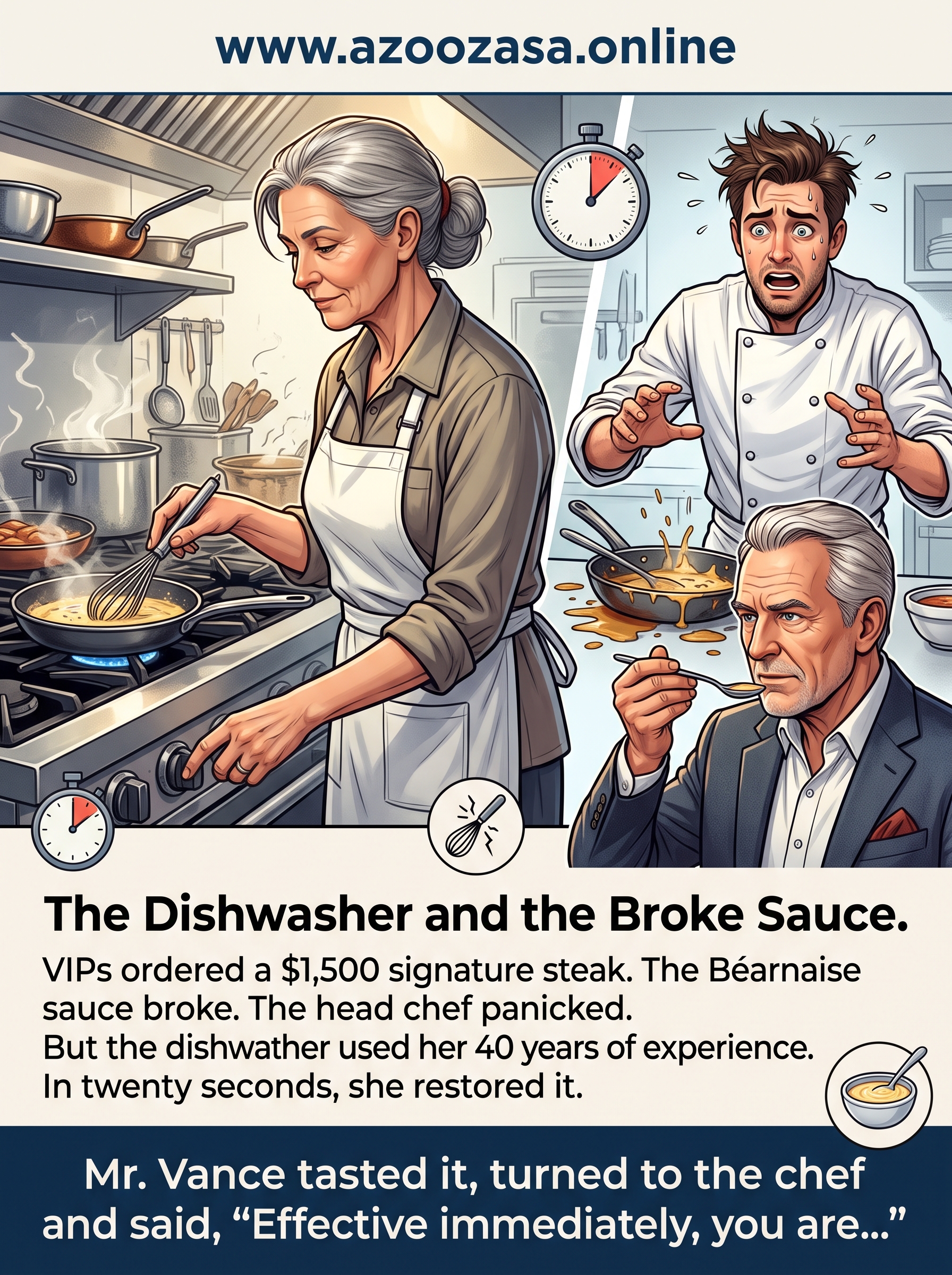
The expeditor ripped it from the machine, his voice cracking slightly as he called it out. It was a VIP party of twelve. The restaurant’s owner, Mr. Vance, a notoriously exacting man who rarely stepped foot in the kitchen, burst through the swinging doors, his face pale and shining with sweat. The party consisted of the primary investors for his planned expansion into Chicago. The order was twelve covers of L’Etoile’s legendary $1,500 signature dish: dry-aged wagyu tomahawks served with a classic, highly temperamental béarnaise sauce.
Béarnaise is a culinary tightrope. It is a fragile emulsion of clarified butter, egg yolks, shallots, tarragon, and white wine vinegar. It requires gentle heat, relentless whisking, and absolute patience. You cannot rush it, and you cannot bully it.
Julian, already rattled by the crushing pressure and the looming presence of his boss, began to rush.
I watched him from the dish pit. I saw the flame under his double boiler was cranked entirely too high. I watched his whisk moving in erratic, panicked circles rather than the smooth, steady figure-eights required to coax the fats and proteins together. He was pouring the melted butter in too quickly, overwhelming the yolks.
I knew what was going to happen before he did.
Suddenly, the smooth, golden ribbon of the sauce rebelled. In a split second, the heat scrambled the yolks. The emulsion violently broke. The butter separated, pooling into a slick, greasy lake of yellow oil, leaving behind a curdled, horrific mess that looked like wet scrambled eggs.
Julian froze. The kitchen fell into a terrified, suffocating silence.
“Chef?” the sous chef whispered, staring at the ruined pan.
Panic seized Julian’s face. He grabbed a fresh whisk and began to beat the curdled mess violently, desperately trying to force the oil back into the proteins, but a broken emulsion cannot be beaten into submission. He was just making it worse.
“It’s split!” Julian screamed, his voice pitching high. He slammed the whisk against the edge of the stove, sending droplets of hot oil flying. “The butter was too hot! Someone get me more yolks! Clarify more butter, now!”
“There’s no time!” Mr. Vance shouted, looking at the kitchen clock with absolute horror. “The steaks have been resting for eight minutes! If we don’t plate them right now, they go cold. If we start a new sauce, the wagyu is ruined!”
Julian looked wildly around the kitchen, his crisp white chef’s coat suddenly feeling like a straitjacket. He had no backup. He had no fix. He had failed on the most important ticket of his career, and he knew it.
I turned off the industrial faucet. The sudden silence of the rushing water made a few line cooks turn their heads. I slowly pulled the heavy yellow rubber gloves off my hands, dropping them onto the aluminum drainboard with a wet slap.
I walked out of the dish pit.
I didn’t run. I moved with the calm, measured authority of a woman who had catered five-hundred-plate weddings in the middle of thunderstorms. I walked past the terrified line cooks, past the expeditor, and stepped directly into Julian’s personal space at the stove.
“What are you doing?” Julian hissed, his eyes wide with frantic disbelief. “Get back to the pit!”
I ignored him entirely. I reached over and firmly pushed him aside with my shoulder.
“Dee, please,” Mr. Vance stammered, stepping forward. “This isn’t the time—”
“I need a tablespoon of boiling water, and a splash of heavy cream, right now,” I barked, my voice cutting through the panic like a cleaver through bone. The command was so absolute, so devoid of hesitation, that the nearest sous chef instantly slammed a small metal pitcher of cream and a ladle of pasta water onto the counter beside me.
I killed the flame entirely, pulling the heavy stainless-steel bowl off the double boiler to stop the residual heat from cooking the eggs any further. The sauce was a greasy, curdled disaster.
I grabbed a fresh balloon whisk. I splashed a few drops of the boiling water into the edge of the bowl, followed by a tiny ribbon of cold heavy cream to shock the temperature downward. I tipped the bowl at a forty-five-degree angle.
And then, I began to whisk.
My arm moved with the speed and precision of a machine, driven by forty years of muscle memory. I didn’t whisk wildly; I whisked with purpose, drawing the shattered proteins into the water and cream, slowly dragging the pooled oil back into the center. The kitchen was dead silent, save for the furious, rhythmic scraping of my metal whisk against the bowl.
For ten agonizing seconds, nothing happened. Julian let out a scoffing, nervous breath.
And then, the magic of the emulsion took hold.
The curdles began to smooth out. The slick, greasy pools of oil vanished, drawn back into the fold. The pale, broken mess transformed, blooming rapidly into a thick, glossy, velvet ribbon of perfect, pale-yellow gold. I gave it one final, powerful whip, tapping the whisk against the rim of the bowl. The sauce cascaded down in a flawless, heavy drape.
I didn’t look at Julian. I picked up a tasting spoon, dipped it into the fresh béarnaise, and held it out to Mr. Vance.
The owner, completely mesmerized, took the spoon and placed it in his mouth. He closed his eyes. The acidity of the tarragon and vinegar perfectly cut the richness of the butter, leaving a luxurious, flawless finish.
Mr. Vance opened his eyes. He looked at the flawless sauce, then looked at the arrogant young chef who was currently trembling with humiliation, and finally, he looked at me—the sixty-one-year-old widow wearing a water-stained apron over a cheap t-shirt.
Mr. Vance turned squarely to Julian.
“Effective immediately, you are relieved of your position as head chef of this restaurant,” Vance said, his voice cold and echoing through the silent kitchen. “Pack your knives and get out of my kitchen.”
Julian’s mouth opened and closed, but no sound came out. The absolute finality in Vance’s eyes left no room for argument. Julian untied his apron, letting it drop to the floor, and walked out the back doors, shrinking into the shadows of the alley.
Mr. Vance turned back to me, the panic entirely gone from his posture, replaced by a profound, deferential respect.
“Dee,” Vance said quietly, gesturing to the perfectly rested steaks waiting on the cutting board. “Can you plate?”
I looked at the silver platters. I looked at the rich, golden sauce I had just resurrected from the ashes. The heavy, crushing weight of grief that had kept me hidden in the dish pit for eight months finally fractured, letting the bright, hot light of the kitchen wash over me.
I reached up, untied the wet, soapy dishwasher’s apron from my neck, and let it fall to the floor right next to Julian’s.
“Yes, Chef,” I said, my voice steady and clear. I picked up a clean carving knife, the handle fitting perfectly into my palm like an old friend coming home. “Let’s serve.”


0 comments