
The Echoes of Room 204
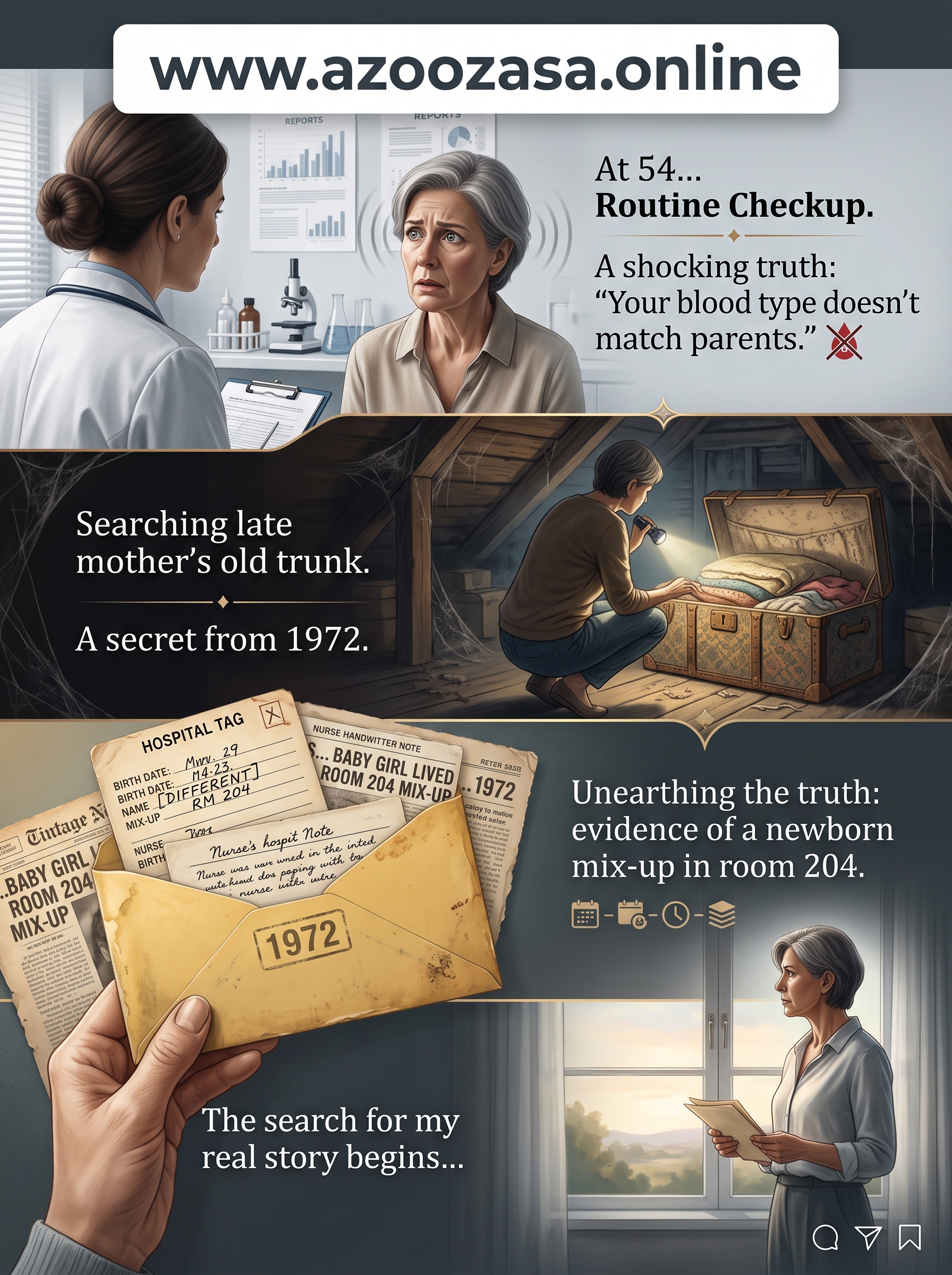
The clinic doctor’s words were a quiet earthquake, reducing fifty-four years of my firmly rooted identity to rubble in a matter of seconds. “Your blood type doesn’t match either of your parents,” he had said, his voice gentle, laced with the cautious pity reserved for life-altering medical anomalies. I was fifty-four years old. I had gone in for a routine cholesterol check and a lingering cough, only to discover I could not biologically belong to the man and woman who had raised me, loved me, and were now resting side-by-side in the local cemetery.
My ears started ringing a high, metallic pitch that followed me all the way home.
That evening, the silence of my empty house became a suffocating weight. My husband was out of town on business, leaving me alone with the ghosts of my sudden illegitimacy. Driven by a frantic, clawing need for an explanation, I pulled down the attic stairs. The space smelled of dry rot and mothballs. I bypassed the boxes of my children’s old school projects and crawled toward the far corner, where my late mother’s heavy wooden sewing trunk had sat untouched since her funeral six years ago.
I dug past the velvet pincushions, the spools of heavy-duty thread, and the folded yards of floral cotton. Pressed flat against the cedar bottom, tucked beneath a layer of pristine white muslin, was a faded yellow envelope. The postmark was illegible, the paper brittle and flaking at the edges.
I opened it with trembling fingers.
Inside was an unfiled hospital intake tag, the string still attached. It bore my birth date—October 14, 1972—but the name typed across the cardboard was not mine. It read: Baby Girl Sterling. Folded neatly beneath the tag was a piece of hospital stationary, bearing a handwritten note from a head nurse. The ink was faded to a pale, ghostly blue, but the frantic, guilty strokes of the pen were undeniable.
God forgive me, the note began. The tags were dropped during the shift change. A mix-up occurred in the nursery. The mother in room 204 noticed her baby had a different hairline, but the mother in 205 was already discharged and halfway home. The hospital administrator threatened my pension if I spoke. I stayed silent. I am so sorry.
My lungs seized. Attached to the back of the note with a rusted paperclip was a newspaper clipping from the local gazette, dated a few days after my birth. It featured a photograph of a smiling, wealthy couple leaving the hospital, holding a bundle wrapped in pink blankets. The caption detailed the birth of the Sterling family heiress, a baby girl born the exact same hour as me, who lived barely twenty miles away in the affluent, gated hills of Blackwood.
My mother—the woman who had baked my birthday cakes, bandaged my scraped knees, and worked double shifts at the diner to buy my prom dress—had known. She had found this envelope somehow, perhaps mailed anonymously by the guilt-ridden nurse years later, and she had buried it at the bottom of her sewing trunk. She had kept the secret to keep me.
I didn’t sleep. I sat at my kitchen table watching the sun rise, the yellow envelope resting on the placemat like an unexploded bomb. Fifty-four years. I had spent half a century thinking I was a Sullivan. I had inherited my father’s supposed stubbornness and my mother’s supposed laugh. Now, I realized I was a mirror reflecting a room I had never stood in.
By nine in the morning, the need to see the other half of this stolen equation overpowered my shock. I opened my laptop and typed in the names from the newspaper clipping: Arthur and Eleanor Sterling, Blackwood.
The internet yielded results with brutal efficiency. Arthur and Eleanor had passed away within the last decade, leaving behind a massive real estate empire and one singular heir: Victoria Sterling. I found her professional biography on her corporate website. She was a powerhouse architectural developer. And there, staring back at me from a high-resolution corporate headshot, was a woman who shared my exact age.
But it wasn’t the age that made the breath rush from my lungs. It was her face.
Victoria Sterling had the sharp, prominent Sullivan jawline. She had my father’s deep-set, dark eyes. She had the unmistakable, slightly crooked smile of the woman whose sewing trunk I had just desecrated. I was looking at a photograph of my mother, polished by millions of dollars and a lifetime of high society, staring right back at me.
I wrote down the address of her flagship development office in downtown Blackwood. I didn’t bother changing out of the jeans and oversized sweater I had worn into the attic. I grabbed my car keys, the yellow envelope, and drove.
The Sterling Building was a towering monolith of glass and steel. I walked through the revolving doors, my practical loafers squeaking faintly against the Italian marble floors. The receptionist on the fortieth floor looked at me with polite, guarded skepticism when I asked to see Victoria, informing me she was entirely booked for the week.
“Please,” I said, my voice eerily calm, devoid of its usual apology. “Tell her a woman is here holding a yellow envelope from St. Jude’s Hospital, dated October 1972. Tell her it concerns room 204.”
The receptionist frowned but relayed the message through her headset. A moment later, her posture went rigid. She nodded silently and gestured toward a massive set of frosted glass doors down the hall.
I pushed the doors open. The corner office was bathed in cold, sterile light, overlooking the sprawling metropolis. Standing behind a massive mahogany desk was Victoria Sterling. Seeing her in person was a visceral shock. She moved with the exact same nervous habit my father had—tapping her thumb against her index finger when anxious.
“Who are you?” Victoria asked. Her voice was sharp, authoritative, but carrying a faint, undeniable tremor. “My assistant said you had something from St. Jude’s.”
I didn’t speak immediately. I walked across the plush carpet and placed the brittle, faded yellow envelope onto the center of her immaculate desk.
“I went to the clinic yesterday for a routine blood test,” I said quietly, the words feeling heavy and jagged in my mouth. “I found out I am not biologically related to the parents who raised me. Last night, I found this in my mother’s attic.”
Victoria stared at the envelope as if it were a venomous snake. Slowly, she reached out, her perfectly manicured fingers undoing the clasp. She pulled out the hospital tag. She read the nurse’s frantic, guilty confession. Then, she looked at the newspaper clipping of her own supposed parents holding me in a blanket.
I watched the imperious, wealthy developer fracture. The color completely drained from her face. She sank heavily into her leather chair, the papers trembling violently in her grasp.
“My mother… Eleanor,” Victoria whispered, her voice cracking. “She was always so cold. She used to look at me like I was a stranger who had wandered into her house. She said I was too loud, too rough, that I didn’t have the Sterling refinement. I spent my entire life trying to buy her approval.”
Victoria looked up, her dark eyes—my father’s eyes—locking onto mine.
“And you,” she breathed, taking in my face. “You look exactly like her. You look exactly like Eleanor.”
“And you look exactly like the man who taught me how to ride a bike,” I replied, the tears finally spilling over my eyelashes, hot and unbidden. “You look like the woman who worked seventy-hour weeks so I could go to college. You have her smile.”
We sat in that opulent, silent office for hours, two strangers bound by a colossal, catastrophic theft of fate. We laid our lives out on the mahogany desk like puzzle pieces that had been forced into the wrong boxes. I told her about the warmth of the Sullivan household, the chaotic Sunday dinners, the smell of cheap roast beef and loud laughter. I watched a profound, devastating grief wash over Victoria’s face as she realized she had been robbed of the unconditional love that was biologically hers.
In return, she told me about the empty, echoing halls of the Sterling estate. She spoke of boarding schools, of nannies who raised her, of a father who only showed affection when she brought home perfect grades. She had been given the kingdom, but she had starved in the castle. I had been given nothing but the clothes on my back, but I had been deeply, fiercely loved.
“Are you angry?” Victoria asked softly, as the city lights began to blink on in the twilight outside the floor-to-ceiling windows.
I looked at the nurse’s note, at the tragic cowardice of the hospital, and at the desperate silence of the mother who had raised me.
“No,” I finally said, the realization settling into my bones, bringing a strange, solid peace. “Margaret Sullivan kept me because she loved me. She chose me, even when she knew the truth. Biology is just the blueprint, Victoria. Love is the actual house.”
Victoria let out a shaky breath, reaching across the desk. Her hand hovered in the air for a fraction of a second before she gently placed it over mine. Her grip was firm, familiar, and anchoring.
“I’d like to see a picture of them,” Victoria whispered, a tear tracing a path down her cheek. “If you wouldn’t mind. I’d like to see the people who were supposed to be mine.”
I smiled, reaching into my purse to pull out my phone. “I have hundreds,” I told her. “And if you want, I can show you where they’re buried. We can go together.”
We were fifty-four years old. The lives we were meant to live were long gone, stolen by a dropped tag and a frightened nurse in the chaos of room 204. But sitting there in the glow of the city skyline, looking at the sister I never knew I had, I realized the story wasn’t over. The first half of our lives was written by a mistake, but the rest of it belonged entirely to us.


0 comments