
The Weight of Oak and Greed
The smell of mineral spirits and sixty years of lemon oil hung thick in the stagnant air of my garage. I dragged the sanding block across the heavy oak writing desk, watching the 220-grit paper strip away decades of grime, coffee rings, and neglected varnish. The physical labor was a meditation, a way to grind down the lingering bitterness that had festered in my chest for four long years.
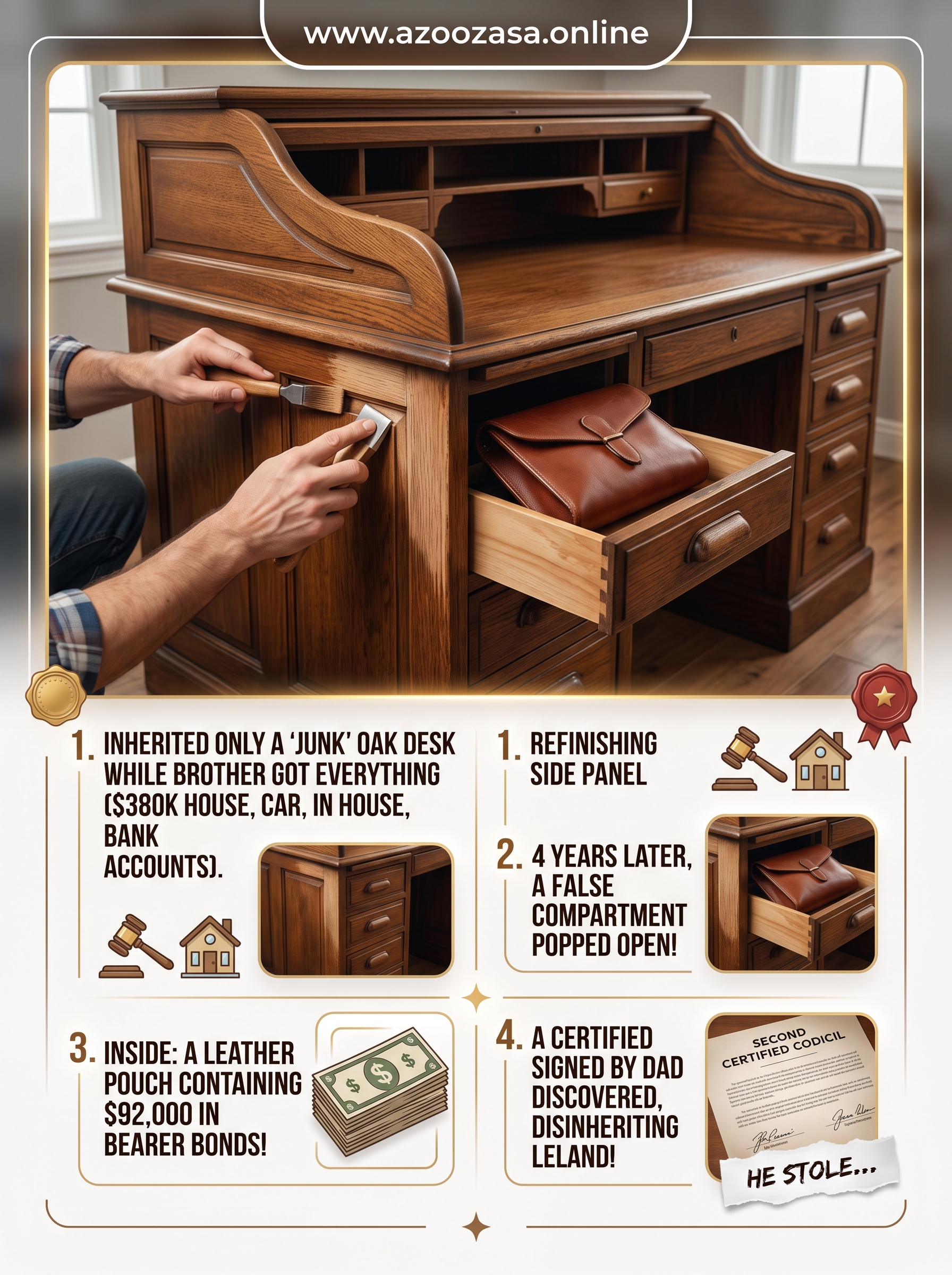
This desk was the only physical proof I had ever meant anything to my father. When his heart finally gave out, the reading of the will had been a brief, brutal affair. My older brother, Leland, sat in the attorney’s plush leather chair wearing a bespoke charcoal suit, his legs crossed at the ankle. He listened with feigned sorrow as the lawyer confirmed what Leland had already orchestrated. The pristine colonial house valued at three hundred and eighty thousand dollars, the restored vintage Mustang, and the entirety of the bank accounts were left to him.
To me, the youngest son who had spent his weekends fixing Dad’s gutters and driving him to dialysis, went a single item: the massive, brass-handled oak desk from the study.
I remember the way Leland smirked at me in the gravel parking lot of the law firm afterward. I was struggling to slide the colossal piece of furniture into the bed of my rusted pickup truck. Leland didn’t offer a hand. He just leaned against the driver’s side door of his new inheritance, checked his gold wristwatch, and said the words that had echoed in my mind every day since: “You got what you deserve, Tommy. Junk.”
I pressed harder on the sanding block, leaning my entire body weight into the side panel of the desk. My fingers were slick with sweat and wood dust. As I ground the sandpaper over a decorative groove near the bottom right leg, I felt a strange vibration. The wood didn’t just vibrate; it gave way.
There was a sharp, mechanical click that sounded like a heavy deadbolt snapping out of place.
I froze, the sanding block slipping from my palm. The solid oak panel I had been leaning against had depressed inward by a quarter of an inch. I wiped my hands on my denim jeans and pressed my thumbs against the wood again. It shifted further, and with a soft scraping sound, a hidden drawer, entirely seamless and disguised by the vertical grain of the oak, slid outward toward my knees.
The air that escaped from the dark compartment smelled of dry parchment and stale tobacco—Dad’s signature scent.
My heart began to hammer a frantic rhythm against my ribs. I reached into the narrow cavity and pulled out a heavy, dark brown leather pouch, the kind bank couriers used to use, fastened with a thick brass zipper. It was surprisingly heavy. I set it gently on the top of the partially stripped desk and pulled the zipper back.
The dim fluorescent light of the garage caught the edges of thick, beautifully embossed paper. I pulled out a stack of certificates, my breath catching in my throat as I read the ornate lettering. They were bearer bonds. Stack after stack of them, crisp and completely unregistered. I counted them twice, my hands shaking so violently I dropped several onto the concrete floor. Ninety-two thousand dollars in untraceable, liquid wealth.
But it was what lay at the bottom of the leather pouch that made the air completely leave my lungs.
It was a thick, ivory envelope sealed with red wax, bearing the official stamp of a notary public I recognized as Dad’s old golfing buddy, Arthur Vance. I broke the wax and pulled out a three-page legal document. At the top, printed in stark, uncompromising black ink, were the words: Certified Codicil to the Last Will and Testament of Harrison James Miller.
The date beside Dad’s shaky, sprawling signature was exactly two weeks before his fatal heart attack. Four years ago.
I leaned against the workbench, the paper trembling in my hands, and began to read the dense legal text. The first page completely revoked the previous will. The second page mandated the immediate liquidation of the estate, ordering the family home and all assets to be sold and split equitably.
But it was the third page that stopped my heart.
I explicitly and completely disinherit my eldest son, Leland Harrison Miller, from any portion of this estate, save for the sum of one dollar. I take this action with a heavy heart, having recently uncovered undeniable proof that Leland has systematically embezzled the two-hundred-thousand-dollar commercial insurance settlement intended for the medical care of his late mother, funneling the funds into his own private real estate ventures and forging my signature to conceal his theft. He left his mother to die in a state-funded facility while he built his empire on her suffering.
The words blurred together as a hot, blinding rage washed over me. Mom’s final years. The dilapidated nursing home Dad claimed was all they could afford. The tears my father cried because he thought the medical bills had bankrupted them. Leland had stolen it all. He had stolen her comfort, Dad’s dignity, and my inheritance, building his pristine life on a foundation of absolute rot.
Dad had found out. He had hidden the proof, the bonds, and the true will inside the only thing he knew Leland’s arrogance would never let him touch: the heavy, outdated oak desk that required manual labor to move. He knew Leland would discard it, and he knew I would eventually restore it.
I didn’t sleep that night. I sat in the garage, the bearer bonds locked in my fire safe, staring at the codicil. By eight o’clock the next morning, I was sitting in the polished conference room of the city’s most aggressive probate litigation firm.
The senior partner, a shark in a pinstripe suit named Vance, scrutinized the document for twenty minutes in absolute silence. He checked the notary seal. He checked the dates. Finally, he looked up at me, a slow, predatory smile spreading across his face.
“This is ironclad,” Vance said, tapping the paper. “The statute of limitations on the estate probate is entirely overridden by the discovery of a concealed, certified codicil involving fraud. Not only does your brother lose the house, but we can also refer the embezzlement of your mother’s settlement to the district attorney for criminal fraud charges.”
“I don’t care about sending him to jail,” I said, my voice eerily calm. “I just want him to feel exactly what he made my father feel.”
It took three days for the legal machinery to lock into place. Vance filed the emergency injunctions, freezing all of Leland’s assets, placing a sudden and immediate lien on the colonial house. I didn’t warn my brother. I wanted to deliver the news in person.
I drove my rusted pickup truck up the manicured driveway of my childhood home on a Thursday afternoon. The house looked pristine, the lawn cut into perfect diagonal stripes. I walked up the brick steps and rang the doorbell.
Leland opened the door holding a crystal tumbler of scotch. He was wearing an expensive cashmere sweater, looking every bit the affluent lord of the manor. When he saw me standing on the porch in my work boots and denim jacket, his face contorted into a mask of supreme annoyance.
“Tommy,” he sighed, taking a sip of his scotch. “If you’re here to ask for a loan, the answer is no. I told you four years ago, you have to make your own way in this world.”
“I don’t need a loan, Leland,” I said, my voice completely devoid of emotion.
I reached inside my jacket and pulled out a thick manila envelope, slapping it hard against his chest. Instinctively, he grabbed it to stop it from falling.
“What is this?” he demanded, looking down at the legal seals on the envelope.
“That is a notice of eviction,” I said quietly. “And an asset freeze. And a subpoena from the district attorney regarding wire fraud and elder abuse.”
Leland scoffed, a nervous, breathless sound, but the color immediately began to drain from his face. “You’re insane. You have nothing. The estate was settled four years ago.”
“Dad left me the desk, Leland. You were right. You thought it was junk.” I took a step closer, watching the terrified realization dawn in his eyes as he tore open the envelope and saw the copy of the codicil on top. “But you forgot that Dad built that desk with his own hands. He knew every groove. He knew exactly where to hide the truth.”
Leland’s mouth opened and closed, but no sound came out. The crystal tumbler slipped from his fingers, shattering into a dozen sparkling pieces on the hardwood floor of the foyer, the expensive scotch soaking into the expensive rug. He stared at the signature on the codicil, his eyes wide with the frantic terror of a man watching his entire universe collapse.
“He knew what you did to Mom,” I whispered, the anger finally bleeding into my words. “He knew you stole her care. You have exactly thirty days to vacate my property before the sheriffs come to physically remove you. I suggest you start packing.”
I didn’t wait for his response. I turned my back on him, walking down the brick steps and climbing into my rusted pickup truck. As I backed down the driveway, I looked through the windshield one last time. Leland was still standing in the open doorway, surrounded by broken glass, clutching the paper that had just destroyed his life.
Six months later, the colonial house was sold at a premium. The funds were transferred into my newly established accounts, securing a future I had long thought impossible. But the most valuable thing I owned didn’t sit in a bank.
It sat in the center of the living room in my new home. The heavy oak writing desk, beautifully sanded, richly stained, and perfectly restored. It gleamed in the afternoon sunlight, a silent, unyielding monument to a father’s love, and the ultimate, devastating cost of greed.


0 comments