
The Alibi in the Wooden Box
The grandfather clock in the hallway ticked with a hollow, rhythmic precision that only seemed to amplify the crushing silence of the house. It had been exactly three months since I buried my husband, Julian. For forty years, our home had been a symphony of his existence—the heavy thud of his work boots on the porch, the low rumble of his baritone humming off-key to the radio, the sharp crackle of the Sunday paper being snapped open. Now, the quiet was so absolute it felt like a physical weight pressing against my chest.
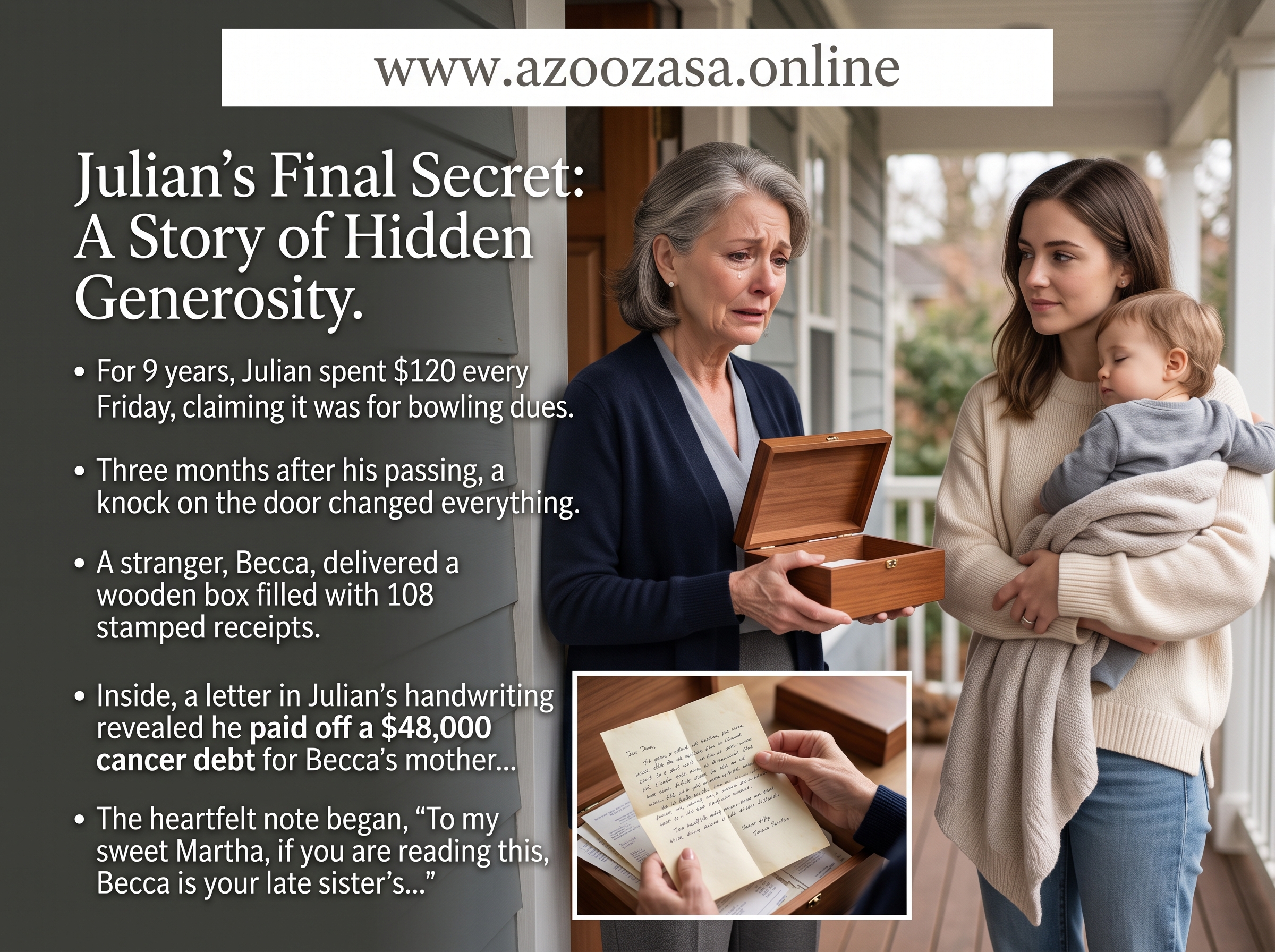
Julian was a man of steadfast routine, a trait that had anchored my chaotic, anxious heart from the moment we met. Among his many rituals, there was one I had never questioned, not even once. Every Friday afternoon for the last nine years, he would withdraw exactly one hundred and twenty dollars in cash from his wallet, slide it into a small white envelope, and announce he was heading to the local recreation center. He called it his bowling league dues, a harmless indulgence for a man who spent the rest of his week managing a chaotic lumber yard. He never brought home a trophy, and his bowling shirts always seemed suspiciously pristine, but I never doubted him. He was Julian. His integrity was the solid ground I walked on.
Yesterday at two o’clock in the afternoon, the illusion of my simple, perfectly understood life was dismantled by three soft knocks at my front door.
I set down my teacup, smoothing the wrinkles from my woolen cardigan, and pulled open the heavy oak door. Standing on the porch, shivering slightly in the crisp autumn air, was a young woman in her late twenties. She had dark, soulful eyes and a mass of unruly auburn curls pulled back into a hasty knot. Balanced on her left hip was a toddler, a little boy with bright, inquisitive eyes who was busy chewing on the sleeve of her denim jacket. In her right hand, she clutched a polished mahogany box with brass hinges.
“Martha?” she asked, her voice trembling, laced with an anxiety that seemed to vibrate through the floorboards.
“Yes,” I replied, my brow furrowing in confusion. “Can I help you?”
She didn’t introduce herself right away. She simply stared at my face, her eyes searching my features as if tracing a map she had memorized long ago. Slowly, she extended her trembling hands, offering the heavy wooden box toward me.
“Julian paid my mother’s forty-eight-thousand-dollar cancer debt in monthly installments,” the young woman said, the words rushing out in a breathless, desperate torrent. “He made me promise not to come until he was gone. He said you needed time.”
The breath left my lungs in a violent rush. My knees instantly lost their structural integrity, buckling against the wooden doorframe. I reached out blindly, my fingers wrapping around the cold brass of the deadbolt to keep myself from collapsing onto the porch. My mind frantically tried to assemble the jagged pieces of this impossible information. Forty-eight thousand dollars. A mother with cancer. Monthly installments. One hundred and twenty dollars a week, tucked into a white envelope every Friday for nine years.
“Who are you?” I choked out, the world suddenly spinning on an unfamiliar axis.
“My name is Becca,” she whispered, stepping forward to press the smooth mahogany box into my hands. “And this is for you.”
I brought her into the living room, the air suddenly thick and suffocating. I sat heavily in Julian’s worn leather armchair, placing the wooden box on my lap. Becca sat on the edge of the sofa, bouncing the restless toddler on her knee, giving me the silence I desperately needed.
The box was unlocked. I lifted the brass latch and opened the heavy lid.
Inside, meticulously organized with rubber bands, were one hundred and eight stamped receipts from the billing department of St. Jude Medical Center. They were monthly cash deposits, each totaling precisely four hundred and eighty dollars. Beneath the stacks of faded thermal paper lay a single, sealed ivory envelope. Written across the front, in Julian’s unmistakable, sweeping cursive, were my initials: M.E.V.
My fingers trembled so violently I could barely break the wax seal. I unfolded the thick parchment paper. The date at the top right corner indicated it had been written just one week before his sudden, fatal heart attack. He had known his time was drawing short.
The letter read:
To my sweet Martha,
If you are reading this, Becca is your late sister’s daughter, and the secret I have carried for nearly a decade is finally sitting in your lap. I know you are confused, and I know your beautiful, fiercely loyal heart is currently breaking. Please, my love, breathe. Let me explain before you let the anger take hold.
I know the vow you made twenty-five years ago. I was standing beside you in the hospital when your father passed away, his heart shattered by Elise’s betrayal. I watched your sister drain your parents’ life savings, run away into the night, and leave you to pick up the shattered pieces of your family. I heard you swear to the heavens that you would never speak her name again, that she was dead to you. And for sixteen years, I honored your boundary. I protected your peace.
But nine years ago, the phone at the lumber yard rang. It was a social worker from a charity ward two counties over. They had found my number on an old emergency contact form Elise had filled out decades ago. Elise was dying of stage four ovarian cancer. She was completely destitute, living in a subsidized apartment with her teenage daughter, Becca.
I drove out there, Martha. I walked into that bleak, sterile hospital room fully intending to look her in the eye and tell her she had made her bed. But when I looked at the fragile, terrified woman hooked up to those machines, I didn’t see the reckless girl who broke your father’s heart. I saw your eyes. I saw your chin. I saw the sister you used to braid flower crowns with in the backyard. She was drowning in medical debt, terrified that when she died, her daughter would be left entirely to the mercy of the state.
I knew you, Martha. I knew your pride was an impenetrable fortress. If I told you, your vow would demand you turn your back on her. But I also knew your soul. If you found out years later that your sister died in agony, completely alone, and that your only niece had been surrendered to the foster system, the guilt would have eaten you alive. You would never have forgiven yourself.
So, I made a choice to carry the burden for you. I couldn’t bring Elise back into your life, but I could make sure she didn’t die in terror. I told her you sent me. I told her that you had forgiven her, but that you just couldn’t bear to see her fading. I gave her peace, Martha. And then, I gave the hospital every spare dollar I could scrape together from my paychecks to ensure she received the palliative care she deserved, and that the debt wouldn’t fall on Becca’s young shoulders.
I told you I was going bowling. I was actually driving two hours north to sit in a hospital cafeteria with a grieving teenage girl, helping her navigate her homework and her impending orphanhood. Elise passed away eight months after I got the call, but I couldn’t abandon Becca. I paid off the lingering debts. I helped her through trade school. I walked her down the aisle when she married, and I stood in the waiting room when little Leo was born.
I am so profoundly sorry for lying to you. A marriage should not have shadows, but this was the only way I knew how to protect the woman I love from a pain she wasn’t ready to survive. The debt is settled. The past is finally buried. But the future is sitting in your living room.
Becca has my heart, Martha. But she has your blood. Please, don’t let the anger of the past steal the family you have left. Forgive me.
Yours eternally,
Julian.
The ink on the bottom of the page began to blur and bleed as the tears finally spilled over my eyelashes, falling hot and heavy onto the paper. I clutched the letter to my chest, letting out a ragged, agonizing sob that seemed to tear itself loose from the deepest foundation of my soul.
I had spent my entire adult life building a fortress of righteous anger to protect myself from my sister’s betrayal. I had allowed my heart to turn to stone, convinced that my rigid boundaries were the only thing keeping me safe. But Julian, in his infinite, quiet wisdom, had seen right through my armor. He knew that beneath my fury was a devastating grief. He hadn’t betrayed me; he had saved me from the catastrophic consequences of my own stubbornness. He had spent nine years quietly tending to a garden in the dark, ensuring that when the sun finally rose, I wouldn’t be standing in a barren wasteland.
Slowly, I lowered the letter and looked across the coffee table.
Becca was crying quietly, her hands covering her mouth, the toddler on her lap oblivious to the tectonic plates shifting beneath our lives. I looked at the young woman sitting on my sofa. I saw the familiar, sharp line of her jaw. I saw the auburn curls that used to catch the summer sun when Elise and I would run through the sprinklers as children.
I looked down at the toddler, who was now staring at me with wide, luminous eyes.
“His name is Leo?” I whispered, my voice cracked and thick with emotion.
Becca nodded, wiping a tear from her cheek with the back of her sleeve. “Leo Julian,” she corrected softly. “He has his middle name.”
A fresh wave of tears cascaded down my face, but they were no longer tears of grief for the husband I had lost. They were tears of overwhelming, absolute awe for the love he had left behind. He had taken one hundred and twenty dollars a week and bought me a daughter and a grandson. He had built a bridge over an impossible chasm, standing in the gap until I was ready to cross it.
I placed the mahogany box gently on the coffee table. I stood up, my knees no longer trembling, supported by a sudden, fierce strength I hadn’t felt in months. I walked across the plush carpet and sat down next to Becca on the sofa.
I reached out, my trembling hands softly framing her face. She leaned into my palm, letting out a small, broken sigh that sounded exactly like the sister I had spent a lifetime missing.
“You have her eyes,” I whispered, pulling her and the heavy, warm weight of the child into my arms, burying my face in her shoulder. The house was no longer silent. It was filled with the sound of our breathing, the soft babbling of a little boy, and the beautiful, undeniable echo of a Friday afternoon bowling league that had saved us all.


0 comments