
The July Auditor
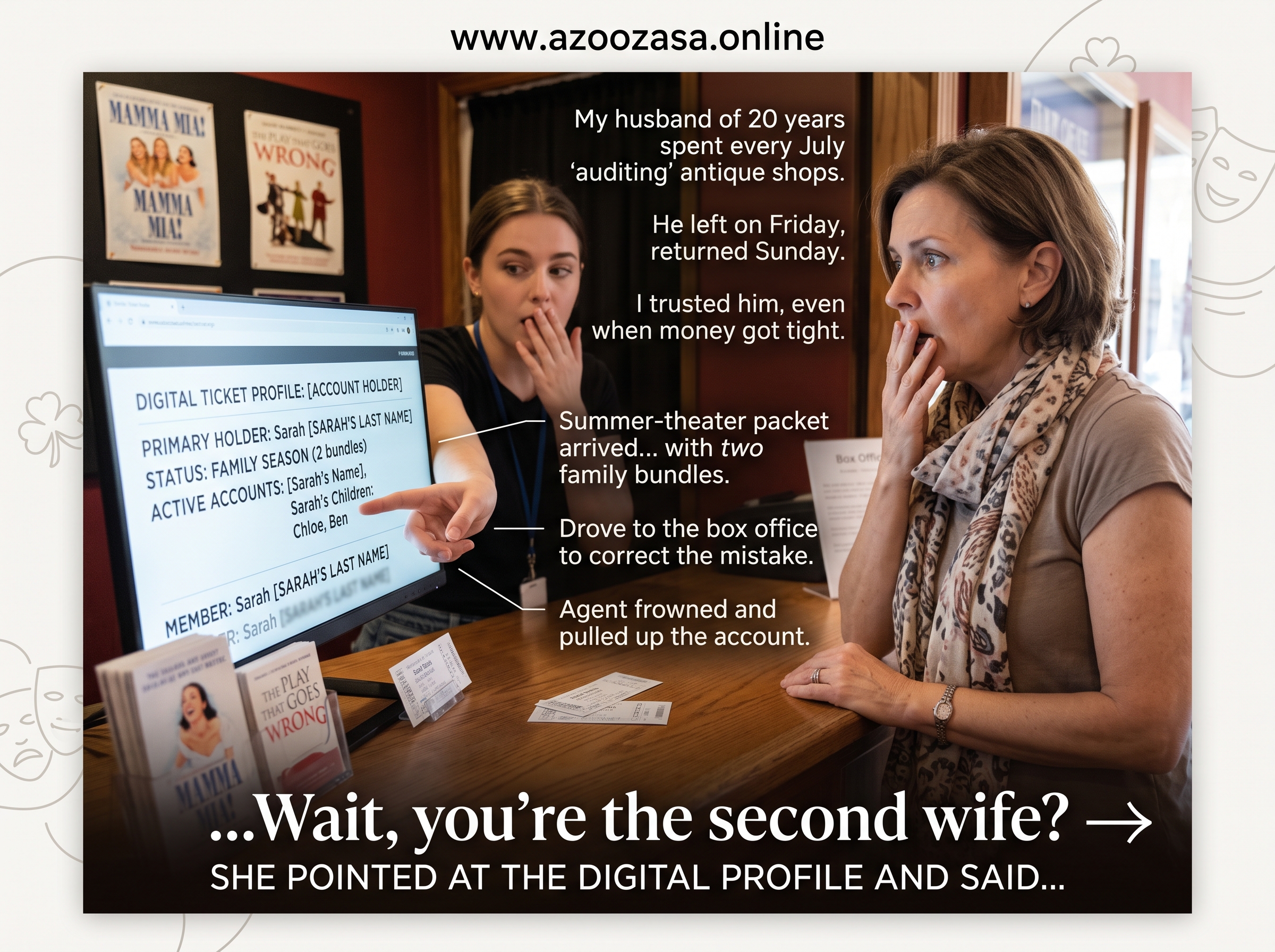
“Wait, you’re the second wife?” she asked, turning the screen toward me.
My vision blurred. She pointed at the digital ticket profile on the monitor, which showed a woman named Sarah listed as the primary account holder, and said, “Sarah and Arthur have held the premium center-orchestra seats for fifteen years. When you handed me your driver’s license with the same last name, I just assumed… well, I assumed he had finally left her. I am so, so sorry.”
The box office smelled of stale popcorn and ozone from the ticket printer, a scent that would forever be seared into my amygdala alongside the absolute shattering of my reality. I stared at the illuminated screen. There it was. Arthur’s smiling face in a small thumbnail photograph, his arm draped casually around a petite blonde woman wearing a floral sundress. They were standing in front of this very theater. He looked deeply happy. He looked relaxed. He looked exactly like the man I had married twenty years ago, long before the phantom financial strains and the endless weekend “business trips” ground us down into a polite, exhausted routine.
“Could you print that for me?” I heard myself ask. My voice sounded as though it were traveling down a long, hollow aluminum tube.
The young woman hesitated, her fingers hovering nervously over her keyboard. “Ma’am, I really shouldn’t have shown you this. It’s a strict breach of our privacy policy—”
“Please,” I whispered, meeting her panicked eyes. “Twenty years. I have been clipping coupons and mending that man’s work shirts for two decades while he spent my July grocery budget on front-row seats for Sarah. Just print the itinerary.”
Human sympathy overrode corporate policy. The laser printer whirred to life, spitting out a crisp, white sheet detailing fifteen years of summer escapades. I took the paper, thanked the terrified agent, and walked out into the blinding, oppressive afternoon sun.
The drive back to our house was a terrifyingly quiet blur of gray asphalt and fragmented memories. Every July, without fail, Arthur would pack his worn leather duffel bag. “The antique shops in Oakhaven are absolute goldmines this time of year, Claire,” he would say, adjusting his wire-rimmed glasses with a practiced sigh. “Estate sales. Liquidations. I have to audit the inventory before the big city dealers swoop in and take the best pieces.”
I had always been the trusting type. I had believed him when he said the antique reselling business was barely breaking even, which was why we had to remortgage our house. I had believed him when he said he preferred the quiet solitude of the road to summer vacations in Europe. I had believed every single carefully constructed, meticulously curated lie that now lay dismantled in the passenger seat of my Subaru.
When I finally pulled into the driveway, the house was empty and suffocatingly silent. Arthur was at his day job at the downtown accounting firm—his legitimate, boring, cover-story job. I walked straight into his home office, a room I usually only entered to dust the blinds or empty the wastebasket. It was a dusty shrine to his supposed side hustle: a few tarnished brass lamps, a stack of heavy appraisal books, and a fireproof safe tucked discreetly beneath his mahogany desk.
I didn’t know the combination, but I knew Arthur. He was a creature of rigid habit, entirely devoid of genuine imagination when it came to security. I tried our anniversary. Nothing. I tried his birthday. Nothing.
I looked down at the theater printout crumpled in my sweaty hand. Sarah’s account was established on July 14th, exactly fifteen years ago. I dropped to my knees on the carpet and spun the cold steel dial. One. Four. Zero. Seven.
The heavy locking mechanism clicked, yielding effortlessly to the truth.
Inside, there were no appraisal documents. There were no receipts for vintage armoires, Victorian tea sets, or mid-century modern credenzas. Instead, there was a neat stack of bank statements for a joint checking account under the names Arthur and Sarah Vance. There was a property deed to a cozy, three-bedroom craftsman house in Oakhaven. And, tucked beneath the financial ruin of my marriage, there were photo albums.
I sat on the floor, the rough fibers of the carpet scraping my bare knees, and leafed through a decade and a half of a parallel universe. Arthur and Sarah carving pumpkins on a porch I had never seen. Arthur and Sarah laughing at a neighborhood block party. Arthur tossing a young boy—his son—into a backyard swimming pool. The boy had Arthur’s distinctive crooked smile and my husband’s unruly dark hair.
A deep, profound silence settled over my mind. It wasn’t the frantic, screaming, sobbing grief I had always imagined would accompany utter betrayal. It was the icy, calculated stillness of a woman realizing she had been an unpaid extra in the movie of her own life.
I didn’t scream. I didn’t cry. I simply put the albums back, locked the safe, and formulated a plan.
Friday arrived with the suffocating humidity typical of late July. Arthur stood in the hallway, zipping up his leather duffel bag just as he had done a hundred times before.
“I should be back by Sunday evening,” he said, offering his usual rehearsed, apologetic smile. “There’s a massive estate liquidation near the lake. Might be some pristine pieces I can flip for a good margin. I’m so sorry to leave you alone again, Claire.”
“Don’t worry about me,” I said, stepping forward to brush a piece of microscopic lint off his lapel, suppressing the urge to dig my nails into his chest. “I have plenty to keep me occupied this weekend. Drive safely, Arthur.”
He kissed my cheek—a dry, perfunctory graze of lips that made my stomach turn—and walked out the door. I watched his car disappear down the oak-lined street, waiting exactly two hours before I went upstairs to change.
I bypassed the practical slacks and sensible blouses that made up my everyday wardrobe. Instead, I reached into the very back of my closet, beneath the garment bags, and pulled out a stunning, deep crimson silk dress I had bought years ago for a charity gala we never ended up attending because “money was tight.” I applied dark, dramatic lipstick. I pinned my hair up in a sleek twist. Staring into the mirror, I didn’t look like Claire, the perpetually understanding, financially stressed wife. I looked like a stranger. I looked dangerous.
The drive to Oakhaven took just under an hour, the winding country roads giving way to a picturesque, wealthy suburban downtown. The Oakhaven Community Theater was a charming, beautifully restored brick building draped in climbing ivy, glowing warmly under the twilight sky. The brightly lit marquee read: Opening Night: The Double Life of Henry.
The irony was thick enough to choke on.
I bypassed the crowded will-call line, having already memorized the digital barcode from the agent’s printout. The usher scanned it directly from my phone screen with a cheerful beep, completely unaware of the explosive device he had just let into the building. I made my way into the hushed, velvet-lined auditorium.
Row C. Center Orchestra. Seats 12 and 13.
I walked down the sloped aisle, the heavy scent of expensive perfume and aged wood washing over me. I took my place in Seat 13. The plush velvet was incredibly comfortable. Premium, indeed. I crossed my legs, smoothed the crimson silk over my knees, folded my hands in my lap, and waited.
The theater began to fill. The low, melodic hum of excited chatter echoed off the high, ornate ceilings. The heavy chandeliers dimmed slightly, a universal warning that the performance was about to begin.
Then, I saw them.
Walking down the center aisle, holding hands like lovestruck teenagers, were Arthur and Sarah. She looked exactly like her photograph—radiant, wearing a light blue summer dress, completely oblivious to the impending collision of her carefully curated world. Arthur was laughing at something she said, looking more vibrant and alive than he had in my presence for over a decade.
They turned into Row C. They shuffled past the knees of apologetic patrons. Arthur was leading the way, his eyes focused on the stage.
“Excuse me, pardon us,” Arthur murmured politely to the people in Seats 10 and 11. He stepped toward Seat 12, looking down to unbutton his sports coat.
He froze.
His hand stopped mid-button. The color drained from his face so rapidly I thought he might actually faint right there on the patterned carpet. His eyes widened to the size of saucers, locking onto mine in sheer, unadulterated terror.
“Hello, Arthur,” I said, my voice perfectly level, easily carrying over the hushed murmurs of the surrounding crowd. “How was the estate sale?”
Sarah bumped into his back, letting out a soft sigh of frustration. “Artie, keep moving, the lights are going down. Is someone in our seat?” She leaned around his frozen frame, peering at me with polite, Midwestern confusion. “Oh, hello. I think you might be in my husband’s seat.”
Husband.
There it was. The final, definitive confirmation spoken aloud in the physical world.
“Actually, Sarah,” I said, standing up smoothly. The heavy crimson silk rustled like a warning rattle in the quiet theater. “He’s my husband. Twenty years this October. Though I must say, I admire your taste in summer theater far more than his taste in imaginary antique shops.”
Sarah gasped, a sharp, ragged sound, her hand flying to cover her mouth. She looked at Arthur, whose mouth was opening and closing silently like a suffocating fish pulled from a lake. “Arthur? Who is this woman? What on earth is she talking about?”
“I… Claire… I…” Arthur stammered, his voice cracking. The polished, confident, two-timing auditor completely crumbled under the blinding stage lights of reality. The surrounding patrons had fallen dead silent, a captive audience to a drama far more gripping than anything scheduled for the stage that evening.
“Don’t worry, Sarah, I’m not staying for the show,” I said, stepping past a paralyzed Arthur. I paused, leaning in so only the two of them could hear my final, devastating review. “The craftsman house here in Oakhaven is lovely, Arthur. I saw the deed in your safe. But you really should have updated the lockbox combination. It was terribly easy to crack. You’ll be hearing from my lawyer on Monday morning. I’ll be taking our real house, the retirement accounts, and whatever is left of your pathetic pride.”
I didn’t wait for his response. I didn’t need to. I walked up the aisle with my head held high, the rhythmic, sharp click of my heels echoing in the stunned, absolute silence of the auditorium.
As I pushed open the heavy brass doors and stepped out into the cool, humid night air, a massive, suffocating weight lifted off my chest. For twenty years, I had been a clueless understudy in a play I didn’t even know I was cast in. But as I started my engine and pulled away from the glowing theater, leaving Arthur to face the burning wreckage of his own making, I finally knew one thing for certain.
My season was just beginning.


0 comments