
The Silence of the Summer Cafeteria
The fluorescent lights of the elementary school cafeteria buzzed with a low, oppressive hum, a stark contrast to the bright July afternoon outside. At sixty-five, I was in the best shape of my life. I maintained a rigorous daily exercise routine and a strict diet of whole foods, a lifestyle choice born from the necessity of having the physical and mental stamina to keep up with my eight-year-old grandson, Leo. My days were typically spent in the quiet sanctuary of my home office, designing digital media content and laying out social media story graphics for my website, www.azoozasa.online. I specialized in crafting intricate, fictional narratives centered on suspense and dark family dramas. I understood the mechanics of a villain, the subtle tells of a liar, and the slow build of a terrifying climax.
But as I sat across the sticky laminate table from my son-in-law, Arthur, I realized that the darkest antagonists do not exist on a screen. They wear tailored linen suits to a children’s summer program and smile with perfectly capped teeth.
Arthur had married my daughter, Claire, three years ago. The attraction, on his end, was painfully transparent to anyone willing to look past his practiced charm. Claire was the sole beneficiary of her late father’s substantial trust fund. For the past six months, Claire had been suffering from a mysterious, debilitating chronic fatigue that kept her confined to her bed, leaving Arthur in complete control of her finances and her son.
I had insisted on taking Leo to lunch today. Arthur, ever the controlling warden, had insisted on escorting us.
He walked right behind us as we navigated the crowded cafeteria aisles. Leo was carrying his plastic tray, his small hands trembling slightly as he balanced a carton of milk and a plate of apple slices.
“He’s such a clumsy boy,” Arthur sneered, his voice dropping to a harsh, cruel register as he reached out and grabbed the back of Leo’s thin arm.
Leo flinched so hard his cafeteria tray slid across the table, the milk carton tipping over and pooling across the laminate surface. The boy didn’t make a sound. He didn’t cry. He simply shrank into himself, a terrifying, practiced physical retraction of a child who was used to making himself as small as possible to avoid a predator’s wrath.
I sat there, my heart hammering violently against my ribs, my fingernails biting into the palms of my hands until they nearly broke the skin. I wanted to reach across the table and tear the smug, patronizing smile right off Arthur’s face, but years of outlining suspense plots had taught me one fundamental rule: you do not confront the antagonist until you possess the absolute upper hand. If I caused a scene here, Arthur would simply drag Leo to his car, lock the doors of their estate, and bar me from ever seeing my daughter or my grandson again.
I forced myself to remain perfectly still. “Accidents happen, Arthur,” I said, my voice deadpan and devoid of emotion. “Let the janitor handle it.”
An older man in a gray uniform came over with a damp rag, wiping the spilled milk and taking the wet tray away to the washing station. Arthur sighed loudly, checking his expensive watch, performing the role of the profoundly inconvenienced parent.
A few moments later, the janitor returned to wipe down the remaining moisture, setting a dry, empty tray at the edge of our table before moving on. As the plastic hit the laminate, a slight, unnatural reflection caught my eye.
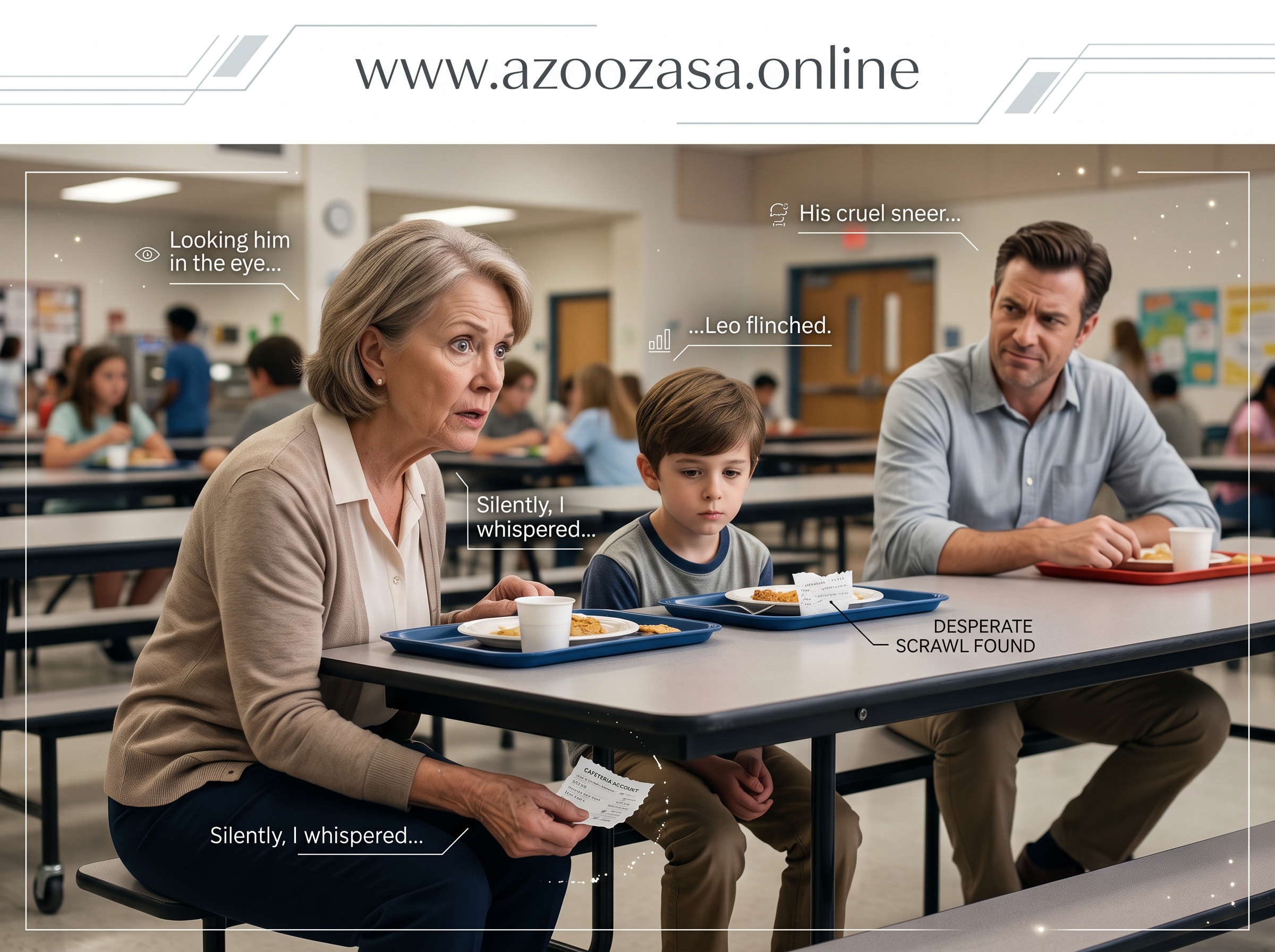
There was a jagged, folded cafeteria-account slip wedged deep inside the clear plastic sleeve on the side of the tray—the sleeve meant to hold daily menu cards.
Leo was staring at his lap, his hands folded tightly together. He wasn’t looking at the tray, but his breathing was shallow and rapid.
I shifted my chair, casually sliding my purse onto the table to block Arthur’s line of sight. Under the cover of the leather bag, I reached out and gently slid the folded piece of paper free. I moved my hands to my lap and carefully unfolded it beneath the table.
My pulse jumped straight into my throat.
It wasn’t a standard lunch receipt. Written on the back of the thermal paper, in the frantic, deeply pressed pencil scrawl of an eight-year-old boy, were three sentences.
He makes Mom drink a special tea every night. I saw him crush the sleeping pills from the blue bottle into the mug. He said he will lock me in the basement forever if I tell you.
The air in the cafeteria evaporated. The loud chatter of the summer camp kids faded into a dull, rushing roar in my ears. The mysterious illness. The sudden chronic fatigue. The complete isolation of my daughter. Arthur wasn’t just waiting for the trust fund to legally transfer into a joint account; he was actively, chemically incapacitating her to ensure she couldn’t stop him, and he was terrorizing an eight-year-old child to maintain his absolute silence.
I folded the slip of paper into a tiny square and slid it securely into the pocket of my slacks. The digital narratives I created for my website were fictional, but the adrenaline currently flooding my system was entirely, terrifyingly real. I didn’t need to write a plot twist. I was sitting in the middle of one, and it was time to orchestrate the ending.
I looked up. Arthur was staring at his phone, his tailored linen suit completely out of place among the finger-painted walls and miniature plastic chairs. He looked bored. He looked victorious.
I leaned across the table. I didn’t raise my voice. I didn’t cause a scene. I locked my eyes onto his, projecting every ounce of maternal fury I possessed, and waited until he was forced to look back at me.
I read the child’s desperate scrawled note, looked the stepfather in the eye, and whispered, “I know exactly what you are putting in Claire’s evening tea, Arthur. And if you ever lay another finger on this boy, the police won’t be the ones you need to worry about.”
The boredom vanished from Arthur’s face instantly, replaced by a stark, absolute shock. His jaw tightened, the polished veneer cracking right down the middle. He opened his mouth to speak, to deny it, to spin one of his smooth, practiced lies, but the words died in his throat. He saw the cold, uncompromising certainty in my eyes. He knew that I possessed the absolute truth.
“Get up, Leo,” I commanded, my voice sharp and authoritative.
Leo’s head snapped up. He looked at Arthur, and then he looked at me.
“We are leaving,” I said, standing up and grabbing my purse. “You are coming home with me.”
Arthur finally found his voice, a reedy, desperate hiss. “You can’t do that. I am his legal guardian. I will call the police and have you arrested for kidnapping.”
“Please do,” I whispered, pulling my cell phone from my pocket and holding it up. “Let’s invite the police to the house right now. Let’s have them bring a toxicology kit for my daughter. Let’s have them test the blue bottle of pills in your bathroom cabinet. Dial the number, Arthur. Or I will.”
Arthur froze. The blood drained entirely from his face, leaving him looking like a pale, hollowed-out ghost of a man. The threat of the law, the threat of exposure, entirely paralyzed him. He was a coward who preyed on a sick woman and a terrified child. Faced with an adversary who was not afraid of him, he had absolutely no defense.
He didn’t dial the phone. He didn’t make another move. He sat frozen in the miniature plastic chair, entirely defeated by a single, folded piece of thermal paper.
I held my hand out to my grandson. Leo didn’t hesitate this time. He practically leapt from his seat, grabbing my hand with a grip so tight it ached. I didn’t look back as we walked out of the cafeteria, leaving Arthur sitting alone in the fluorescent glare of his own collapsing empire.
The next few hours moved with brutal efficiency. I drove straight to their house, marched past the stunned housekeeper, and went directly to Claire’s bedroom. She was groggy and disoriented, but when I showed her Leo’s note and explained what was happening, the fog of the sedatives was pierced by the fierce, protective instinct of a mother.
We packed two bags. We took the blue bottle from the bathroom cabinet. We left the house before Arthur even pulled his car into the driveway.
That night, sitting in the safety of my living room, the authorities were called. The physical evidence of the tampered tea, the crushed pills, and Leo’s heartbreaking, handwritten testimony were more than enough to secure an immediate emergency restraining order and launch a full criminal investigation into Arthur’s actions. The trust fund was immediately frozen by my attorneys, severing his access to the very wealth he had tried to steal.
Arthur is currently awaiting trial in the county penitentiary. He will not see a dime of the money, and he will never breathe the same air as my family again.
Today, Claire is entirely recovered, the color returned to her cheeks and the light back in her eyes. Leo is thriving, a happy, energetic boy who no longer flinches when someone walks up behind him. And I still wake up early every morning, complete my daily exercise routine, and sit down in my home office with a cup of green tea. The fictional dramas I post to my website are darker now, filled with higher stakes and sharper twists. But my readers always note that my heroes have changed. They are no longer detectives or action stars. They are grandmothers, quiet and observant, proving that the most dangerous force on earth is a woman who refuses to look away.



0 comments