
The Six-Thousand Dollar Lie
The fluorescent lights of the emergency room hummed with a low, oppressive frequency, casting a sterile, blue-white glare over the scuffed linoleum floor. I sat on the edge of the examination bed, the crinkly sanitary paper protesting every time I shifted my weight. The air smelled of rubbing alcohol, bleached cotton, and metallic iodine. For most people, it is the scent of modern medicine and healing. For me, it has always been the scent of absolute, irreversible theft.
I was forty-seven years old, nursing a throbbing ache in my neck and a bruised collarbone after a distracted teenager had plowed his sedan into the back of my car at a red light. The paramedics had insisted on a precautionary transport to City General. My physical injuries were entirely minor, but the sheer, suffocating panic of being trapped inside a hospital room was threatening to send my heart rate into dangerous territory.
I closed my eyes, trying to breathe through the rising tide of anxiety, but the sterile smell immediately dragged me violently backward through time.
Twenty-eight years ago, I was nineteen years old, terrified, and lying in a vastly different hospital bed in Salem. Outside, a torrential autumn rain had battered the windowpanes, blurring the city streetlights into chaotic streaks of yellow and red. Inside, the recovery room was freezing, dominated by the suffocating, immovable presence of my father.
Arthur Vance was a man constructed of sharp angles, imported wool suits, and rigid, terrifying societal expectations. He was a wealthy local developer who ruled our community with a velvet glove over an iron fist. Reputation was his currency, his religion, and his weapon. An unwed, pregnant teenage daughter was a catastrophic blemish on his pristine societal ledger, an embarrassment he refused to tolerate. He had kept me hidden away in the house for the duration of the pregnancy, a prisoner of his towering shame.
The memory of that night in Salem remains burned into my neurology like a brand. I had labored for fourteen grueling hours, gripping the steel bed rails until my knuckles bled, begging for my mother, who had passed away years before. When the final push brought a sudden, piercing cry into the cold air, a fleeting rush of overwhelming, desperate love had consumed me. I saw a shock of dark hair. I saw a tiny, flailing fist.
And then, she was gone.
The nurses, clearly operating under strict, pre-arranged instructions, whisked the baby away before she was even cleaned. I screamed for her, thrashing against the sheets, but my father simply stepped into my line of sight, entirely blocking the door.
He was holding his custom leather checkbook.
“She is going to a good, married family out of state, Elena,” my father had said, his voice flat, devoid of a single ounce of human empathy. He signed his name with a heavy gold pen, tore the check free, and dropped it onto my bedside tray. I stared at the bold, undeniable ink. $6,000.
“This covers the private hospital fees and the attorney’s expedited retainer,” he continued coldly, buttoning his suit jacket. “This never happened. You will go back to college next week. You will forget this entirely, or you will no longer be a part of this family.”
But a mother does not forget. You do not simply erase the violent severing of your own soul. For twenty-eight years, I had lived as a hollowed-out ghost of a woman. I had walked through grocery stores, staring at little girls in pigtails, then teenagers in prom dresses, and eventually, young women navigating their twenties, constantly wondering if my daughter was looking back at me. The grief was a phantom limb, an invisible, agonizing weight that I dragged through every single day of my life.
The sharp, aggressive screech of the curtain rings scraping across the metal rod snapped me violently back to the present.
A young ER doctor stepped into the small cubicle. She was tall, with dark, intelligent eyes and hair pulled back into a severe, no-nonsense bun. She radiated that specific blend of chronic exhaustion and sharp competence unique to emergency medicine. Her white coat swished around her knees as she reviewed my digital chart on a tablet, her brow furrowed in concentration.
“Elena Vance?” she asked, her voice calm and melodic. “I’m Dr. Bennett. The radiology tech just uploaded your cervical x-rays. Good news—no fractures, just some moderate whiplash. We’re going to prescribe a muscle relaxer and get you discharged shortly.”
“Thank you, Doctor,” I murmured, the tension slowly draining from my shoulders. “I’m ready to go home.”
“I just need to check the insertion site on this IV before I sign the release,” she said, stepping closer and setting her tablet down on the rolling tray table. “Make sure there’s no infiltration or swelling.”
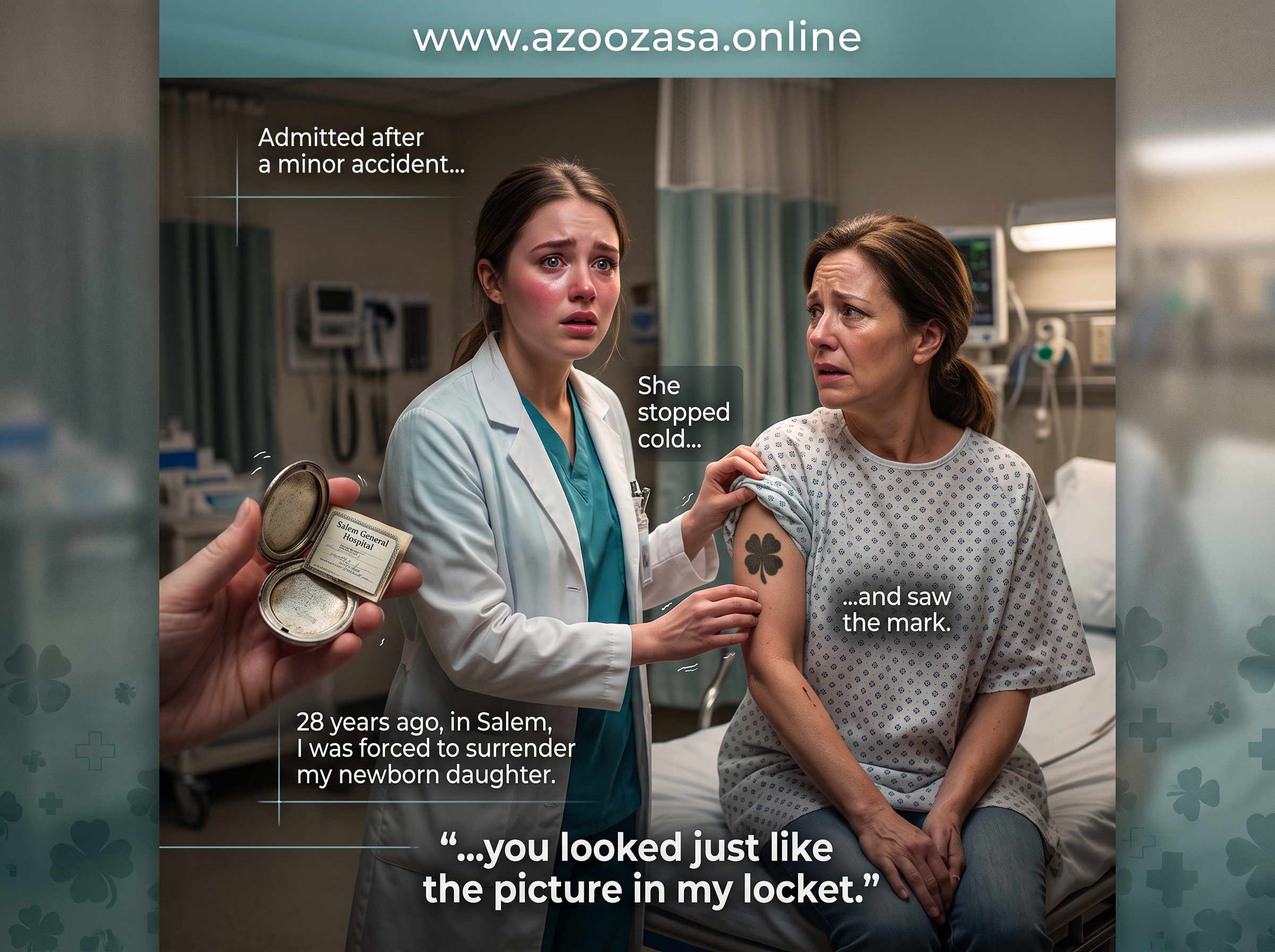
She reached out with gloved hands and gently gripped my left arm. To access the clear plastic tape securing the needle, she pushed the loose, short sleeve of my hospital gown all the way up to my shoulder.
Dr. Bennett stopped.
She didn’t just pause; her entire body froze into absolute, statuesque rigidity. The ambient noise of the emergency room—the distant wail of an ambulance siren, the rhythmic beeping of cardiac monitors, the chatter of the nurses’ station—seemed to instantly evaporate, leaving behind a dense, terrifying vacuum of silence.
She was staring directly at my upper left deltoid.
Right below the curve of my shoulder rested a distinct, reddish-brown pigmentation flaw. It was a highly unusual, completely unique vascular birthmark shaped perfectly like a three-leaf clover. I had inherited it from my grandmother, a rare genetic stamp passed down through the women in my bloodline.
I watched the young doctor’s throat bob as she swallowed hard. Her breathing hitched, becoming shallow and rapid.
“Doctor?” I asked, a spike of alarm cutting through my fatigue. “Are you alright?”
She didn’t answer. Slowly, as if moving underwater, Dr. Bennett raised her left hand. Her fingers were trembling violently, the latex glove vibrating in the harsh fluorescent light. She reached under the stiff collar of her white lab coat and pulled out a heavy, deeply tarnished silver locket that hung from a long chain around her neck.
With a definitive click, she popped the small clasp open.
Inside the locket wasn’t a photograph. It was a tiny, meticulously folded square of heavy, yellowed parchment paper.
Dr. Bennett carefully unfolded it with shaking hands. I leaned forward, my heart suddenly hammering a frantic, deafening rhythm against my ribs. I recognized the heavy, embossed blue ink immediately. I recognized the official county seal.
It was a fragment of a hospital birth certificate.
At the top, printed in bold, block letters, was the name of the facility: SALEM GENERAL HOSPITAL.
“Where did you get that?” I whispered, my voice sounding like it belonged to a stranger, entirely stripped of air. The room began to spin, the edges of my vision darkening with an impossible, staggering realization.
Dr. Bennett looked up from the paper. Her dark eyes, which moments ago had been filled with clinical detachment, were now brimming with a sudden, violent swell of tears. She looked at the cloverleaf mark on my arm, and then she looked directly into my face, frantically searching my features, tracing the shape of my jaw, the set of my eyes, the arch of my brow.
She stepped closer, her voice dropping to a raw, fractured whisper that echoed louder in my soul than any scream ever could.
“The man who arranged my private adoption charged my parents six thousand dollars in legal fees,” she whispered, a tear spilling over her lashes and cutting a hot path down her cheek. “He gave them this certificate. And he told them… he told them my nineteen-year-old mother bled to death on the delivery table.”
The words struck me with the physical force of a freight train.
My father hadn’t just forced an out-of-state adoption to hide his shame. He had executed a masterpiece of absolute, sociopathic cruelty. The six thousand dollars hadn’t gone to hospital bills. It was a bribe. It was a blood-money transaction paid to a corrupt attorney to permanently seal the records, to falsify a death certificate, and to entirely erase my existence from my own daughter’s life. He had killed me in her eyes so that she would never, ever come looking for me, guaranteeing his precious reputation would remain forever unblemished.
I stared at the brilliant, beautiful twenty-eight-year-old doctor standing in front of me. I saw the dark hair I had glimpsed in that freezing Salem delivery room. I saw the fierce, resilient spark of life that my father had tried so desperately to extinguish.
“He lied,” I choked out, a profound, agonizing sob tearing its way up from the very depths of my chest. The twenty-eight years of phantom grief, the empty birthdays, the hollow, echoing silence of my life—all of it violently shattered, replaced by the blazing, blinding light of the truth.
I reached out, entirely ignoring the sting of the IV line, and placed my trembling hand gently over hers, covering the silver locket and the faded paper inside.
“He lied to us both,” I wept, pulling her down into my arms as my own tears soaked into the shoulder of her white coat. “I am right here. I never wanted to let you go. I have been right here all along.”
She collapsed against my chest, the professional barrier of the young ER physician entirely washing away, leaving only a daughter who had spent a lifetime mourning a ghost, finally finding the very real, beating heart of the mother who had never stopped loving her. The sterile, terrifying scent of the hospital vanished. In its place, surrounded by the beeping monitors and the harsh fluorescent lights, there was only the overwhelming, miraculous warmth of a family, twenty-eight years delayed, finally coming home.



0 comments