
The Weight of the Foundation
My father was a man composed entirely of calloused hands, quiet grunts of approval, and absolute, unbreakable rules. For as long as I could remember, the heavy oak doors of the root cellar embedded in the hillside behind our house were strictly forbidden territory, secured by a massive, rust-pitted Master Lock. “The foundation is unstable,” he would warn us kids, his voice carrying a dark, gravelly authority that tolerated zero negotiation. “The earth shifts. You stay away from it.”
Out of a deeply ingrained childhood fear, we obeyed. Even as adults, whenever my siblings and I returned to the old property, we gave the hillside a wide berth.
I have spent the entirety of my adult life architecting secrets for a living. As a digital media creator, I run the website www.azoozasa.online, dedicating my hours to crafting intricate fictional narratives, suspense outlines, and complex family dramas for my audience. My own life is deliberately structured to counter the chaotic fiction I write; I maintain a rigorous daily exercise routine and a strict diet of nutrient-dense whole foods just to keep my mind grounded and my anxiety at bay. I always believed I understood the mechanics of a good mystery, and how meticulously a person could hide their true motivations.
I was completely wrong. The greatest suspense plot I would ever encounter wasn’t on a screen; it was buried in my own backyard.
Yesterday afternoon, a violent, unprecedented July storm stalled over our county. The sky bruised a terrifying purple, and the heavens opened up, dropping eight inches of rain in a matter of hours. The deluge turned the steep hillside behind the old house into a rushing river of brown slurry. The mudslide slammed into the side of the property, ripping the rotting wooden doors of the root cellar completely off their rusted hinges.
When the storm finally broke, leaving behind a humid, ozone-scented silence, I pulled on my heavy rubber boots and trudged out into the muck to assess the damage.
The interior of the cellar gaped open like a dark, muddy wound in the earth. I clicked on my heavy-duty flashlight, the beam cutting through the damp, stagnant air. The smell of wet stone and decaying roots was suffocating. The rear retaining wall, constructed of loose river stones, had entirely collapsed under the hydrostatic pressure of the storm, revealing a deep, hollow cavity carved directly into the bedrock.
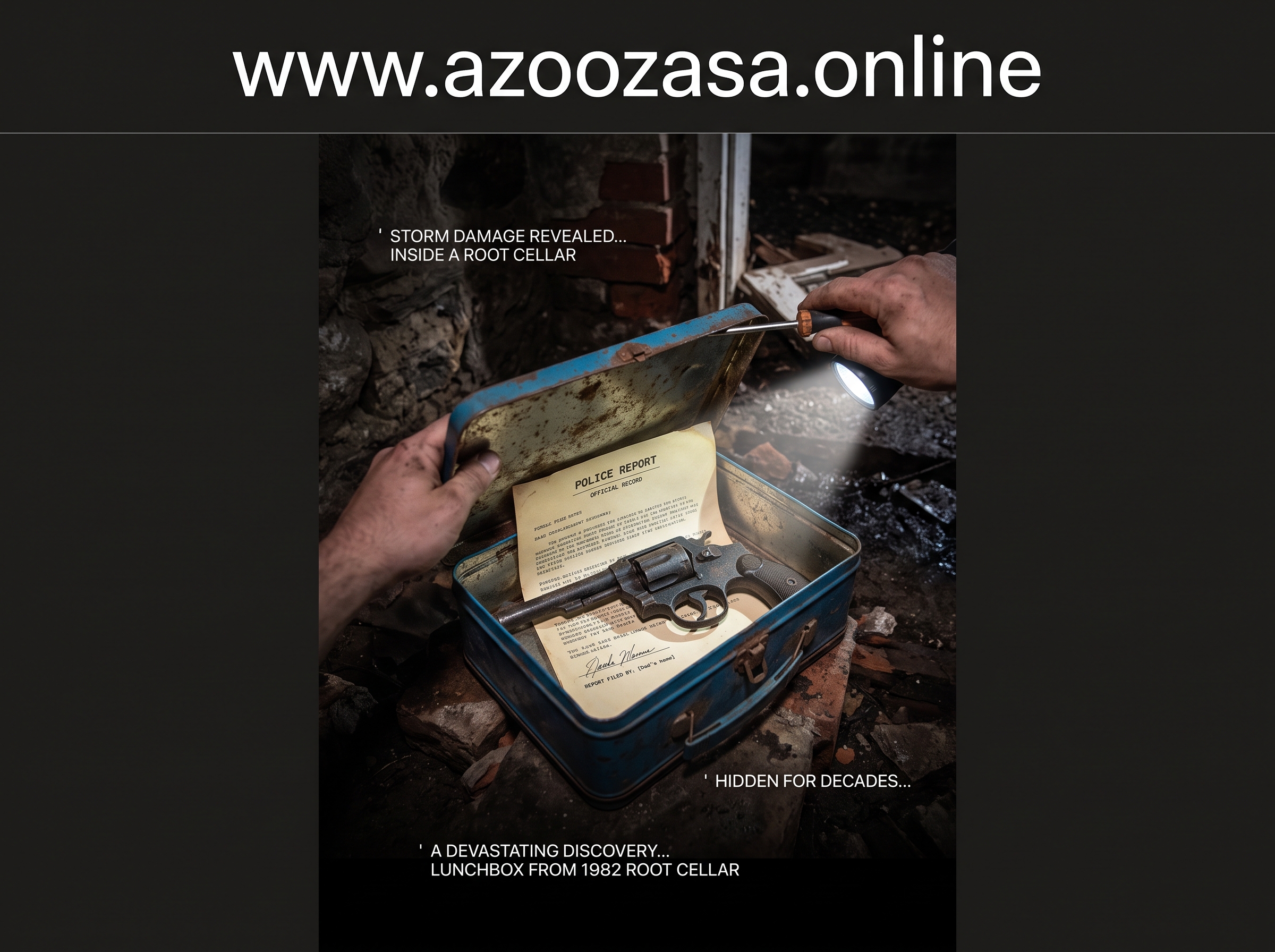
I stepped cautiously over the threshold, my boots sinking into the silt. Wedged in the back of that dark cavity, resting on a small, perfectly preserved wooden pallet, was a sealed, vintage Aladdin Stanley metal lunchbox.
It was a faded, industrial green, wrapped tightly in brittle layers of clear plastic sheeting that had yellowed with age. It looked as though it hadn’t been touched since the Reagan administration.
My breath hitched in my throat. I reached out and pulled it into the light. It was startlingly heavy. I carried it out of the cellar and set it on the wet grass, my heart hammering a frantic rhythm against my ribs. I fetched a flathead screwdriver from my truck and carefully sliced through the brittle plastic. The metal clasps were seized with rust, but a sharp twist of the screwdriver popped them free with a loud, violent crack.
I opened the lid.
The distinct, metallic scent of gun oil and old paper wafted into the humid summer air. Resting right on top of a folded stack of documents was a heavy, snub-nosed .38 Special revolver. The blued steel was perfectly pristine, lovingly oiled and wrapped in a soft flannel cloth.
My knees physically buckled. I sank onto the wet grass, my mind racing through a thousand terrifying implications. I reached past the weapon with trembling fingers and pulled out the top document.
It was a heavily redacted county police report dated August 12, 1982. I was only four years old at the time. The typewritten pages detailed the sudden, unresolved disappearance of a man named Silas Vance. I recognized the name instantly. Silas was my father’s older brother, an unstable, violent man who had terrorized our family for years before allegedly skipping town to escape a mountain of gambling debts. That was the story we had been fed our entire lives.
But at the bottom of the second page, beneath a paragraph detailing the discovery of Silas’s abandoned vehicle near the county line, was an official sign-off. It wasn’t the signature of the investigating detective.
It was my father’s signature.
And tucked beneath the police report was a handwritten confession, penned on a piece of yellow legal pad paper, detailing exactly how my father had intercepted his brother on the night Silas had threatened to burn our house to the ground with us inside it. The confession outlined how the .38 Special had been used, how the police report had been intercepted by a sympathetic desk sergeant who owed my father his life, and how the narrative of the fleeing gambler had been meticulously fabricated.
My father hadn’t padlocked the root cellar because the foundation was unstable. He had padlocked it because the foundation of our entire lives was built on top of a murder.
I sat in the mud for an hour, the damp chill seeping through my jeans, entirely paralyzed by the weight of a forty-four-year-old ghost.
My father is currently eighty-two years old. For the past year, I have been personally navigating the grueling complexities of senior care in the United States, managing his transition into an assisted living facility on the other side of town. His mind is still sharp, but his body is failing him, his strong hands now trembling with the early stages of Parkinson’s. He spends his days sitting in a vinyl recliner, watching old Westerns and complaining about the sodium content of the cafeteria food.
I put the gun and the papers back into the metal box, locked it in the trunk of my car, and drove straight to the facility.
The corridors of the nursing home smelled of institutional lemon cleaner and boiled vegetables. I found my father in his room, staring out the window at the parking lot, a crocheted blanket draped over his frail knees.
“You’re here early,” he noted, not turning his head as I closed the heavy wooden door behind me.
I didn’t offer a greeting. I walked to the edge of his bed, my pulse roaring in my ears, and set the folded, yellow legal pad paper directly onto his lap.
My father slowly lowered his gaze. He recognized the paper instantly. The trembling in his hands seemed to stop, replaced by an eerie, absolute stillness. He didn’t gasp. He didn’t feign ignorance. He simply closed his eyes, a profound, heavy sigh escaping his lungs, sounding like a man who had been holding his breath for four decades.
“The storm washed out the retaining wall,” I whispered, the anger and the terror warring in my chest. “I found the box. I found the gun.”
He looked up at me, his eyes faded but carrying the same dark, gravelly authority that used to warn me away from the cellar doors.
“Your Uncle Silas was a monster,” my father said, his voice quiet but completely devoid of regret. “He came to the house that night high on amphetamines. He had a can of gasoline. He told me he was going to wait until you and your mother were asleep. I gave him all the money I had in the safe to leave. He laughed in my face.”
My father reached out and placed his frail, blue-veined hand over the yellow paper.
“The police wouldn’t touch him back then. He was an informant for the vice squad. They protected him,” my father continued, his gaze locking onto mine with an intense, burning clarity. “I was a father. I had a wife. I had a four-year-old child who liked to sleep with the window open. I did what a man has to do to protect the only thing in this world that matters. I built a safe house for you, and I buried the rot in the dark.”
I stared at the man who had raised me. The fictional villains and complex anti-heroes I designed for my website paled in comparison to the agonizing, terrifying reality of the man sitting in front of me. He had carried the weight of a human life on his conscience for forty-four years. He had endured the terror of discovery every single day, internalizing the stress, smiling at my little league games, and kissing my mother goodnight, all while standing guard over a padlocked door.
“Why keep the confession?” I asked, my voice cracking. “Why keep the gun? You could have thrown it in the river. You could have burned the paper.”
“Because I am not a monster,” he replied softly, leaning his head back against the vinyl chair. “I took a life. You don’t get to just erase that from the earth. You don’t get to pretend it didn’t happen. I kept it because I needed to look at it every year on the anniversary, to remind myself of the price of your foundation.”
The silence in the room stretched out, heavy and suffocating. The anger that had propelled me here was rapidly dissolving, replaced by a devastating, crushing wave of empathy. I saw the toll that the secret had taken on him. I saw the rigid rules of my childhood not as tyranny, but as the desperate architecture of a man terrified that his sins would collapse on top of his children.
I reached out and pulled the yellow paper from his lap.
“The foundation held,” I whispered.
I folded the paper, slipped it into my jacket pocket, and walked out of the room. I didn’t drive to the police station. I drove to the state park, hiked three miles into the dense, uninhabited woods, and threw the .38 Special into the deepest part of the gorge. I burned the yellow paper and the police report in a small, smokeless fire, watching the ashes scatter into the summer wind.
Some stories are meant to be written, published, and shared with the world. But the most profound narratives—the ones built on blood, sacrifice, and the terrifying depths of a father’s love—are meant to stay exactly where they belong: buried deep in the dark, keeping the house from falling down.



0 comments