
The Starved Heart
The wheels of the meal-delivery cart always squeaked on the linoleum of the fourth floor, a rhythmic, high-pitched chirp that announced my arrival long before I pushed through the heavy double doors of the recovery ward. For three years, I had volunteered in this specific wing, delivering breakfast, lunch, and dinner to patients navigating the complex, often frightening landscape of senior care in the United States. Over time, you develop a sharp eye for the quiet realities of physical health. You learn to read the subtle signs of decline—the way a patient’s grip trembles against a carton of milk, or how the nutritional benefits of the whole foods we meticulously prepare are entirely lost when a patient is simply too exhausted, or too deeply discouraged, to chew.
Mrs. Eleanor Gable was eighty-two years old, and for the last three weeks, she had been a resident in Room 412 following a successful hip replacement. By all clinical metrics, her surgery had been flawless. The orthopedic surgeon had assured the staff that with a steady routine of daily exercise and dedicated physical therapy, Eleanor would be walking unassisted within a month.
But Eleanor wasn’t walking. She was fading, slipping into a terrifying, gray lethargy that seemed to deepen with every passing afternoon.
The primary architect of this decline was her daughter, Sarah.
Sarah was a woman constructed of sharp angles, expensive designer coats, and a chilling, practiced impatience. She hovered over her mother’s bed like a well-dressed vulture, intercepting every doctor, deflecting every nurse, and maintaining an iron grip on Eleanor’s schedule. Whenever the physical therapists arrived with their walkers and words of encouragement, Sarah would step into the hallway, her perfectly manicured hand raised like a traffic cop.
“She’s just tired,” Sarah would say, her voice dripping with a patronizing, sugary concern that never quite reached her eyes. “The surgery took a lot out of her. We aren’t going to push her today. She needs her rest.”
I had seen this specific brand of family drama before. I had watched relatives weaponize a senior’s vulnerability, isolating them under the guise of protection while slowly stripping away their autonomy. But Sarah’s presence felt different. It felt calculated. It lacked the frantic, messy warmth of a daughter genuinely worried about an aging parent. Sarah was currently at the nurses’ station, aggressively signing a stack of Against Medical Advice discharge forms, demanding a private medical transport to take her mother home by three o’clock that afternoon.
Today, Eleanor had finally been taken down to the imaging department for a mandatory follow-up X-ray, leaving Room 412 blissfully, completely empty.
I pushed my cart into the quiet room to collect her untouched lunch tray. The meal was a depressing sight—a beautiful piece of baked salmon and a vibrant side of steamed spinach, nutrient-dense whole foods designed to promote tissue healing, completely ignored. A single bite of a dinner roll had been torn away. I sighed, reaching out to lift the heavy plastic tray cover.
As I lifted the molded plastic, something fluttered against the edge of the tray.
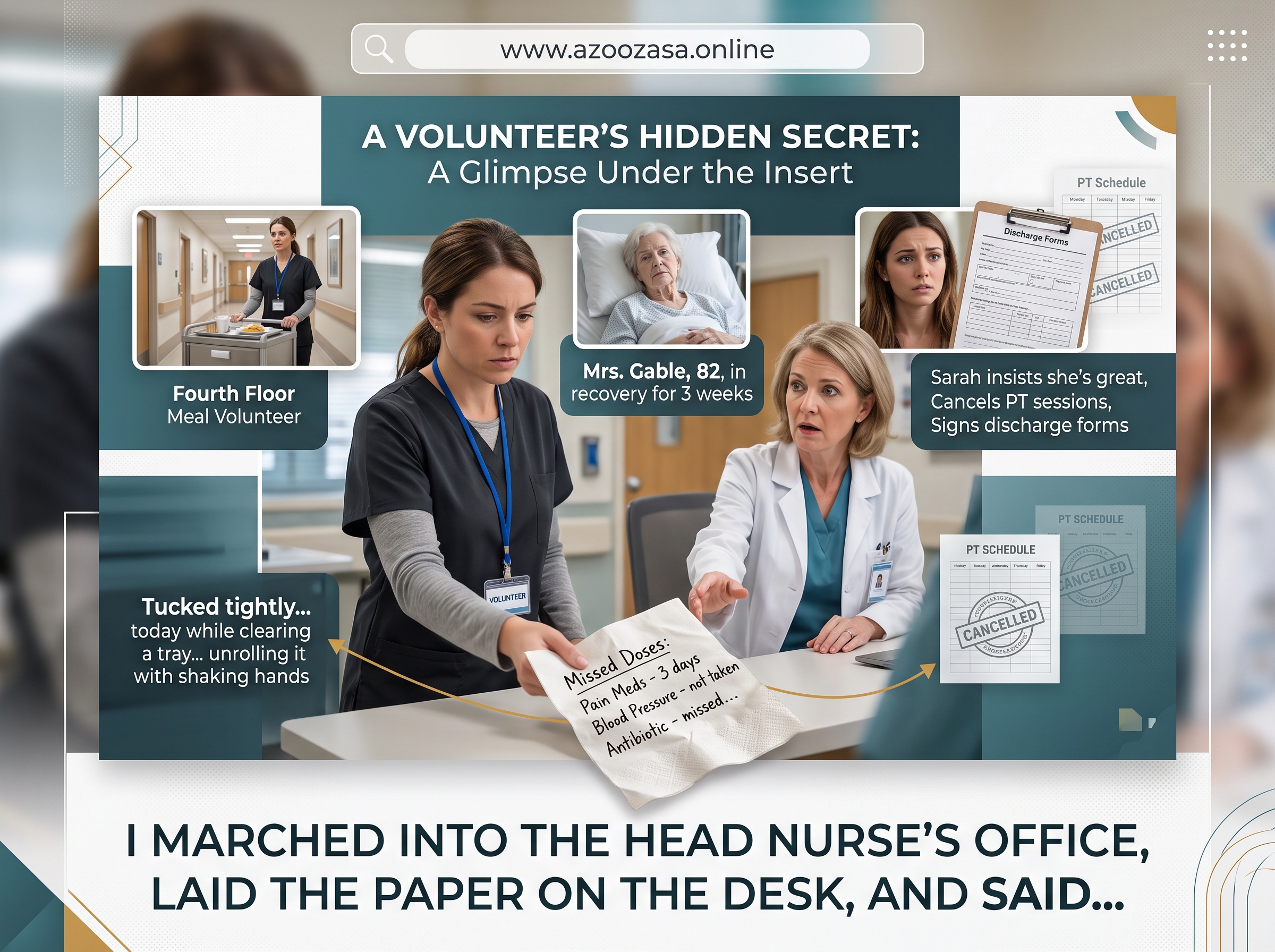
It was a standard, rough paper hospital napkin, but it had been folded over and over into a tight, dense square, wedged forcefully beneath the lip of the plastic plate insert so that it was entirely concealed from anyone casually glancing at the bedside table.
I stopped. The ambient hum of the hospital seemed to dial down to a dull roar in my ears. I glanced over my shoulder, ensuring the hallway was empty, and slid the small, compressed square of paper free. I tucked it deep into the pocket of my blue volunteer smock, grabbed the tray, and walked out of the room with a perfectly composed face.
I didn’t stop in the hallway. I didn’t stop at the cafeteria drop-off. I pushed the cart to the side of the corridor and slipped quietly into the sterile supply closet near the staff elevators, pulling the heavy door shut behind me. The room smelled intensely of bleach and packaged gauze.
My hands were shaking violently when I reached into my pocket. I unrolled the napkin.
The writing was faint, executed with the stub of a blue golf pencil that must have been smuggled from a dietary menu card. The handwriting was shaky, the loops and stems trembling with the effort of a failing nervous system, but the words were terrifyingly, unmistakably clear. It wasn’t a note to a loved one. It was a meticulous, desperate ledger.
Metoprolol – 4 days missing.
Furosemide – 3 days missing.
Eliquis – 4 days missing.
She gives me her own pills when the nurse leaves. Blue capsules. I can’t wake up. Please.
My pulse surged into my throat, hammering against my windpipe so hard I could barely swallow. Metoprolol to regulate her heart rate. Furosemide to keep the fluid out of her lungs. Eliquis to prevent massive, fatal blood clots after a major surgery. These weren’t vitamins. They were the critical, life-sustaining pillars of Eleanor’s cardiovascular survival.
Sarah wasn’t just canceling physical therapy to keep her mother compliant. She was actively intercepting the nurses’ medication cups, palming the life-saving prescriptions, and replacing them with a heavy, unprescribed sedative—the “blue capsules”—to keep Eleanor incapacitated, lethargic, and entirely unable to advocate for herself. If Sarah successfully discharged her today, taking her out of the hospital’s monitoring systems and into the isolated privacy of their home, Eleanor’s compromised heart would simply stop within forty-eight hours. It would look like a tragic, entirely natural post-operative complication. The perfect, quiet murder of a wealthy widow.
I didn’t stop to consider my rank on the hospital hierarchy. I didn’t care that volunteers were strictly instructed never to interfere with clinical diagnoses or family disputes. The raw, terrifying reality of the suspense plot unfolding on the fourth floor overrode every protocol in the manual.
I shoved the door of the supply closet open and sprinted down the linoleum corridor, my rubber-soled shoes squeaking frantically.
I bypassed the crowded central desk and marched straight into the glass-walled office of Brenda, the fourth-floor head nurse. She was a formidable, no-nonsense woman with thirty years of emergency room experience, currently buried under a stack of discharge charts.
I marched into the head nurse’s office, laid the paper on the desk, and said, “Sarah Gable isn’t taking her mother home to rest, Brenda. She is taking her home to die, and she has been actively poisoning her to make sure it happens.”
Brenda’s head snapped up, her expression morphing from administrative annoyance to immediate, clinical alarm. She looked at the crumpled, pencil-stained napkin resting on her keyboard. She read the names of the medications, her eyes widening as the clinical puzzle pieces of Eleanor Gable’s mysterious, sudden lethargy violently snapped into place.
“Where did you get this?” Brenda demanded, already reaching for the heavy red emergency phone on her desk.
“Hidden under her lunch tray,” I said, my voice trembling but resolute. “Eleanor is down in X-ray right now. Sarah is at the front desk demanding the AMA discharge papers. If she gets her mother into that private transport van, she will suffer a massive cardiac event by tomorrow morning.”
Brenda didn’t ask another question. She slammed her hand down on the receiver, bypassing the hospital operator entirely to dial hospital security and the attending physician simultaneously.
“Code Grey, fourth-floor nurses’ station,” Brenda barked into the receiver, her voice possessing a sharp, metallic authority that commanded absolute obedience. “I need security to intercept a family member, Sarah Gable, at the front desk immediately. Do not let her leave the building. Dr. Aris, I need a stat tox-screen and a full cardiovascular workup on patient 412 the second she returns from imaging. Do not return her to her room.”
The next twenty minutes played out in a blur of controlled, terrifying medical chaos.
When Eleanor was wheeled back from the imaging department, she was immediately diverted into a high-acuity trauma bay. The blood draws were rushed to the lab with priority status. Within an hour, the toxicology reports confirmed the devastating truth: Eleanor’s bloodstream was entirely devoid of her prescribed heart medications, and flooded with a dangerously high concentration of a potent, central-nervous-system depressant.
Down the hall, the scene at the nurses’ station was a vastly different kind of trauma.
Sarah Gable had been cornered by three large security guards just as she was trying to force the nursing staff to unhook her mother’s IV lines. When the attending physician and Brenda confronted her with the toxicology results and the handwritten napkin, the polished, arrogant veneer shattered completely. She didn’t weep or beg for forgiveness. She screamed, a vicious, cornered sound, demanding her lawyers and threatening to sue the hospital into oblivion, inadvertently revealing the sheer, sociopathic depth of her greed.
The local authorities arrived shortly after. They escorted Sarah out of the building in handcuffs, the designer coat hanging awkwardly over her bound wrists. A subsequent search of her oversized designer handbag revealed the missing heart medications, dumped carelessly into a side pocket, alongside a prescription bottle of heavy sedatives in Sarah’s own name.
I stayed long after my volunteer shift ended, pacing the waiting room until Brenda finally walked out of the high-acuity bay, her shoulders slumped with exhaustion but her eyes bright with a profound relief.
“We pushed the reversal agents and got her back on the IV beta-blockers,” Brenda said quietly, handing me a cup of terrible breakroom coffee. “Her heart rhythm is stabilizing. She’s awake, Margaret. She’s weak, but she is finally lucid.”
I closed my eyes, a massive, shuddering breath escaping my lungs. The fragile, beautiful machinery of a human life had been pulled back from the absolute brink of the abyss.
Eleanor Gable spent another two weeks on the fourth floor, under the fierce, uncompromising protection of the hospital staff. Without the poison in her veins, her natural resilience returned. She began eating the nutrient-dense meals I brought her, and with the help of the physical therapists she had been denied for so long, she finally took her first unassisted steps down the linoleum hallway.
I still push the squeaking meal cart every Tuesday and Thursday. The hospital remains a place of profound vulnerability, a quiet battleground where the physical frailty of age often collides with the darkest elements of human nature. But I look at the food trays differently now. I watch the hands of the elderly a little closer. Because I know that sometimes, the most critical prescriptions aren’t written by doctors on digital tablets, but scrawled in blue pencil on a crumpled paper napkin, waiting patiently for someone willing to read the truth.



0 comments