
The Price of Pressure
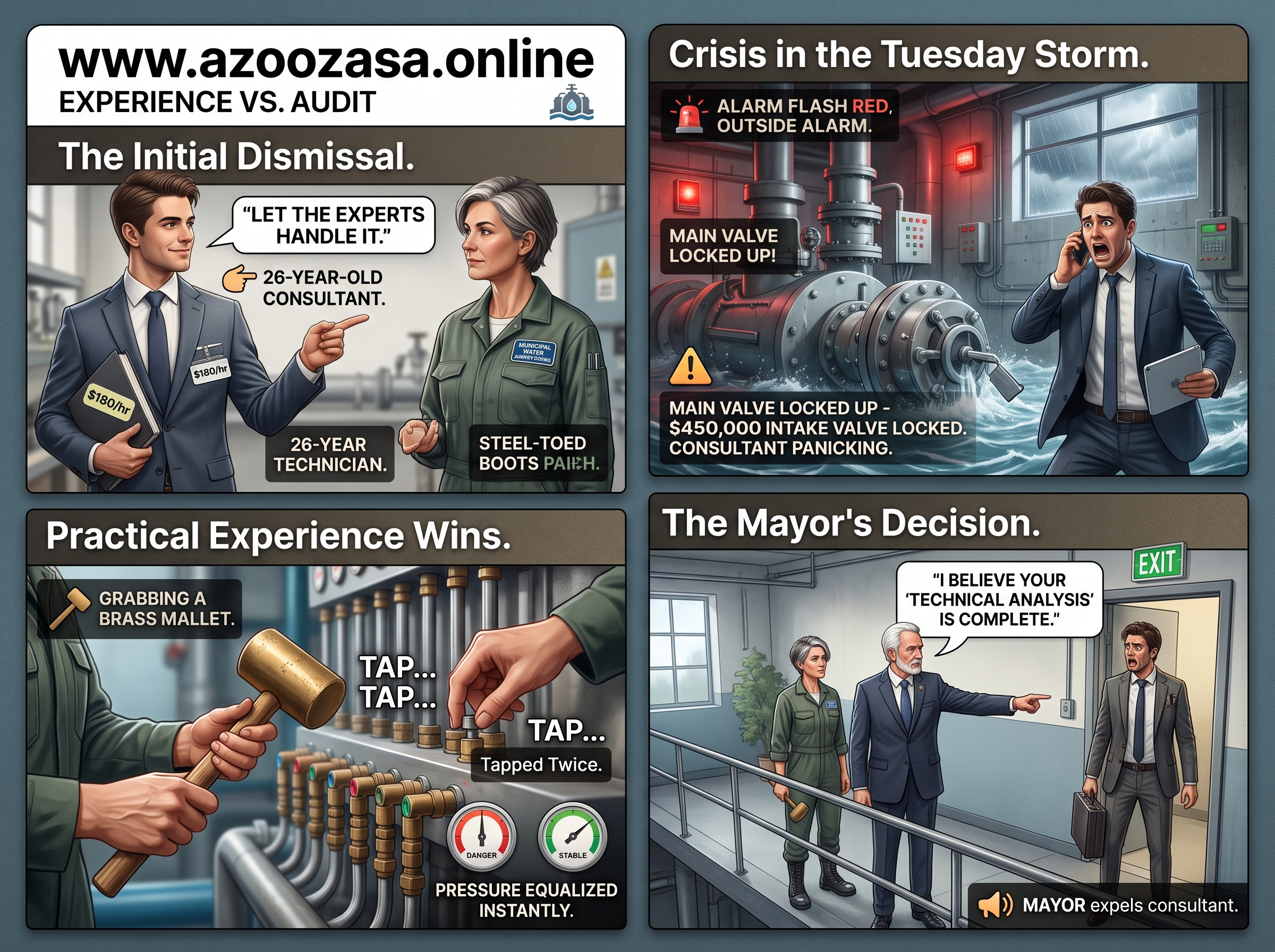
One hundred and eighty dollars an hour. That was the exorbitant figure the city council had agreed to pay the pristine, glass-tower consulting firm from the city to audit our municipal water plant. The stated goal was modernization and efficiency, a political buzzword initiative meant to trim the town’s budget before the upcoming election. They sent us a team of three, led by a twenty-six-year-old named Carter who wore a tailored slim-cut suit beneath a high-visibility safety vest that still held the rigid creases of its original plastic packaging.
Carter operated entirely through the glowing screen of his silver tablet. He did not smell the ambient chlorine. He did not feel the rhythmic, subsonic vibration of the centrifugal pumps radiating through the concrete floor. To him, the plant was merely a collection of digital readouts, efficiency algorithms, and budget line items.
On his first morning, I tried to hand him the physical maintenance logs. I wanted to show him the erratic thermal expansion patterns of the aging intake manifolds, quirks of cast iron and hydrostatic physics that never translated accurately to a spreadsheet. Carter looked down at my scuffed steel-toed boots, his lips curling into a condescending, practiced smirk.
“Let the experts handle the technical analysis, ma’am,” he said, turning his back to me without another word.
I didn’t argue. I simply returned my clipboard to the master control desk. I had worked as a plant technician in this exact facility for twenty-six years. I had been maintaining these massive, temperamental pipes since the year Carter was born. I knew the Oakhaven Municipal Water Plant the way a mother knows the breathing patterns of her sleeping child. I knew that the number three centrifuge always ran a little hot in the summer, and I knew that the digital sensors on the lower filtration floor had a thirty-second latency when the barometric pressure dropped. Carter had a master’s degree in theoretical engineering; I had a doctorate in mechanical sympathy. I decided to let him run his expensive analysis. The plant, I knew, would eventually speak for itself.
It chose to speak on Tuesday afternoon.
The storm rolled over the county with an apocalyptic fury. It wasn’t just a heavy rain; it was a violent, torrential deluge that turned the sky a bruised, unnatural purple. The river that fed our primary intake swelled rapidly, churning with heavy brown silt, broken tree branches, and the violent kinetic energy of a flash flood. The ambient noise inside the concrete facility shifted from a steady, industrial hum to a deafening, terrifying roar as the raw power of the river battered against our outer grates.
Mayor Sterling had chosen that exact afternoon to tour the facility alongside Carter, eager to hear the preliminary findings of the audit. They stood safely elevated on the steel-grated observation walkway that suspended directly over the main processing floor. The Mayor looked nervous, gripping the yellow safety rail, while Carter confidently swiped through colorful bar graphs on his tablet, raising his voice to be heard over the deafening mechanical roar of the building.
I was on the main floor, my eyes locked on the analog pressure gauges. The digital readouts were flashing green, signaling that the automated systems were compensating for the river’s surge. But the soles of my steel-toed boots felt a different story. The vibration coming through the concrete was wrong. It was too sharp, too erratic. The rhythm was stuttering.
Suddenly, the deafening shriek of a high-pressure friction bind echoed through the cavernous room.
It came from the primary intake array. The main four-hundred-and-fifty-thousand-dollar intake valve—a massive, automated steel gate designed to regulate the raw river water before it hit the delicate filtration membranes—had violently locked up. The digital sensors, overwhelmed by a sudden, massive influx of cold water and silt, had sent a contradictory command to the automated hydraulic actuator. The heavy steel gate had tried to close and open simultaneously under immense hydrostatic pressure.
It resulted in a catastrophic vapor lock. The massive valve froze dead in a partially open position.
Immediately, the plant’s master alarm system erupted. Blinding red strobe lights painted the concrete walls in a chaotic, bloody rhythm. The digital screens on the master control console flashed from green to a stark, terrified crimson.
The raw, unfiltered river was surging through the jammed valve at a thousands of gallons per minute, bypassing the diversion channels. The pressure gauges on the lower filtration floor were spiking exponentially. Within three minutes, the reinforced glass panels of the lower level would shatter under the pressure. The floodwaters would completely submerge the primary electrical turbines and the million-dollar micro-filtration arrays. It would destroy the plant, contaminate the city’s drinking water for months, and cause millions of dollars in catastrophic damage.
Up on the observation walkway, the facade of the twenty-six-year-old expert violently shattered.
Carter dropped his tablet. It clattered against the steel grating, the colorful bar graphs cracking under the impact. He stared down at the massive, shuddering intake valve, his face drained of all color. He pulled his smartphone from his pocket, his hands shaking so violently he nearly dropped it into the churning water below.
“The actuator is non-responsive!” Carter screamed, shouting over the blaring alarms into his phone, desperately trying to reach his firm’s technical support line in the city. “The digital override is locked! The primary interface is completely frozen! Tell me the reboot sequence! What is the digital reboot sequence?”
He was panicking because his entire worldview was confined to a screen. When the digital systems failed, he had no physical tether to the reality of the machinery.
I didn’t have time to look at a screen. I didn’t have time to call a hotline.
I turned away from the flashing master console and sprinted toward my heavy steel rolling toolbox. I bypassed the sophisticated digital calibration tools, the expensive electronic diagnostic scopes, and the gleaming titanium wrenches. I reached into the very bottom drawer and grabbed a heavy, scarred brass mallet.
Brass is a soft metal. It doesn’t spark when it strikes steel, and it doesn’t mar or shatter heavy cast iron. It is the blunt-force instrument of a seasoned mechanic.
I sprinted across the vibrating concrete floor, the red strobe lights flashing across my vision, the roar of the incoming river threatening to deafen me. I didn’t run toward the massive, jammed $450,000 intake valve. Hitting that under this much pressure would do absolutely nothing. Instead, I ran ten yards to the left, dropping to my knees beside the secondary bypass manifold.
The secondary manifold was an older, purely mechanical failsafe, a system of heavy pipes covered in condensation and decades of peeling gray paint. Embedded in the side of the thick iron casting was a small, two-inch relief valve pin, designed to manually vent vapor locks.
The automated system was applying thousands of pounds of pressure, keeping that pin wedged perfectly tight.
I didn’t calculate the physics on a tablet. I relied on twenty-six years of muscle memory. I raised the heavy brass mallet, calculated the precise angle of the mechanical bind, and swung it forward.
Clang.
I hit the heavy iron casing exactly one inch to the right of the pin, sending a concentrated, violent shockwave through the atomic structure of the metal.
Clang.
I struck it a second time, perfectly mirroring the first blow.
The physical shock of the brass mallet interrupted the harmonic resonance of the hydrostatic bind for a fraction of a millisecond. It was just enough time for the mechanical tension to snap.
The relief valve pin shot outward with a deafening, concussive hiss.
A massive plume of trapped, highly pressurized air and vaporized river water exploded from the manifold, instantly releasing the invisible hydraulic lock that had paralyzed the entire system.
With a deep, resonant, metallic groan that shook the dust from the ceiling rafters, the primary $450,000 intake valve suddenly slammed shut, functioning exactly as it was designed to do once the vapor lock was cleared.
The deafening roar of the surging river was instantly cut off, replaced by the beautiful, rhythmic chug of the diversion pumps taking over. The spiking pressure dials on the master console immediately dropped back into the safe green zone. The blaring red alarms ceased, leaving the massive concrete room in a stunned, echoing silence, save for the gentle hum of the electrical turbines.
I stood up slowly, my knees popping, wiping a mixture of sweat and condensed river water from my forehead. I slipped the brass mallet into the heavy canvas loop of my utility belt and looked up at the observation walkway.
Carter was still clutching his cell phone, his mouth hanging open, staring at me in absolute, uncomprehending shock. He looked from his shattered tablet on the floor to the massive intake valve, entirely unable to process how a problem that didn’t exist in his software had been solved by a piece of heavy metal.
Mayor Sterling stood beside him. The Mayor was a politician, but he was also a man who had grown up working in a steel mill before putting on a suit. He understood exactly what he had just witnessed. He understood the profound, unquantifiable difference between education and experience.
The Mayor looked down at me, offering a single, slow nod of profound respect.
Then, Mayor Sterling turned to the twenty-six-year-old consultant. He looked at Carter’s pristine, unblemished high-visibility vest, and then at the shattered, useless tablet resting on the steel grating. The Mayor didn’t yell. He didn’t lose his temper. His voice carried clearly across the quiet, echoing expanse of the water plant, dripping with absolute, authoritative finality.
The Mayor turned to the consultant, pointed firmly at the heavy steel exit door at the end of the walkway, and said, “You can bill us for your time up to this exact minute, son. But I suggest you pack up your broken toys and leave the technical analysis to the experts.”




0 comments