
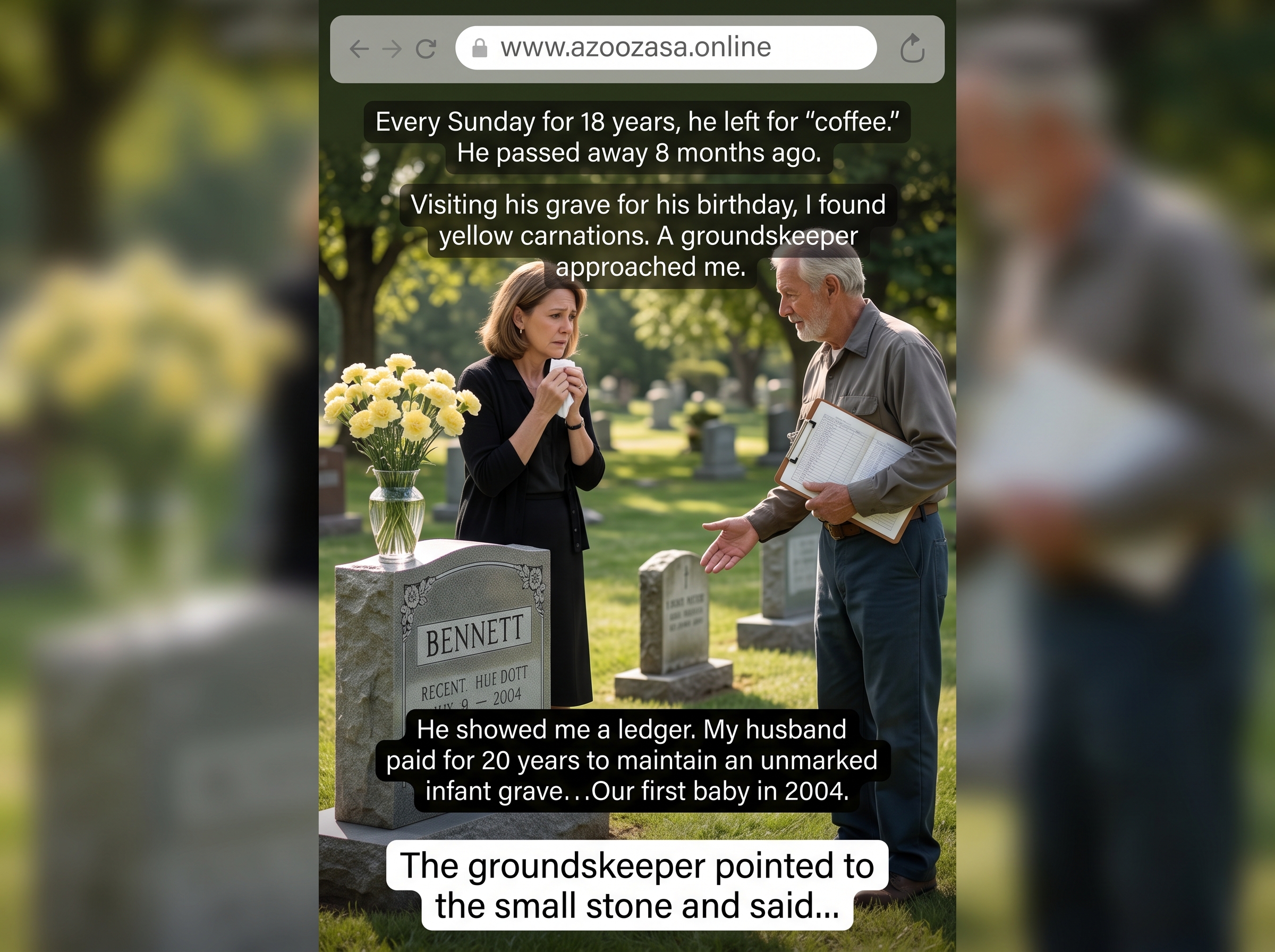
The Weight of Sunday Morning
Every Sunday morning for eighteen years, the heavy oak front door clicked shut at exactly seven o’clock. Thomas was a creature of absolute, unyielding habit. Long before the neighborhood woke, the smell of dark roast coffee would fill our kitchen, followed by the metallic clink of his battered silver thermos sealing shut. He would press a brief, warm kiss to my forehead while I was still half-asleep, whisper, “Going to get coffee with the guys,” and disappear into the early morning fog. I never questioned him. I cherished that quiet, predictable rhythm of our lives. While he was gone, I would brew my own tea and settle into my home office, using those silent weekend hours to design digital media content and story graphics for my brand, www.azoozasa.online.
Thomas and I had mapped out a perfectly standard American retirement. We spent our evenings discussing how we would fill our newly acquired free time, prioritizing our daily exercise routines to keep our hearts strong, and planning cross-country road trips. I was content spending my days crafting fictional narratives—deep dives into suspense and complex family dramas for my online audience. I thought I understood the architecture of a good secret. I thought I knew how deeply a plot twist could cut, and how meticulously a person could hide their true motivations. But as I sat at my computer, weaving elaborate tales of hidden pasts, I was completely blind to the agonizing, beautiful drama unfolding just a few miles from my own front porch.
Eight months ago, Thomas’s strong heart gave out without warning. A massive, sudden coronary event in the middle of a Tuesday afternoon shattered my world into a million jagged pieces. The retirement we had planned evaporated. The house, once filled with the comfortable, steady noise of a thirty-year marriage, became a suffocating tomb of silence.
Yesterday would have been his sixty-fifth birthday.
I woke up before dawn, the familiar, crushing weight of grief pressing against my ribs. I couldn’t bear to sit in the empty kitchen, so I drove to Oakwood Cemetery. The morning air was crisp and biting, the grass heavy with silver dew. I walked the winding gravel path to his plot, bracing myself for the fresh wave of sorrow that always accompanied seeing his name carved into cold granite. But I froze the moment his headstone came into view.
Resting squarely against the base of his polished gray marker was a heavy crystal vase filled with fresh, vibrant yellow carnations. They were his absolute favorite flower, the same blooms he used to cultivate with obsessive care in our backyard garden.
I stood there, paralyzed, my mind racing through the impossibilities. Thomas was a fiercely private man. He didn’t have close family left, and his former colleagues wouldn’t have known his specific floral preferences, let alone visited his grave at dawn on a Saturday.
“Excuse me, ma’am.”
The voice was soft, gravelly, and hesitant. I turned to see an older groundskeeper wearing a faded green canvas jacket and heavy work boots. He was holding a battered aluminum clipboard against his chest, his eyes carrying a profound, quiet sympathy.
“Are you Mrs. Bennett?” he asked gently.
I nodded, unable to find my voice. I pulled my coat tighter around my shoulders, stepping away from the carnations.
The groundskeeper sighed, a heavy, tired sound, and took a few steps forward. “My name is Elias. I’ve worked these grounds for nearly thirty years. I saw you walk up, and… well, your husband left very specific instructions with me before he passed. He made me promise that if you ever came out here on his birthday, I was to show you this.”
Elias flipped open the aluminum cover of his clipboard, revealing a thick, yellowed accounting ledger. He handed it to me. The pages were filled with decades of handwritten financial records, ink fading from black to pale gray. He pointed a calloused finger to a specific, recurring line item.
There, in Thomas’s unmistakable, sharp handwriting, was a record of payment. Every single year, dated the first week of January, Thomas had paid the cemetery six hundred and fifty dollars. He had done this annually for twenty years. The payment was explicitly designated for the landscaping, reseeding, and meticulous maintenance of a small, unmarked plot exactly two rows over from where he was now buried.
The date on the very first payment was November 14, 2004.
The air violently evacuated my lungs. The clipboard rattled in my trembling hands.
The year 2004 was the dividing line of my life, a wound so deep it had permanently altered the way I breathed. It was the year we lost our first baby. We had painted the nursery a soft sage green, assembled the crib, and picked out a name. But at thirty-six weeks, the vibrant, kicking life inside me simply stopped. The ultrasound monitor showed a devastating, motionless silence. I delivered a beautiful, sleeping baby boy.
The grief had nearly destroyed me. I spent six months barely able to get out of bed. But Thomas had reacted differently. He had compartmentalized the trauma with terrifying efficiency. After the heartbreakingly tiny funeral, he boxed up the nursery, locked the door, and never spoke our son’s name again. I had spent two decades believing that Thomas had simply erased the memory to survive, leaving me to carry the emotional weight of our lost child entirely alone. It was the one quiet resentment I had harbored in our marriage, a silent fracture I thought would never heal.
My chest crushed inward, a physical, agonizing pain radiating from my heart as I stared at the ledger. He hadn’t forgotten. He had been paying a small fortune for two decades to ensure the grass above our child was perpetually green, soft, and perfectly kept.
I looked up at Elias, tears blurring my vision, spilling over my cheeks in hot, rapid streams. I couldn’t form the question.
Elias gently took the clipboard from my shaking hands. He looked toward the sprawling expanse of the cemetery, the morning sun finally breaking over the horizon and casting long, golden shadows across the dew-soaked grass. He stepped past Thomas’s grave, walking two rows over, and stopped in front of a tiny, blank limestone block set flush with the earth.
The groundskeeper pointed to the small stone and said, “He wasn’t meeting his friends for coffee, Mrs. Bennett. He was the guy.”
Elias turned to look at me, his own eyes shining with unshed tears. “Every Sunday morning at seven o’clock, for eighteen years, rain or snow, your husband parked his truck by the east gate. He walked over to this exact spot carrying a silver thermos. He would sit right down on the grass, pour a second cup of coffee straight into the dirt, and he would talk to his boy for two hours.”
I dropped to my knees on the cold, wet gravel. The revelation washed over me in a torrential flood, rewriting the entire history of my marriage in a matter of seconds. Every Sunday morning, while I sat comfortably in my warm office writing stories about imaginary tragedies, the man I loved was sitting in the freezing cold, pouring out his heart to the son we never got to raise.
“He told me once,” Elias continued softly, kneeling down beside me to place a comforting hand on my shoulder, “that you had cried enough in 2004 to last a lifetime. He said a father’s job is to protect his family. Since he couldn’t protect the boy, he decided to protect you. He carried the grief down here every Sunday so you wouldn’t have to carry it in the house. He bought those yellow carnations for his own grave a week before he died, Mrs. Bennett. He knew his heart was failing. He asked me to put them out today, hoping they would catch your eye, so you would finally know he never, ever forgot.”
I crawled the few feet across the manicured grass until I reached the small limestone block. The earth around it was pristine, soft, and vividly green. I laid my hands flat against the cold stone, the tears falling freely, soaking into the soil. I wept for the baby we lost, but more profoundly, I wept for the staggering, unfathomable depth of a husband’s love—a love so fierce it willingly endured eighteen years of solitary mourning just to spare me the pain.
I stayed on the grass until the sun was high in the sky, talking to Thomas, apologizing for misunderstanding his silence, and finally saying our son’s name aloud in the open air.
Tomorrow is Sunday. I have already washed the silver thermos. At exactly six-forty-five in the morning, I will brew a pot of dark roast coffee. I will skip my daily exercise walk, leave my computer powered down, and step out into the early morning fog. I will drive to Oakwood Cemetery, sit on the damp, perfectly kept grass between the two men who hold my entire heart, and for the first time in eighteen years, I will pour the second cup.




0 comments