
What the Water Brought Back
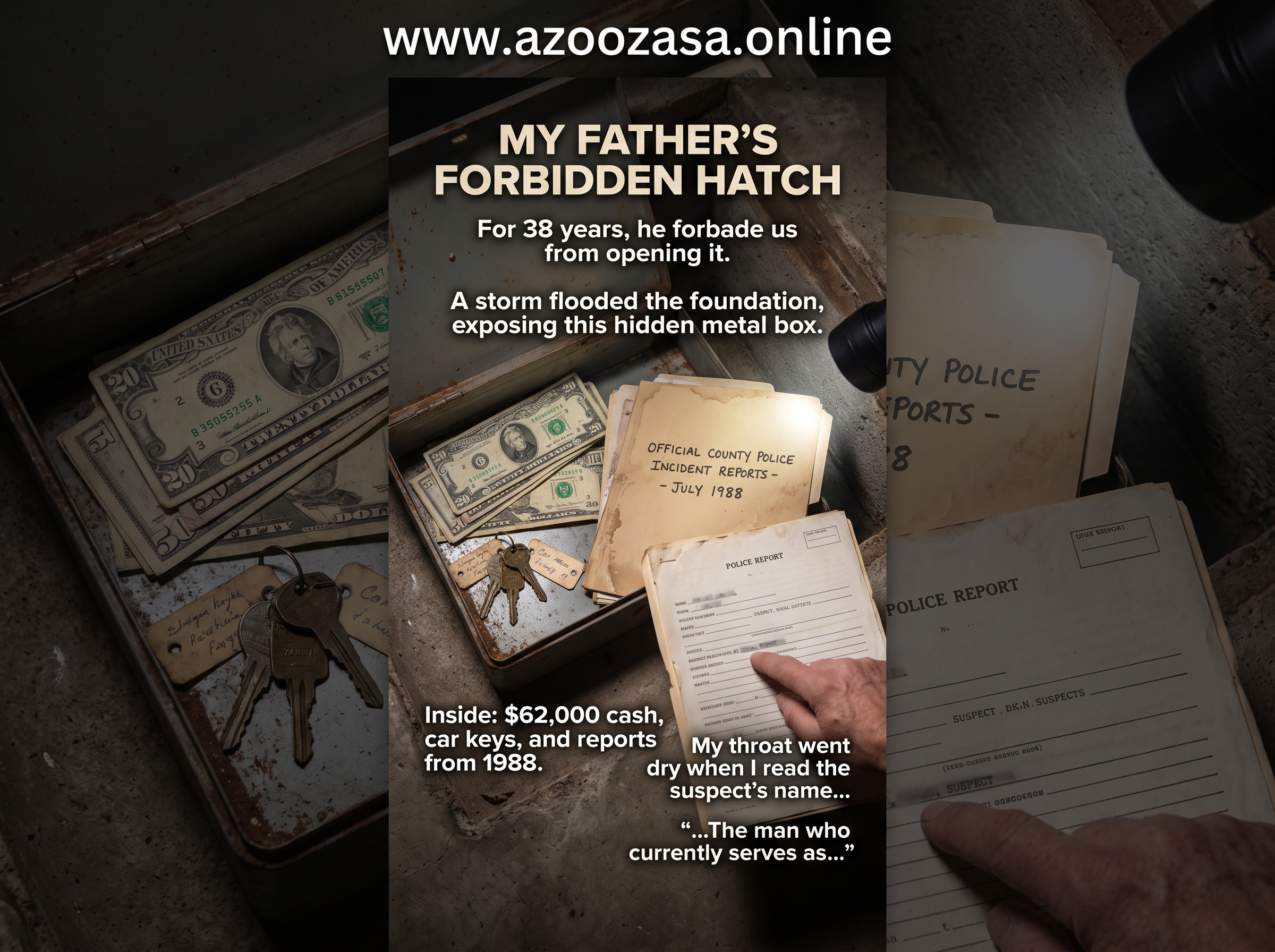
My father was a man of calloused hands, few words, and ironclad rules, but only one of those rules was absolute. For thirty-eight years, the small wooden hatch in the corner of his backyard workshop was strictly forbidden territory. As children, my brother and I were warned that even stepping on the heavy oak planks covering it would result in a grounding so severe we’d forget what the sun looked like.
“Some things are buried for a reason,” he told us, his voice dropping to a low, gravelly register just days before his heart finally gave out. He was staring out the hospital window, not at us, as if talking to a ghost only he could see. Out of respect—and perhaps a lingering childhood fear—we left the workshop exactly as it was.
But respect cannot hold back a hundred-year storm.
Last week, an unrelenting summer deluge stalled over our county, dumping ten inches of rain in a single afternoon. The creek behind the property crested its banks, turning the backyard into a rushing river of brown mud. The floodwaters breached the foundation of the old workshop, ripping through the rotting floorboards and washing away the ancient wooden hatch cover entirely.
When the waters finally receded, I went down to assess the damage. The workshop smelled of ozone, wet sawdust, and decades of decaying earth. Mud slicked the floor, but the corner where the hatch had been was scrubbed clean, revealing a gaping, dark square.
I fetched a heavy-duty flashlight from the kitchen and crept to the edge of the hole. The beam cut through the damp gloom, illuminating a concrete cavity about four feet deep. The water had drained away, leaving a perfectly preserved, miniature crypt. Resting squarely in the center on a small brick pedestal was a heavy, military-style metal lockbox. It was wrapped in thick, yellowed plastic sheeting, tightly bound with a braided nylon rope.
I lowered myself into the cavity, my boots squelching in the residual muck. The box was startlingly heavy. Grunting with the effort, I hauled it up onto the surviving floorboards. The plastic was brittle, flaking away in my hands like dead skin. The metal beneath was cold, slick with condensation, and secured by a heavy brass padlock. A quick strike with my father’s heavy ball-peen hammer shattered the rusted internal tumblers.
The latch popped.
I opened the lid, expecting to find old war medals, embarrassing family heirlooms, or perhaps the deeds to long-lost properties. Instead, a wave of stale, trapped air hit my face, carrying the distinct, metallic scent of old money and decaying paper.
Stacked neatly on the left side were thick bundles of cash. The bills were old—small-faced hundreds, fifties, and twenties—bound tightly by rubber bands that had dried and melted into cracked black lines across the paper. I counted it quickly, my hands trembling. Sixty-two thousand dollars. For a man who had worked himself to the bone fixing lawnmowers and framing houses just to keep our lights on, this was an unfathomable fortune.
Next to the money lay three distinct sets of car keys. They were vintage, heavy metal blanks lacking any modern plastic fobs, bearing the logos of Ford and General Motors. Attached to each was a small, circular brass tag with a single number punched into the metal: 1, 2, and 3.
But it was the right side of the box that commanded my attention. A thick manila folder rested there, the edges curled and darkened with age. Stamped in fading red ink across the front were the words: DO NOT COPY – BLACKWOOD COUNTY SHERIFF’S DEPARTMENT.
I pulled out the folder and opened it. Inside were official county police incident reports, all dated July 14, 1988. I was only four years old at the time. The typewritten pages detailed a horrific, unsolved triple homicide—a brutal hit-and-run that had claimed the lives of a local investigative journalist and her two young daughters on a dark stretch of Route 9.
The official narrative had always been that a drunk driver crossed the center line, forced them into the ravine, and vanished into the night. It was the great tragedy of our town. But my father’s hidden reports told a drastically different story.
I scanned the preliminary detective’s notes. Blood evidence. Paint transfer. Witness statements that had been officially redacted from the public record. And then, at the bottom of the second page, I read the primary suspect line.
My throat went completely dry when I saw the name of the man who currently serves as the Governor of our state.
Marcus Thorne.
Thirty-eight years ago, Marcus Thorne was merely the reckless, arrogant son of a powerful state senator. Today, he was a political titan, a man celebrated for his tough-on-crime platform and his flawless family-man image, heavily favored for a presidential run.
I sank back onto a milk crate, my pulse hammering against my ribs, struggling to breathe. The pieces began to lock together with sickening clarity. My father wasn’t a crooked cop or a criminal. In 1988, he ran the only heavy-duty independent tow yard in Blackwood County.
I leafed through the remaining pages. Attached to the back was a handwritten confession—not by Thorne, but by the original investigating deputy. It outlined how the Thorne family had used their immense wealth and influence to shut down the investigation before it even started. The deputy had been paid off to bury the initial report. But the physical evidence—the heavy, mangled steel of the three vehicles involved in the collision and the subsequent cover-up—needed to disappear entirely.
That was where my father came in. He was paid sixty-two thousand dollars to crush the cars and melt them down in the scrap yard’s furnace. Hush money. Blood money.
But my father, a man of quiet, uncompromising conscience, couldn’t bring himself to destroy the truth, even if he was too terrified to expose it. He knew the Thorne family would slaughter us if he went to the authorities. So, he kept the money as insurance, untouched for nearly four decades. And he kept the cars.
I picked up the three sets of heavy keys.
One, two, three.
They didn’t belong to the ignitions. They were padlock keys.
My father owned a small tract of desolate, wooded land about ten miles outside of town, a place we rarely visited. There were three old corrugated steel hunting sheds on that property, completely overgrown with blackberry brambles and poison ivy. We had always been told they were structurally unsafe, filled with asbestos and rusty farm equipment.
I left the cash in the box, grabbed the keys and the manila folder, and ran to my truck. The rain had started again, a cold, driving mist that blurred the windshield as I tore down the winding county roads. The heater blasted, but I couldn’t stop shivering.
When I reached the property, I grabbed a pair of heavy bolt cutters from my truck bed and waded into the thick brush. The thorns tore at my jacket and scratched my face, but I pushed through until the dull gray wall of the first shed materialized through the gloom. The padlock on the door was massive, encased in a weather-proof rubber boot that my father must have maintained religiously over the years.
I didn’t use the bolt cutters. I didn’t want to break the illusion of my father’s careful work. I slid key number 1 into the lock. It slid in smoothly, a testament to my father oiling the mechanisms. With a heavy clack, the hasp released.
I pulled the heavy sliding door along its rusted track. The screech of the metal echoed through the quiet woods.
Inside the dry, dust-choked shed sat a 1986 Lincoln Town Car. It was a massive, hulking machine, and its entire front end was crushed inward in a catastrophic V-shape. The windshield was shattered into a spiderweb of violent impact, and the deep, unmistakable stain of dried blood coated the driver’s side dashboard.
I stepped back, the air suddenly knocked from my lungs. I didn’t need to open the other two sheds to know what was inside them. The decoy car. The getaway vehicle. The physical proof of a massacre that had built a political dynasty.
Governor Marcus Thorne had spent thirty-eight years smiling for cameras, shaking hands, and building an empire on the foundation of a slaughtered family. He believed his sins were permanently erased, crushed in a scrap yard and buried under decades of unquestioned power. He believed my father had been bought and silenced.
He was wrong. My father hadn’t been silenced; he had been standing guard. He had taken the burden of the truth, carrying the terrible weight of it in his own heart so that we wouldn’t have to, waiting for a day when the Thorne family’s grip on the local police might slip—or perhaps, simply waiting for me to find it when he was safely out of their reach.
I pulled my cell phone from my pocket. I didn’t dial 911. You don’t call the local sheriff to arrest the Governor, especially not in a county where the Thorne name was still inscribed on the police department’s funding plaques.
Instead, I looked down at the folder. The journalist who had been killed all those years ago had worked for a major national syndicate. I typed the name of her former publication into my phone, found the contact information for their current editor-in-chief, and drafted a very short email.
I have the vehicles from July 14, 1988. I have the original police reports. I have the Governor.
I hit send, the screen illuminating my face in the darkening woods.
As I walked back to my truck, the rain began to wash the mud from my boots. I thought about the workshop, the brick pedestal, and the wooden hatch. My father was right. Some things are buried for a reason. Not to stay hidden forever, but to be kept safe in the dark, waiting patiently for the storm that would finally wash the dirt away.


0 comments