
Title: The Sins Beneath the Soil
The summer storm that tore through Oakhaven didn’t just break the heat; it broke the earth. It came in the dead of night, a howling squall of wind and torrential rain that snapped hundred-year-old pines like brittle toothpicks. From my kitchen window, I watched the chaotic ballet of lightning and bending branches, but it was the metallic shriek from the backyard that made my blood run cold.
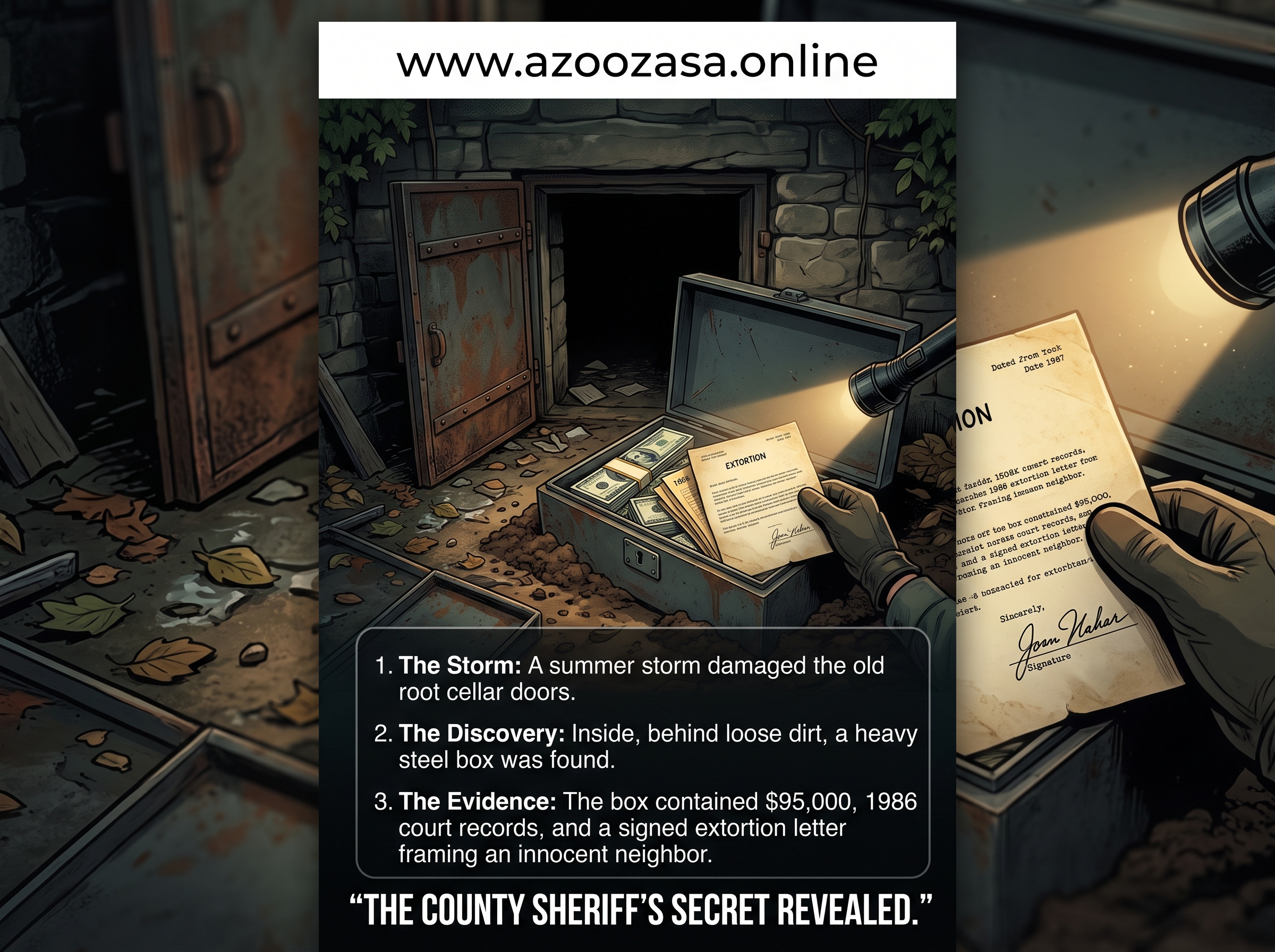
The heavy iron doors of my late father’s root cellar—padlocked and rusting for as long as I could remember—had been violently ripped from their hinges by a massive uprooted oak tree.
For thirty-eight years, Arthur Pendelton had guarded that cellar with a quiet, terrifying ferocity. “Stay out of that cellar or you’ll regret it, David,” he used to warn me. It wasn’t a casual caution to keep a child away from rusty tools, exposed nails, or black widow spiders. It was a command delivered with a dark, hollow look in his eyes, the kind of look that promised severe consequences. When he passed away six months ago, I inherited the sprawling, isolated property, but I hadn’t dared touch the cellar. Some deeply ingrained childhood fear had kept me away.
But now, nature had forced the issue.
When morning broke, the tempest had reduced to a steady, dismal drizzle. I pulled on my rubber boots, grabbed a heavy-duty flashlight, and trudged through the muck to the gaping maw in the earth. The iron doors lay twenty feet away, twisted and defeated, looking like the discarded armor of some fallen giant.
I carefully descended the slick stone steps. The air inside was thick, smelling of wet earth, decaying roots, and something sharply metallic. The rainwater had flooded the earthen floor, pooling around ancient, rotting wooden shelves. But it had also done something else: it had washed away a large section of the loose dirt wall at the very back of the cellar, revealing a cavity that had been meticulously concealed.
I shined my flashlight into the dark gap. The beam caught the dull, unnatural gleam of metal.
My heart hammered against my ribs as I dug my hands into the cold, wet mud, pulling away rocks and fibrous roots until the object came free. It was a heavy steel lockbox, roughly the size of a briefcase, covered in decades of grime. The padlock on it was rusted through. With a swift, desperate strike from a loose brick I found on the floor, the hasp snapped, and the heavy lid groaned open.
I fell back onto the damp cellar floor, my breath catching in my throat.
Neatly stacked in waterproof canvas bags were bundles of hundred-dollar bills. I didn’t count it right then, but the faded leather ledger tucked beside the stacks boldly stated the sum: $95,000. In 1986, that was a fortune. To a struggling mechanic like my father had been back then, it was unthinkable, life-altering wealth.
But the money wasn’t what made the cold sweat break out across my forehead. Beneath the canvas bags lay a thick manila folder, warped but perfectly intact. I opened it with trembling fingers. Inside were 1986 court records, blurred police reports, and a single, neatly folded extortion letter.
The name printed on the court records hit me like a physical blow: Elias Thorne.
Elias had been our closest neighbor when I was a boy. He was a quiet, gentle widower who spent his weekends whittling wooden toys for the neighborhood kids and tending to a massive apple orchard. I remembered the exact day the cruisers had swarmed his property. The sirens had wailed like banshees across the open fields. In the winter of 1986, Elias was arrested for the armed robbery of the Oakhaven County Bank. The town was shocked, but the evidence was apparently insurmountable. The stolen money was never found, but Elias was sent to the state penitentiary, where he died of a heart attack in his cell three years later.
I pulled the signed letter from the bottom of the box and aimed my flashlight at the faded ink. It was written on official Oakhaven County Sheriff’s Department letterhead.
Arthur,
You know exactly what happens if you open your mouth. The weapon is in Thorne’s shed, right where I told you to plant it. I’ve ensured his alibi won’t hold up in front of the judge. The $95,000 is your cut of the bank’s insured cash. Keep it buried, keep your head down, and keep your family safe. If you get a sudden bout of conscience, remember that I am the law in this county, and I can just as easily find evidence tying you to the murder of that teller.
We take this to our graves.
Sheriff Vance Holloway
My stomach violently convulsed, and I had to lean over, coughing in the damp air. The man who wrote that letter—the county sheriff who had orchestrated a deadly robbery, framed an innocent neighbor, and blackmailed my father into being his accomplice—was not just some forgotten ghost. Vance Holloway had served as the beloved sheriff for thirty years before passing the badge to his son, Dale Holloway, who was the current sheriff of Oakhaven.
My father hadn’t been protecting me from rusty tools. He had been protecting me from the horrifying truth. I thought back to his sleepless nights, the way he would sit on the back porch with a shotgun across his lap, staring out into the dark fields. I had always thought it was early-onset dementia or just eccentric paranoia. Now, I knew. He had traded an innocent man’s life for our family’s safety, burdened with a box of stolen cash he was too terrified to ever spend. The guilt must have eaten him alive, hollowing him out from the inside until he was nothing more than a paranoid shell guarding a tomb. “Stay out of that cellar or you’ll regret it.”
He was right. God, he was right. I regretted it instantly. The image of Elias Thorne, handing me a polished red apple with a warm smile, clashed sickeningly with the reality that my own father had buried Elias’s freedom in this damp hole.
Suddenly, the sound of heavy tires crunching on the wet gravel of my driveway pulled me from the nightmare.
I scrambled up the cellar steps just far enough to peer over the rim of the foundation. A white SUV with the Oakhaven County Sheriff’s star emblazoned on the door was idling near my front porch. The driver’s door opened, and Sheriff Dale Holloway stepped out. He was a massive man, built like a linebacker, possessing the exact same cold, calculating eyes as his father.
Panic, raw and suffocating, seized my chest. Why was he here? Had he seen the mangled iron doors from the county highway?
I bolted back down the stairs, frantically shoving the manila folder and the bundles of cash back into the steel box. I slammed the lid shut, hauled it over to the washout, and kicked it deep into the muddy cavity in the wall. I grabbed a rusted metal wash tub and shoved it in front of the hole, desperately kicking loose dirt over the edges to disguise the disturbed earth.
“David? You down there?”
The deep, booming voice echoed down the stone steps. Heavy footsteps were approaching the cellar entrance.
I stood up, wiping mud on my jeans, trying to slow my ragged breathing. “Yeah! Just checking the storm damage!” I called back, praying the tremor in my voice wasn’t obvious.
Sheriff Holloway’s large frame blocked out the gray morning light at the top of the stairs. He peered down into the gloom, a heavy Maglite in his hand clicking on. The piercing beam swept across the flooded floor, pausing for a terrifying second on the displaced dirt and the rusted tub, before settling directly on my face.
“Hell of a storm, huh?” Holloway said, slowly descending a few steps. His hand rested casually on his thick utility belt, fingers brushing the grip of his sidearm. “Saw the old iron doors blown clear across your yard from the main road. Figured I’d stop in, make sure Arthur’s boy didn’t get washed away in the flood.”
“I’m fine, Dale. Just a lot of mess to clean up,” I said, forcing a tight, appreciative smile. “Foundation held up, though.”
Holloway stopped halfway down. He looked at the dirt walls, taking a deep breath of the musty air. “Your old man loved this cellar. Always kept it locked up tight as a drum. Used to tell my dad that it was the only place on the property that felt secure.” Holloway’s eyes locked onto mine. The implication hung heavily in the damp air. Did he know? Did Vance Holloway pass down his dark secrets to his son, just as my father had tried to bury his?
“He was a paranoid guy in his old age,” I replied, keeping my voice remarkably level, despite the adrenaline screaming through my veins. “Turns out it’s just full of mud, spiders, and rats.”
Holloway stared at me for a long, agonizing moment. The silence stretched, filled only by the rhythmic dripping of rainwater from the exposed ceiling beams. Finally, the corners of his mouth twitched upward into a humorless, tight smile.
“Well. Glad to hear everything’s secure. You need any help hauling those iron doors back up, you call the station. We look out for our own in Oakhaven.”
“Appreciate it, Sheriff.”
I watched him turn and climb back up the stairs. I didn’t take a single breath until I heard his heavy boots hit the gravel, followed by the heavy slam of his car door and the crunch of tires fading down the rural highway.
My legs finally gave out, and I sank onto the bottom step of the stairs, burying my face in my muddy hands.
The current sheriff of Oakhaven was sitting on a throne built by his father’s corruption and violence. I was sitting on ninety-five thousand dollars of blood money. If I went to the local deputies, the evidence would undoubtedly disappear, and I would likely meet a tragic, accidental end on a lonely county road. If I burned the box, I would be just as complicit as my father—another generation burying Elias Thorne to save its own skin.
I stood up, the trembling in my hands replaced by a sudden, icy resolve.
I shoved the metal tub aside and dragged the heavy steel box out of the mud. I didn’t bother trying to clean it. I carried it up the stone steps, into the gray light of the stormy morning, and marched straight to my pickup truck. I placed the box on the passenger seat and threw a heavy wool blanket over it.
My father had spent his entire life paralyzed by fear, held hostage by the sins beneath the soil. He warned me I would regret opening that door. But as I turned the ignition, feeling the engine roar to life, I felt absolutely no regret. I felt only purpose.
I wasn’t driving to the local precinct. I was driving three hours north, straight to the FBI field office in the state capital.
The storm was finally breaking, a thin sliver of morning sun piercing through the bruised clouds, casting a golden glow over the soaked fields. I shifted the truck into drive and pulled out of the driveway, leaving the ruined iron doors behind in the mud. For thirty-eight years, the truth had been trapped in the dark.
It was time to bring it into the light.



0 comments