
📋 Table of Contents
The Calendar of Omissions
The hum of the fluorescent lights in the transitional care wing was a sound I had learned to tune out over my five years as a rehabilitation aide. In the complex, heavily regulated landscape of senior care in the United States, my job was often the only consistent human connection these patients had. I spent my days guiding frail limbs through physical therapy, adjusting pillows, and listening to the stories of lives temporarily paused by failing bodies.
Room 412 was occupied by Eleanor Vance, a 76-year-old retired schoolteacher who had spent the last eight months fighting a grueling battle to reclaim her mobility after a severe ischemic stroke. Eleanor was sharp, observant, and kind, though the stroke had stolen her ability to speak in anything more than a whisper. We communicated in small gestures, squeezed hands, and knowing looks.
Until last Thursday, when the air in her room suddenly turned ice-cold.
The Premature Departure
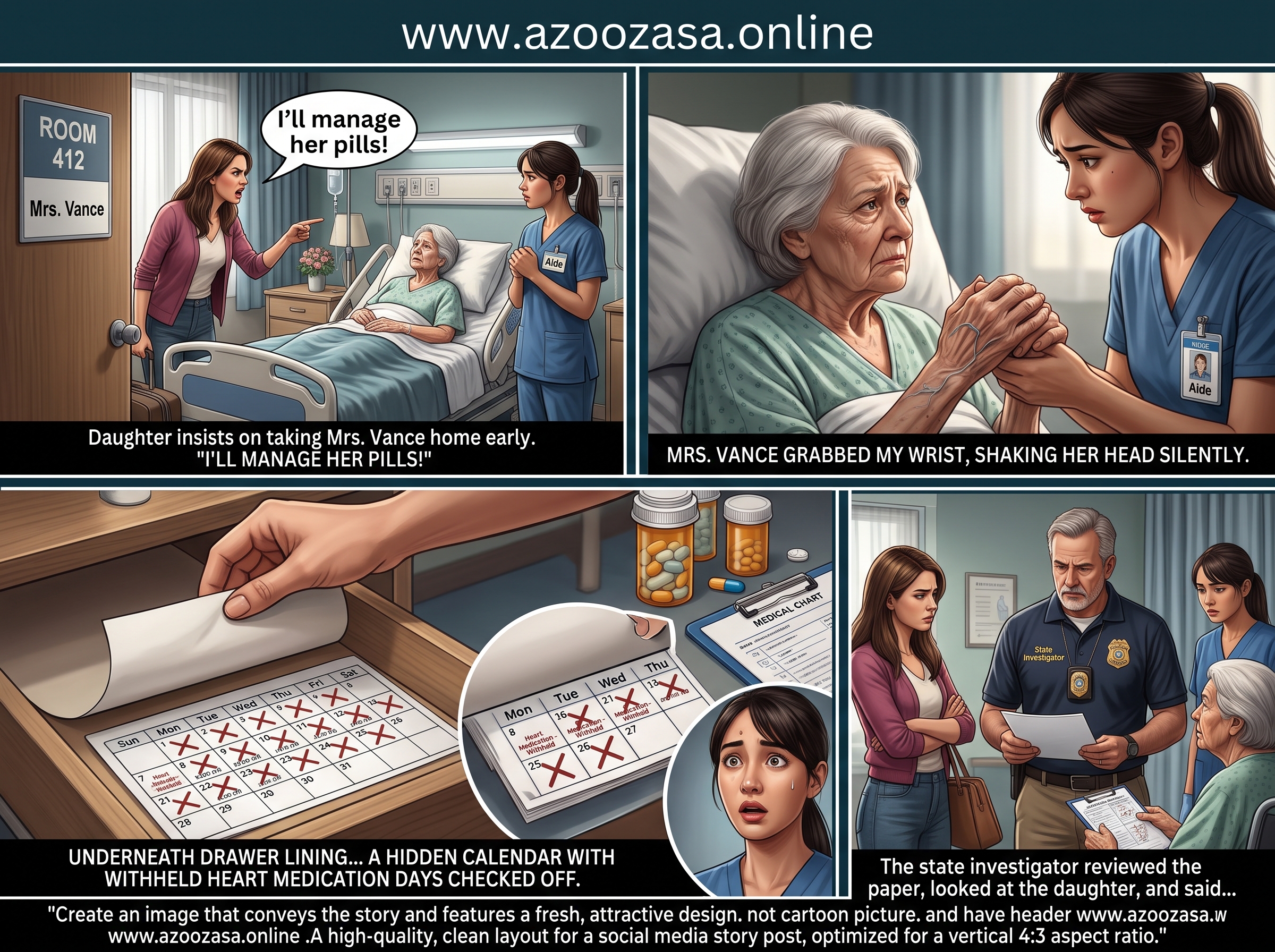
Eleanor’s daughter, Elise, marched through the heavy wooden door of Room 412 at two in the afternoon, dragging a scuffed polycarbonate suitcase behind her. Elise was a sharply dressed woman in her late forties, carrying an aura of impatient entitlement that made the nursing staff instantly edge away.
She didn’t bother to ask how her mother’s physical therapy session had gone that morning. She simply slapped a stack of signed discharge papers onto the rolling overbed table.
“Pack her things,” Elise barked at me, not even making eye contact as she began pulling clothes from the small closet. “We’re leaving. I’ve already signed the AMA forms at the front desk.”
“Ma’am, Mrs. Vance is scheduled for another three weeks of intensive cardiac monitoring and physical rehabilitation,” I said, keeping my voice calm and professional. “Her resting heart rate has been unstable. Discharging her against medical advice—”
“She doesn’t need this six-thousand-two-hundred-dollar monthly care,” Elise snapped, whirling around to face me, her eyes flashing with venom. “It’s a complete drain on the estate. The insurance company is fighting the extended stay, and I am not paying out of pocket for glorified babysitting. I’ll manage her pills at home. Have her dressed in ten minutes.”
I looked past the furious daughter to the hospital bed. Eleanor was sitting completely rigid against her pillows. Her face had drained of color, leaving her skin a translucent, sickly gray.
As I stepped closer to the bed to check her vitals, Eleanor reached out with her good arm. Her frail, trembling hand clamped down on my wrist with a surprising, desperate strength. She didn’t look at her daughter. She stared directly into my eyes, and she shook her head in a microscopic, frantic motion.
No.
Her eyes were wide pools of absolute terror. My chest tightened. In this line of work, you learn to differentiate between a patient who is simply anxious about leaving a safe environment and a patient who is actively afraid for their life. Eleanor was terrified.
“I’ll just get her overnight bag packed, ma’am,” I told Elise, gently placing my hand over Eleanor’s trembling fingers, offering a silent promise that I wasn’t going anywhere.
The Hidden Ledger
I moved to the small, faux-wood nightstand beside the bed. Elise stood by the window, aggressively tapping on her smartphone, completely ignoring her mother’s distress.
I opened the top drawer to gather Eleanor’s personal items: a pair of reading glasses, a tube of hand cream, a worn crossword puzzle book. As I lifted the puzzle book, my fingernail caught the edge of the floral contact paper lining the bottom of the drawer. The paper shifted slightly, revealing a flash of stark white underneath.
My pulse quickened. Keeping my back angled to block Elise’s view, I carefully lifted the corner of the liner.
Hidden flat against the bottom of the drawer was a folded piece of heavy cardstock. I slid it out and unfolded it silently. It was a printed calendar for the previous three months.
At first glance, it looked mundane. But as my eyes scanned the grid, the horrifying pattern snapped into focus. Specific dates were circled in thick red ink. Beside each red circle were small, neat tally marks. I quickly cross-referenced the dates in my head. They aligned perfectly with the weekends Elise had insisted on taking her mother home for “family day passes,” a right she had aggressively fought the facility administrators to secure.
But it was the handwritten notes in the margins that made the blood freeze in my veins.
June 12: 0 doses. BP rising.
June 26: 0 doses. Mild chest pain reported.
July 10: 0 doses. Breathless.
Eleanor was prescribed a highly specific, tightly scheduled regimen of Beta-blockers and blood thinners to prevent a secondary, fatal stroke. Elise wasn’t just managing her mother’s care; she was systematically documenting the physical decline caused by intentionally withholding life-saving cardiac medication.
The six-thousand-dollar monthly care bill was eating into an inheritance Elise was desperately trying to accelerate. She was using the weekend passes to stress her mother’s weakened heart, creating a paper trail of declining health so that when Eleanor finally succumbed to a fatal cardiac event at home, it would look perfectly natural.
Eleanor hadn’t hidden the calendar. Elise had. She was keeping it tucked away in the very room she was trying to empty, a twisted ledger of her mother’s impending demise.
I folded the paper, slipped it seamlessly into the deep pocket of my scrubs, and closed the drawer.
“I need to grab Mrs. Vance’s prescription transfer forms from the charge nurse,” I said, my voice eerily steady despite the adrenaline roaring in my ears. “I’ll be right back.”
“Make it quick,” Elise muttered, not looking up from her screen.
The Intervention
I didn’t go to the charge nurse. I sprinted down the hallway to the secure administrative office, locked the door behind me, and called the facility supervisor. Within two minutes, we had Adult Protective Services on the line.
In cases of active, documented elder endangerment, the state response is swift and absolute. I stalled Elise for forty-five agonizing minutes, blaming the delay on pharmacy computer errors and missing doctor’s signatures. Elise paced the room, her anger boiling over into verbal abuse, while Eleanor sat frozen in her bed, her eyes fixed on the door.
When the heavy wooden door finally swung open again, it wasn’t a pharmacist holding transfer papers.
It was Agent Harris, a seasoned state investigator with Adult Protective Services, flanked by two uniformed county sheriff’s deputies.
Elise stopped pacing. The aggressive entitlement melted off her face in a single second, replaced by sudden, trapped panic.
“What is the meaning of this?” Elise demanded, though her voice shook. “I have medical power of attorney. My mother is coming home with me.”
Agent Harris didn’t acknowledge her right away. He walked to the center of the room, his imposing presence immediately changing the atmospheric pressure of the ward. He looked at Eleanor, offering her a gentle, reassuring nod, before turning his cold, uncompromising gaze onto her daughter.
I handed Agent Harris the folded piece of cardstock.
He opened it, his eyes scanning the red circles and the chilling margin notes. The room was dead silent, save for the rhythmic, steady hiss of the oxygen concentrator in the corner.
The state investigator reviewed the paper, looked at the daughter, and said, “You know, Elise, medical fraud is common. Financial exploitation is a tragedy we see every day. But keeping a meticulously handwritten ledger of premeditated murder? That is a special kind of arrogance.”
“That… that isn’t mine,” Elise stammered, taking a clumsy step backward toward the window. “She has dementia! She wrote that!”
“Your mother suffered a left-hemisphere stroke, rendering her right hand completely paralyzed,” Agent Harris countered, his voice a low, dangerous rumble. He held up the calendar. “This is written in perfect, steady cursive. Furthermore, withholding prescription cardiac medication from a vulnerable adult resulting in physical deterioration constitutes attempted homicide in this state.”
Elise opened her mouth, but the lies dried up in her throat. She looked at the two deputies, then at the calendar, realizing simultaneously that the trap had completely closed around her.
“Power of attorney is a shield meant to protect the vulnerable,” Harris continued, stepping forward and gesturing to the deputies. “It is not a license to execute them for a quicker payout. Place her under arrest.”
The Aftermath
The metallic click of the handcuffs echoing through Room 412 was a sound I will carry with me for the rest of my career.
As the deputies escorted Elise out of the room—her designer suitcase abandoned in the center of the linoleum floor—the suffocating tension that had gripped the space evaporated.
I walked over to the hospital bed and sat gently on the edge. Eleanor was crying, silent tears tracking through the deep lines of her face. But for the first time that day, she wasn’t trembling with fear. She reached out with her good hand and grabbed my wrist again. This time, the grip was loose, warm, and profoundly grateful.
“She’s gone, Eleanor,” I whispered, resting my other hand over hers. “She is never going to hurt you again. You are safe.”
The systemic pressures of senior care, the astronomical bills, and the complicated family dynamics can drive people to dark, desperate places. But as I sat there in the quiet hum of the transitional care wing, watching a 76-year-old survivor finally breathe a sigh of relief, I was reminded of the absolute necessity of vigilance. The real value of our work isn’t just in rehabilitating bodies; it is in standing as the final, unyielding line of defense between the vulnerable and the dark.




0 comments