
📋 Table of Contents
The Toll on Maple Street
Twenty-four years is a remarkably long time to build a life with someone. But as I discovered on a quiet Saturday morning, it is an even longer time to build a lie.
My husband, Robert, was a man composed entirely of predictable, comforting habits. Every Monday through Friday, he managed a mid-sized logistics firm with unyielding precision. Every Sunday, he mowed the lawn in immaculate, straight lines and watched football. And every single Saturday, for the past four years, he woke up at 5:00 AM, climbed into his silver Chevy Silverado, and drove 214 miles to Oak Ridge.
“Antique restoration,” he called it. He claimed he had partnered with an old college buddy, fixing up mid-century modern furniture in a sprawling warehouse on the edge of the county line. It brought in a little extra cash, he said, but mostly it was his “escape,” a way to work with his hands and decompress. I believed him. Why wouldn’t I? He occasionally brought home a beautifully restored side table, always smelled faintly of wood varnish when he returned at 8:00 PM, and always kissed me on the forehead before taking his boots off.
Then, I found the toll statement.
The Paper Trail
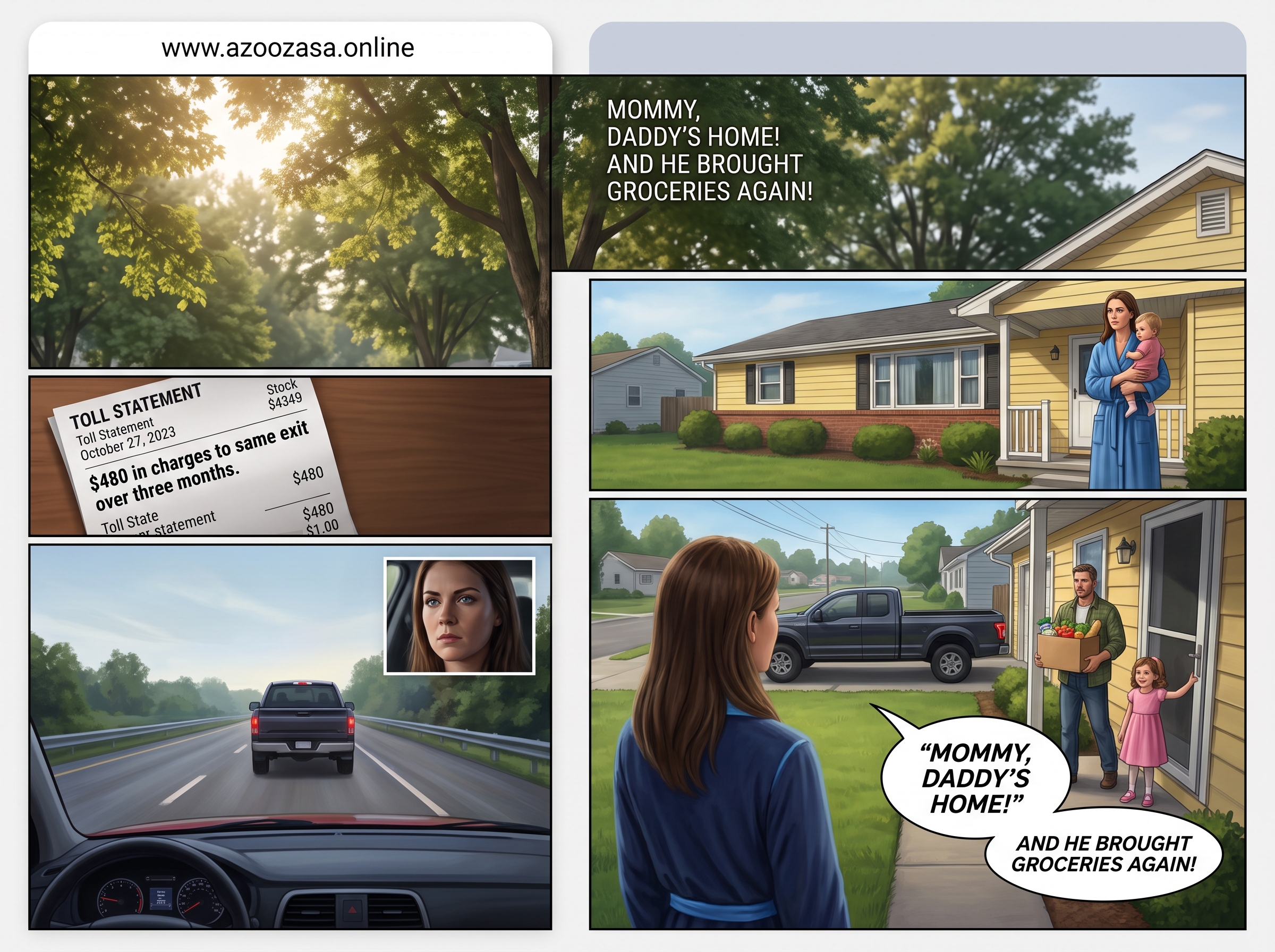
It was entirely an accident. I was looking for the vehicle registration in his glove box to renew our auto insurance. Tucked deep beneath the thick leather owner’s manual was a physical bill from the state turnpike authority.
It detailed three months of automated charges. Four hundred and eighty dollars in total.
I sat in the passenger seat of his truck, the small dome light casting a pale glow over the paper, and did the math. The sheer volume of the charges meant he was making the drive every single week without fail. But that wasn’t what made the blood freeze in my veins. It was the location data. Every single line item logged his truck exiting at Mile Marker 112—a purely residential exit in the Oak Ridge suburbs, miles away from the industrial park where his supposed restoration warehouse was located.
I didn’t confront him that night. After twenty-four years of marriage, you learn the fundamental difference between a skirmish and a war. You do not go to war without reconnaissance.
Last Saturday, when his alarm buzzed in the pre-dawn darkness, I kept my eyes closed, regulating my breathing to mimic a deep, unbroken sleep. I listened to the familiar, domestic sounds of betrayal: the shower running, the clinking of his coffee mug in the kitchen, the heavy thud of the front door closing. As soon as his headlights swept across the bedroom blinds, I threw off the covers.
I followed him in my daughter’s dark blue sedan—a car he rarely drove and wouldn’t immediately recognize in his rearview mirror.
For two hundred and fourteen miles, the highway unspooled ahead of us like a dark, gray ribbon. The sun slowly rose, bleeding pale orange light over the horizon, illuminating the back of the truck I had trusted for so long. My stomach was a tight, agonizing knot. Part of me prayed that I was wrong. I prayed he would pull into a warehouse. I prayed there would be a rusty sign that said Oak Ridge Antiques.
But when we passed the commercial district and his blinker flashed for the exit at Mile Marker 112, the last shred of my hope evaporated into the morning mist.
The Yellow House
He drove into a quiet, working-class neighborhood where ancient oak trees formed a thick canopy over the street. He didn’t hesitate at the intersections. He didn’t check his GPS. He drove with the fluid, practiced ease of a man returning home.
He pulled into the driveway of a modest, well-kept yellow ranch house on Maple Street. I drove past, my heart hammering violently against my ribs, and parked half a block down under the shade of a weeping willow, killing the engine.
Through the windshield, I watched the nightmare unfold.
The front door of the yellow house opened. A young woman stepped out onto the porch. She was in her late twenties, wearing a fluffy blue bathrobe, her dark hair pulled up into a messy bun. Resting casually on her hip was a toddler, perhaps eighteen months old, chewing happily on a plastic teething ring. She smiled—a warm, radiant, completely exhausted smile—and waved as Robert stepped out of his truck.
The world tilted on its axis. My breath caught in my throat, literally choking me. The woman wasn’t old enough to be his peer. She was young. Far too young.
Robert walked around to the tailgate of his truck and hoisted out two heavy brown paper grocery bags. He didn’t look like a man sneaking around. He looked completely at peace, operating in the broad daylight of a suburban morning. He walked up the concrete path, leaned forward, and kissed the young woman warmly on the cheek, gently ruffling the toddler’s hair.
I couldn’t breathe, but I could move.
I opened my car door. My legs felt like lead, heavy and completely uncoordinated, but I forced myself to walk down the cracked sidewalk. I had to know. I had to shatter the illusion entirely, stepping out of the shadows and forcing the truth into the blistering light of day.
The Screen Door
I reached the edge of the driveway just as Robert was stepping onto the wooden porch. He had his back to me, maneuvering the heavy grocery bags on his knee to open the glass storm door. The young woman had already stepped back inside, leaving the door cracked open.
I stopped at the base of the porch stairs. My shadow stretched across the concrete, dark and looming.
Before I could speak, before I could scream his name and tear his carefully constructed double life to shreds, the inner wooden door swung wide open. A little girl, perhaps six years old, wearing pink dinosaur pajamas, bounded onto the threshold.
She pushed the screen door open, looked up at Robert, and said, “Grandpa! Mommy is crying again. She said the hospital called and they need the money for my surgery today.”
The grocery bags slipped from Robert’s hands.
They hit the porch with a wet, heavy thud. A glass jar of pasta sauce shattered over the concrete, bleeding crimson across the woven welcome mat. Oranges rolled aimlessly across the wooden deck.
He didn’t look at the mess. He slowly, mechanically, turned around.
When his eyes met mine, all the blood instantly drained from his face. He looked at me, then at the little girl, then back at me. The distinguished, reliable husband I had known for twenty-four years crumbled right before my eyes, leaving behind a terrified, hollow shell of a man.
“Grandpa,” I repeated, the word tasting like battery acid on my tongue.
I looked down at the little girl. She had Robert’s exact eyes—the same deep, hazel hue that our own children shared. Then I looked past her, into the hallway of the yellow house. On the wall, framed in cheap plastic, was a collage of photographs. Graduation pictures. Birthday parties. A timeline of a life I had never been permitted to see. The woman in the blue robe wasn’t his mistress; she was his daughter. A daughter who appeared to be exactly twenty-three years old.
He had conceived her during the first year of our marriage.
“Helen, please,” Robert rasped, his hands trembling so violently he had to grip the porch railing to stay upright. “Let me explain. It’s… she’s sick. My granddaughter is sick. I had to help them.”
“You’ve been helping them for twenty-three years, Robert,” I said, my voice eerily calm. The rage was absolutely there, a burning inferno in my chest, but it was currently buried beneath a glacier of cold, absolute clarity. “You built an entire lineage on a foundation of lies. While I was taking extra shifts to pay our mortgage, you were funding a parallel family two hundred miles away.”
The young woman in the blue robe came back to the door, her eyes red and puffy from crying. She froze the moment she saw me standing there. She knew exactly who I was. The guilt and absolute terror in her expression confirmed it.
“I’m sorry,” she whispered, pulling her daughter protectively behind her legs.
I didn’t yell. I didn’t cause a scene in front of the children. I looked at the shattered glass and the ruined groceries bleeding out on the porch. It was the perfect, tragic metaphor for the man standing before me—a mess entirely of his own making, unable to be put back together.
“You don’t need to apologize,” I said to the young woman, my tone softening just a fraction. Then, I turned my eyes back to my husband, letting the ice in my voice return. “I hope the antique business is lucrative, Robert. Because my lawyer is going to take absolutely everything else.”
I turned on my heel and walked back down the driveway. The 214-mile drive back home would be agonizingly long, but for the first time in twenty-four years, I would be driving on a road built on the truth.
What specific aspect of the legal fallout or Robert’s history with the other family would you like to explore in the next chapter of this family drama?




0 comments