
📋 Table of Contents
The Synthetic Stitch: Unraveling a $16,000 Fraud
The grand ballroom of the Metropolitan Historical Society was a swirling sea of champagne flutes, tuxedoed billionaires, and the heavy, intoxicating scent of old money. I stood near the back of the room by a towering marble pillar, a glass of sparkling water in my hand, feeling entirely out of place in my tailored but decidedly off-the-rack suit. For thirty-two years, I had worked in the basement of the adjacent museum as a senior textile conservator. My life was defined by white cotton gloves, magnifying loupes, and the painstaking preservation of history, one thread at a time.
My former boss, Vivian, lived for nights exactly like this one.
Vivian had been the museum’s regional director of acquisitions for three years—a woman who viewed historical artifacts not as pieces of human heritage, but as high-status trophies. She was the one who had unceremoniously pushed me into early retirement six months ago. She had claimed my department was a “financial black hole,” arguing that the museum needed modern, aggressive acquisition strategies, not a team of people taking six months to stabilize a decaying tapestry.
I took a slow sip of my water as the crowd in the center of the room parted. Vivian was holding court, and she was making sure everyone knew it.
The $16,000 Masterpiece
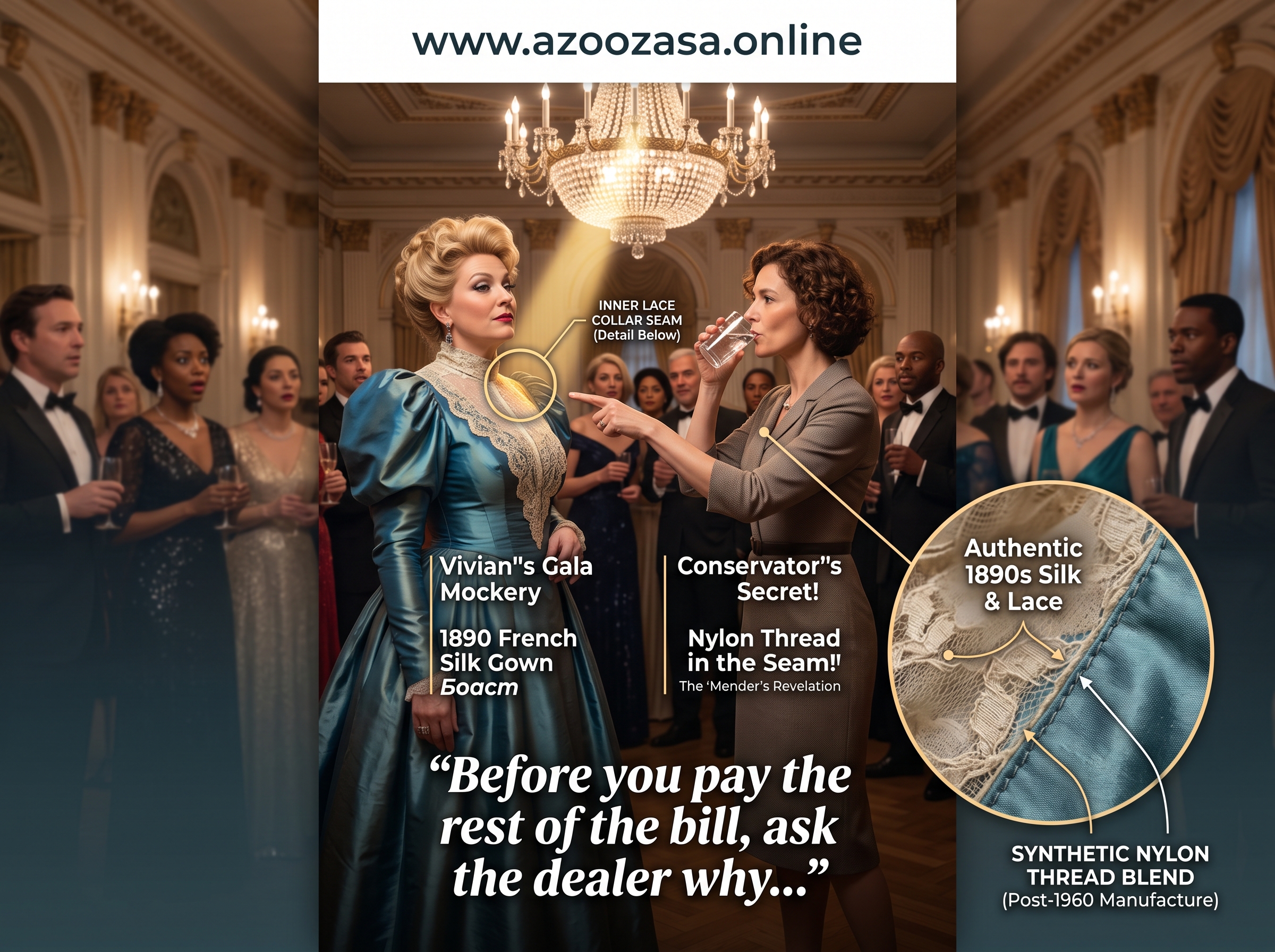
She was wearing a stunning, floor-length silk gown in a deep, iridescent midnight blue. It featured a high, structured collar of intricate black lace and dramatic gigot sleeves that swept commandingly as she moved. She was surrounded by a dozen wealthy donors, her laughter ringing out over the string quartet as she proudly detailed her latest personal triumph.
“It’s an authentic 1890 Parisian evening gown,” Vivian boasted, her voice elevated specifically so the surrounding tables could hear. “Sourced it from a private dealer in Milan just last week. Sixteen thousand dollars, but honestly, for a pristine piece of the Belle Époque, it was an absolute steal.”
The donors murmured in awed appreciation, leaning in to admire the sheen of the antique fabric. Vivian turned slightly, the crystal chandelier above casting a brilliant, blinding spotlight on the dark silk. That was when her eyes locked onto mine across the room.
A cruel, familiar smirk spread across her face. She couldn’t resist the opportunity to elevate herself by stepping on someone else.
“Arthur!” Vivian called out, waving me over with a manicured hand. The crowd of donors parted, turning to look at the man she had summoned. “I’m surprised you came upstairs. I thought you’d be down in the basement, darning socks. Come tell my friends what you think of my latest find.”
I walked over calmly, my expression entirely neutral.
“It’s a very striking silhouette, Vivian,” I said, keeping my hands clasped behind my back.
Vivian let out a sharp, condescending laugh. She turned to the wealthy couple standing next to her. “Arthur used to work for me. He’s just an old mender, really. Always obsessed with dust and decaying rags. He never quite understood the business of high-end historical fashion. Tell me, Arthur, have your hands ever even touched a garment worth this much?”
A few of the guests chuckled awkwardly, glancing at my modest suit.
The Conservator’s Eye
I didn’t flush with anger. I didn’t defend my thirty-two-year career. I simply did what I had done every single day in the archives: I looked closely at the fabric.
My eyes bypassed the dramatic silhouette and zeroed in on the structural integrity of the garment. I looked at the drape of the heavy silk, the way the bodice was darted, and finally, the intricate black lace collar framing her neck.
The cardinal rule of textile conservation is that fabric can lie, but thread never does. The tension, the material, and the chemical composition of a stitch are the fingerprints of an era.
Under the intense, multi-directional halogen light of the chandelier, the dark silk absorbed the illumination beautifully. But the thread securing the intricate lace collar did not.
In 1890, a Parisian atelier would have used a spun silk twist or, occasionally, a high-grade mercerized cotton to attach delicate lace. Both of those natural fibers possess a specific, matte-like luster. They degrade over a century, becoming incredibly fragile, requiring immense care just to breathe on, let alone wear to a crowded gala.
But the thread holding Vivian’s collar together wasn’t fragile. It was pulled entirely taut, showing no signs of historical relaxation. More damningly, under the bright lights, the thread caught the glare with a distinct, microscopic, plastic-like sheen. It was refracting the light, not absorbing it.
It was a synthetic nylon-polyester blend. Nylon hadn’t even been invented until 1935, and that specific, high-tensile industrial spun blend didn’t become commercially available for garment construction until the late 1960s.
The Unraveling
Vivian was still smirking, waiting for me to bow out in embarrassment.
I took another calm sip of my water, lowered my glass, and stepped forward, entering the direct pool of the chandelier’s light.
“It is a fascinating piece, Vivian,” I said, my voice projecting clearly over the soft jazz of the string quartet. “But before you pay the rest of the bill to your private dealer in Milan, ask them why they used a serger machine from 1975 to construct it.”
The laughter in the circle died instantly. Vivian’s smirk froze, her eyes narrowing into thin, dangerous slits. “Excuse me? What on earth are you talking about?”
I reached into my breast pocket and pulled out my small, brass-rimmed jeweler’s loupe—a tool I carried out of sheer habit. I held it out to the wealthy donor standing to Vivian’s left.
“Take a look at the inner seam of the lace collar, right where the light hits it,” I instructed gently.
The donor, a prominent local judge, hesitated before taking the loupe. He leaned in close to Vivian’s neck, squinting through the magnifying glass.
“In 1890,” I explained to the captivated crowd, “this gown would have been meticulously hand-stitched using a natural silk twist. But if you look at the threading under the lace, you’ll see a uniform, continuous machine-locked stitch. More importantly, you’ll see a distinct plastic gleam.”
“It… it does look a bit shiny,” the judge muttered, pulling back and handing the loupe to someone else.
“That is a synthetic nylon thread blend,” I continued, my voice steady and completely devoid of malice. “That specific chemical blend was only manufactured after 1960. The silk itself is a modern, chemically weighted reproduction, which is why it hasn’t shattered or frayed at the stress points under the arms. What you are wearing, Vivian, is not an authentic Belle Époque antique.”
The Anatomy of a Textile Fraud
| Assessment | Vivian’s Claim | The Conservator’s Reality |
| Origin Era | 1890 Parisian Atelier | Post-1960 Reproduction |
| Textile Material | Antique French Silk | Modern chemically-weighted fabric |
| Construction | Meticulous Hand-Stitching | Machine-locked synthetic nylon |
| True Value | $16,000 | ~$300 high-end theatrical costume |
“It is a beautifully executed theatrical costume,” I concluded. “Likely crafted for a stage production in the 1970s. It’s worth perhaps three hundred dollars. Whoever sold this to you preyed entirely on your desire for a high price tag, knowing you didn’t have the technical expertise to look at the seams.”
The Masterpiece of Silence
The silence that followed was absolute. The string quartet had paused between songs, leaving my words to hang in the air like a guillotine.
The blood drained entirely from Vivian’s face, leaving her pale and trembling beneath her synthetic collar. She looked down at her sleeves, her hands suddenly shaking as the realization washed over her. She hadn’t just been scammed out of sixteen thousand dollars; she had been publicly, surgically humiliated in front of the exact people she was trying to impress. She was standing in the center of the room wearing a glorified Halloween costume.
“You… you don’t know what you’re talking about,” Vivian stammered, her voice shrill and entirely devoid of its former confidence. “My dealer provided a certificate of authenticity!”
“Paper can be forged for a few dollars,” I replied softly. “But thread never lies.”
I didn’t wait for her to erupt into a defensive tantrum. I had spent thirty-two years fixing the damage caused by time and carelessness, and I had no interest in watching Vivian unravel.
I took my jeweler’s loupe back from the bewildered donor, slipped it back into my pocket, and offered Vivian a polite, incredibly brief nod.
“Enjoy the rest of the gala, Vivian,” I said.
I turned around and walked toward the exit, the crowd parting silently to let me through. The crystal chandeliers glittered brightly above me, but as I walked out into the cool, refreshing night air of the city, the most valuable thing in the room wasn’t the jewelry or the champagne. It was the absolute, undeniable power of an “old mender’s” hands.




0 comments