
📋 Table of Contents
The Teacup Prescription: A $480,000 Chemical Prison
I have been a visiting hospice nurse for fourteen years. Over a decade of sitting at the bedsides of the dying teaches you a lot about human nature. You learn to recognize the specific, shallow rattle of a body preparing to let go, and you learn how to comfort the shattered families left behind. But more importantly, you develop a sixth sense for the shadows that sometimes lurk in the corners of a quiet house. You learn to smell deception.
When I was assigned to eighty-four-year-old Irene, the intake file painted a tragic but standard picture: end-stage heart failure complicated by severe, rapidly advancing dementia. Her daughter, Valerie, had moved in six months prior to act as her full-time caregiver and had recently assumed total legal control over Irene’s $480,000 estate.
From the very first day, Valerie was a hovering, anxious presence. She wore her exhaustion like a badge of honor, constantly sighing and rubbing her temples. “She gets confused and hallucinates constantly,” Valerie told me during our initial consultation, her voice dripping with practiced exhaustion. “It’s getting dangerous. I really think we need to increase her liquid morphine and Ativan. We just need to keep her comfortable.”
But as the weeks wore on, the math of Irene’s decline simply wasn’t adding up.
A Tale of Two Irenes
My visits were scheduled for Tuesday and Thursday mornings. Typically, Valerie was glued to her mother’s side, answering questions on Irene’s behalf and shushing the elderly woman whenever she tried to speak. During these times, Irene was a ghost. She stared blankly at the floral wallpaper, her jaw slack, her eyes glazed over with a milky, vacant fog.
However, in my third week, Valerie ran out to the pharmacy, leaving me alone with Irene for forty-five minutes. Within twenty minutes of Valerie’s departure, a profound shift occurred. As the heavy morning sedation began to wane, the fog in Irene’s eyes unexpectedly cleared.
“Could you open the window, dear?” Irene asked, her voice raspy but perfectly coherent. “The hydrangeas should be blooming, and I’d love to smell the breeze.”
I froze, the blood pressure cuff stalling in my hand. We spent the next half hour talking. Irene didn’t hallucinate. She knew exactly what year it was, who the president was, and that she was dying of heart failure. She also told me, with a profound, quiet terror in her voice, that her daughter made her drink a special “vitamin syrup” every morning that made the world go dark.
The Assessment Discrepancy
| Clinical Observation | Valerie’s Claim | My Nursing Assessment |
| Cognitive State | “Severe, unmanageable dementia” | Lucid, oriented x3 when unmedicated |
| Hallucinations | “Constant and terrifying” | Non-existent during private interviews |
| Physical Decline | “Natural progression of disease” | Chemically induced lethargy |
| Financial Motive | “Protecting mother’s assets” | Total control of a $480,000 estate |
The moment Valerie’s car pulled back into the driveway, Irene’s entire body tensed. She squeezed her eyes shut and pretended to sleep, terrified of the woman who was supposed to be her protector.
The Hidden Truth Behind the China
I spent the next two days sick to my stomach, analyzing every medication on Irene’s official hospice chart. The prescribed doses of Ativan and morphine were minimal—nowhere near enough to induce the catatonic states I had witnessed when Valerie was present. Something else was in Irene’s system.
Yesterday, I arrived for my morning shift thirty minutes early. Valerie was in the shower, the water running loudly through the thin walls of the hallway. I took the opportunity to do a full inventory of the kitchen, where Valerie prepared all of Irene’s meals and medications.
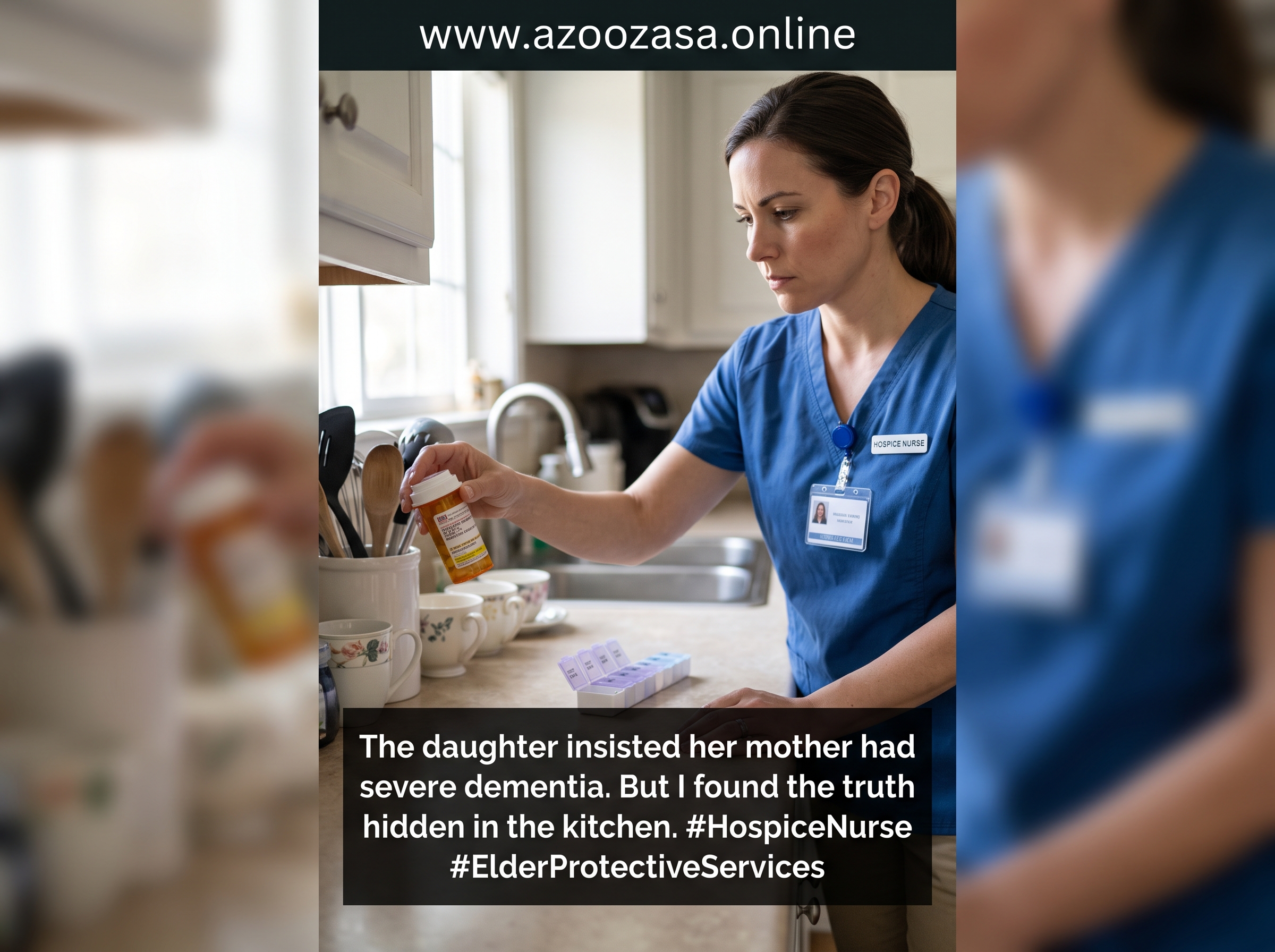
I checked the standard hospice organizer on the counter. Everything matched the chart. But my instincts, honed by fourteen years of walking into strangers’ homes, screamed at me to look deeper. I opened the high cupboards above the sink. Behind a row of dusty, vintage china teacups, my fingers brushed against a heavy, amber plastic bottle.
I pulled it down, my heart hammering against my ribs. It wasn’t a hospice medication.
-
The Drug: A highly potent, liquid antipsychotic/tranquilizer, typically reserved for severe, institutionalized psychiatric patients.
-
The Prescriber: An out-of-state telemedicine clinic.
-
The Patient Name: It wasn’t prescribed to Irene. It was prescribed under Valerie’s maiden name.
-
The Dosage: The instructions on the label indicated a dosage high enough to sedate a grown man, let alone a frail, eighty-four-year-old woman with a failing heart.
“Elder abuse thrives in the shadows of assumed benevolence. The most dangerous predators often wear the mask of a exhausted, devoted caregiver.”
My jaw set tight. The picture snapped into horrifying focus. Valerie wasn’t just stealing her mother’s money; she was methodically erasing her mother’s mind to do it. She was creating the illusion of severe dementia to justify her absolute control over the estate, trapping her own mother in a terrifying, chemical prison where no one would believe a word she said.
Breaking the Chemical Chains
I didn’t confront Valerie. When she emerged from the bathroom, her hair wrapped in a towel, I simply smiled, logged my vital signs in the hospice binder, and told her Irene was resting comfortably. I packed my medical bag, walked out to my car, and locked the doors.
My hands were shaking as I pulled out my phone, but my voice was entirely steady. I bypassed the standard nursing hotline and dialed the direct emergency line for the state’s Adult Protective Services, requesting an immediate joint response with local law enforcement.
“I am a licensed hospice RN,” I told the dispatcher, staring through my windshield at the quiet, picturesque house that hid a waking nightmare. “I am reporting an active, life-threatening case of elder abuse and forced chemical imprisonment. The daughter is secretly dosing her mother with unprescribed, heavy tranquilizers to fake dementia and secure control of a $480,000 estate. I have the physical evidence, and I need officers here right now.”
Within an hour, three police cruisers and an APS investigator were parked on the lawn. I watched from the end of the street as Valerie, screaming and demanding to speak to her lawyer, was escorted out of the house in handcuffs.
Irene was immediately transferred to an inpatient hospice facility. Over the next few days, as the toxic cocktail of unauthorized sedatives finally flushed from her system, the ghost faded away, and the real Irene returned. She spent her final three weeks of life surrounded by a compassionate nursing staff, enjoying the smell of blooming hydrangeas, and, most importantly, in total, lucid control of her own mind.
I sat by her bed on her final afternoon. She couldn’t speak much, but she reached out, her frail hand covering mine, and gave it a weak, knowing squeeze. It was a silent thank you from a woman who had almost been erased, but who was ultimately allowed to leave this world in the light.


0 comments