
📋 Table of Contents
The Judas Ledger: A Sanctuary of Secrets
The rain always brought a deep, familiar ache to the congregation of St. Jude’s. For five long years, every time the skies over our small town turned a bruised, heavy gray, the sanctuary echoed with the rhythmic, hollow plink-plink-plink of water dripping into the dozens of tin buckets we scattered between the oak pews.
We were a modest church. Our congregation was made up of factory workers, retired schoolteachers, and young families scraping by. Yet, piece by piece, dollar by dollar, we built the Roof Repair Fund. It was born from weekend bake sales, car washes in the sweltering July heat, and the quiet, sacrificial offerings of widows who gave more than they could afford. We raised exactly $68,000. It was a staggering sum for us—a testament to our collective faith and endurance.
Deacon Thomas was the man entrusted with safeguarding that miracle. With his perfectly tailored suits, booming baritone voice, and a smile that seemed to radiate pure integrity, Thomas was the undisputed pillar of our community. He had managed the church’s building fund for five years.
But three weeks ago, Thomas stood before the pulpit, his head bowed in a masterful display of manufactured sorrow. He gripped the edges of the wooden lectern, looking out over the hopeful faces of the congregation.
“Brothers and sisters,” Thomas announced, his voice thick with practiced regret. “I bring heavy news. I have met with the contractors. Material costs have jumped exponentially since our initial estimates. The work must be delayed until we can raise an additional thirty thousand dollars. God is testing our patience, but we must remain steadfast.”
A collective sigh of heartbreak swept through the pews. I watched elderly Mrs. Higgins wipe a tear from her cheek. But nobody questioned him. Nobody ever questioned Deacon Thomas.
The Secretary’s Audit
I had served as the church secretary for nearly a decade. My job was generally confined to printing the Sunday bulletins, organizing the choir schedule, and filing the administrative paperwork. However, the week after Thomas’s announcement, Pastor Miller asked me to organize the financial office for an upcoming regional synod visit.
It was late on a Tuesday evening. The church was empty, silent except for the wind rattling the stained-glass windows. I sat at my desk with the heavy, blue financial binder spread open under the harsh glare of a desk lamp.
As I flipped through the quarterly expense reports, something felt wrong. The pages were too neat. Thomas was notoriously disorganized, yet the latest section on the building fund was flawlessly, suspiciously sparse. I ran my fingers along the back cover of the binder, feeling a strange thickness behind the cardboard backing.
I pulled out a letter opener and carefully wedged it behind the vinyl seam. The false divider popped open.
A thick manila envelope slid out, landing with a heavy thud on my desk.
My breath caught in my throat as I opened the clasp and poured the contents onto the blotter. They were contractor receipts from O’Malley Construction—the largest roofing company in the county. But they weren’t estimates. They were finalized invoices.
I scanned the itemized list of labor and materials, my eyes darting to the bottom line.
The Financial Discrepancy
| Category | Deacon Thomas’s Claim | Actual Invoice Evidence |
| Material Costs | “Jumped exponentially” | Donated by local suppliers |
| Labor Fees | “Unattainable at current funds” | $0.00 (Waived by O’Malley Construction) |
| Project Status | “Delayed indefinitely” | Scheduled and fully paid (via donation) |
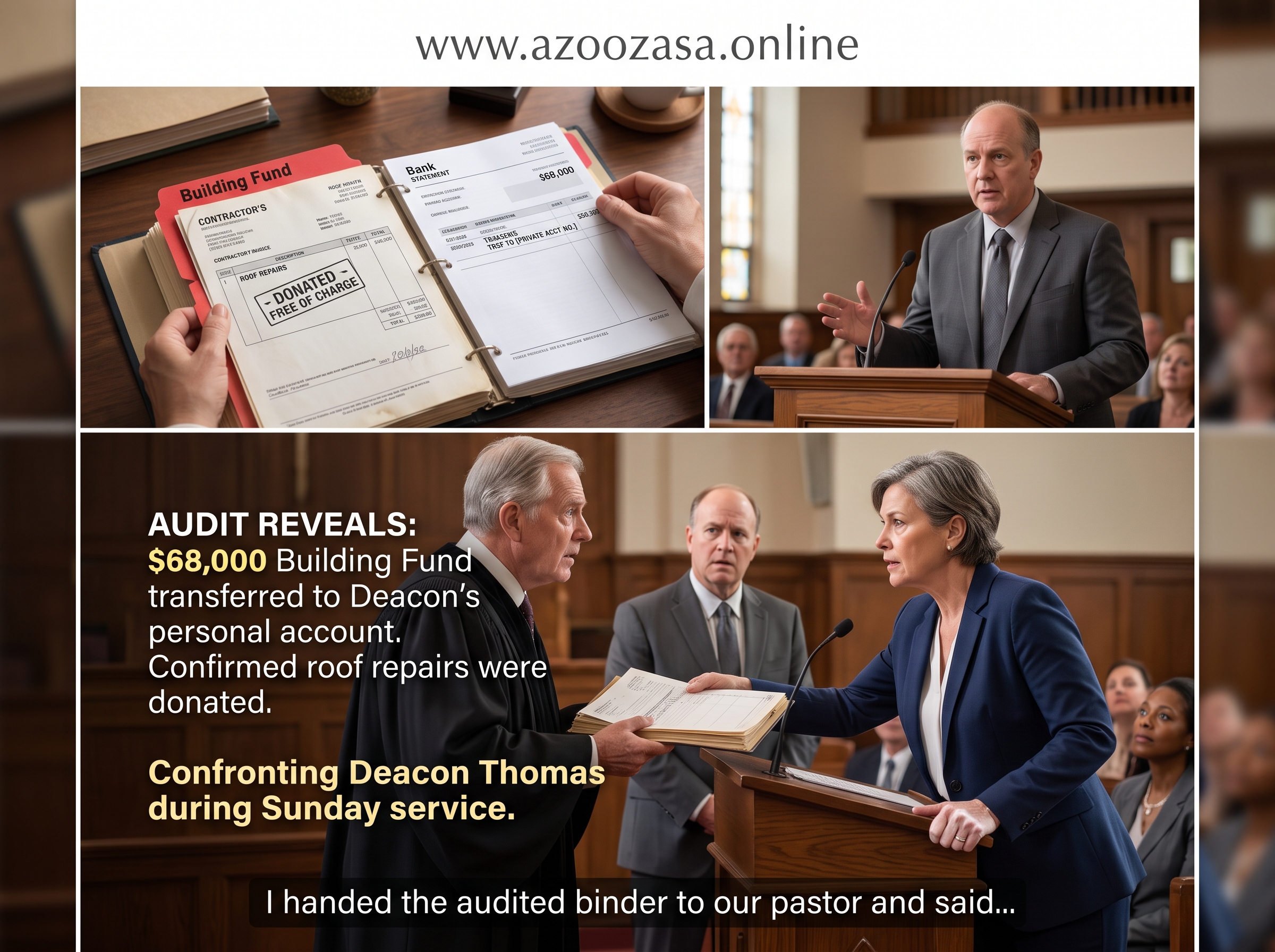
| Fund Balance | Required an extra $30,000 | $68,000 unaccounted for |
The local tradesmen, many of whom had grown up in this very church, had quietly coordinated to donate the entire roof repair free of charge. They had gifted us a miracle.
My hands began to violently shake as I pulled the final piece of paper from the envelope. It was a printed confirmation of a wire transfer. Thomas hadn’t left the $68,000 in the church’s reserve account. He had executed a direct wire transfer of the entire sum.
Transfer Destination: Liberty Bail Bonds & Legal DefenseBeneficiary Account: Marcus ThomasAmount: $68,000.00
Marcus was Thomas’s estranged son. We had all heard the whispered rumors a month ago that Marcus had been arrested on serious federal fraud charges in the city, but Thomas had fiercely denied it, claiming his son was on a “spiritual retreat.”
The truth hit me with the force of a physical blow. Thomas had stolen the widow’s mites. He had taken the bake sale money, the children’s tithes, and the sacrifices of three hundred hardworking people, and he had transferred the entire $68,000 to a private account to pay for his son’s bail. He had looked Mrs. Higgins in the eye and lied through his teeth to protect his own flesh and blood from a prison cell.
The Sunday Reckoning
I didn’t sleep for the rest of the week. The secret felt like a burning coal swallowed whole, searing my conscience every time I walked into the sanctuary. I could have gone to the police privately. I could have pulled Pastor Miller aside in his office. But Thomas had committed this betrayal in public, standing on the very altar he was desecrating. He had demanded our tears and our money in front of the entire congregation.
He needed to answer to them.
Sunday morning arrived with a torrential downpour. The buckets were out again, catching the rhythmic drips of water. The church was packed.
We were midway through the service. Pastor Miller had just finished the opening hymn and called Deacon Thomas to the pulpit to deliver the morning prayer. Thomas walked up the carpeted steps, adjusting his silk tie, his face adopting that familiar, pious serenity.
I stood up from my seat in the second row.
The rustle of my dress was loud in the quiet sanctuary. Heads turned as I stepped out into the center aisle. My heart was hammering against my ribs like a trapped bird, but my legs moved with terrifying certainty. I carried the blue financial binder clamped under my arm.
Thomas paused, his brow furrowing in irritation. “Sarah? The morning announcements aren’t until after the sermon.”
I didn’t stop. I walked straight up the altar steps, bypassing Thomas entirely, and stopped in front of Pastor Miller, who was sitting in the high-backed clergy chair.
I gripped the wooden lectern until my fingers turned white. The wood was polished and smooth, anchoring me in the storm of silence that had fallen over the room. I opened the binder, pulled out the O’Malley Construction receipts and the wire transfer confirmation, and handed them directly to the pastor.
Pastor Miller looked down at the papers, his kind eyes scanning the blue ink. I watched the blood drain entirely from his face.
I turned slowly to face Deacon Thomas, then looked out over the sea of confused, watching faces.
“Deacon Thomas was right about one thing,” I said, my voice ringing out, clear and steady, cutting through the sound of the rain hitting the roof. “God is testing us. But the test isn’t about material costs.”
I pointed a trembling finger at the man who had stolen our hope.
“The roof repairs were never delayed,” I continued, projecting my voice to the very back pews. “O’Malley Construction and the local tradesmen donated the entire job. It was free. But our building fund is entirely empty.”
A low murmur rippled through the congregation. Thomas took a step backward, his polished facade instantly cracking. “Sarah, you don’t know what you’re talking about, step down—”
I stepped up during Sunday service, handed the receipts to our pastor, and said, “Thomas stole it. He took all sixty-eight thousand dollars of this congregation’s blood and sweat, and he wired it to a bail bondsman to keep his son out of federal prison.”
The Collapse of a Pillar
The sanctuary erupted. It wasn’t a roar of anger, but a collective gasp of profound, agonizing betrayal.
Thomas stammered, raising his hands as if to physically push the truth away. “It was a loan! I was going to pay it back! My boy was in a cell, they were going to ruin his life! I just needed time!”
“You didn’t ask for a loan, Thomas,” Pastor Miller said. His voice was devastatingly quiet, but it carried an authority that made the entire room fall silent again. The pastor stood up, clutching the receipts, looking at the man he had trusted for years. “You used this altar as a shield for a thief.”
The rest of the morning dissolved into a blur of chaotic justice. The police were called before the choir could even sing the closing hymn. Thomas was escorted out of the sanctuary by two uniformed officers, his head hung low, the booming baritone voice completely silenced.
The betrayal left a deep, jagged scar on our congregation. It is a terrible thing to realize the shepherd you followed was actually the wolf.
But out of the devastation, something miraculous bloomed. When the news of the embezzlement hit the local papers, the town rallied around St. Jude’s in a way we could never have imagined. The tradesmen from O’Malley Construction arrived that very Monday, true to their word, and fixed the roof. A local law firm took up the civil case pro-bono to freeze Thomas’s assets and reclaim our stolen funds.
It rained heavily three weeks later. For the first time in five years, we sat in the oak pews, and the only sound in the sanctuary was the choir. The tin buckets were gone. We had lost a deacon, but we had finally found our sanctuary.



0 comments