
📋 Table of Contents
The Weight of the Wool: A Mother’s Twenty-One-Year Secret
My mother, Evelyn, was a woman carved from the stoic, unforgiving granite of a different era. She was quiet, relentlessly practical, and entirely unmoved by the shifting tides of fashion or comfort. For twenty-one years, she wore the exact same faded winter coat. It was a heavy, charcoal-gray wool garment that had lost its shape a decade ago, its edges frayed and its once-stiff collar worn soft against her neck.
Every Christmas, without fail, my husband and I would try to replace it. We would wrap beautiful, insulated down jackets in festive paper, hoping that this year she would finally retire the threadbare wool. But every year, she would gently place the gift back in its box, smooth the wrinkled fabric of her old coat with her weathered hands, and smile.
“You return this and put the money in savings,” she would say, her tone leaving absolutely no room for argument. “This one keeps me warm enough. I don’t need new things.”
We assumed it was simply the stubborn frugality of a woman living on a fixed $1,600 monthly pension. Her entire life was a masterclass in stretching pennies. She kept the thermostat in her small house so low that you could see your breath in the hallway during January. Instead of buying groceries with the rest of us, she survived on simple, homemade broths—onion, carrot, and celery simmered for days to extract every ounce of flavor. We thought she was terrified of outliving her meager retirement fund. We had absolutely no idea that she was quietly moving mountains.
The Empty Closet
Four months after she passed away, the sharp, suffocating edge of grief had finally softened enough for me to clear out her bedroom. The house was painfully quiet, smelling faintly of lavender soap, old paper, and the distinct, dusty chill that always seemed to follow her.
I worked my way through her dresser, folding her sensible cotton blouses and worn slacks into donation boxes. When I finally opened the door to her closet, my breath caught in my throat. Hanging right in the center, dominating the small space, was the charcoal-gray winter coat.
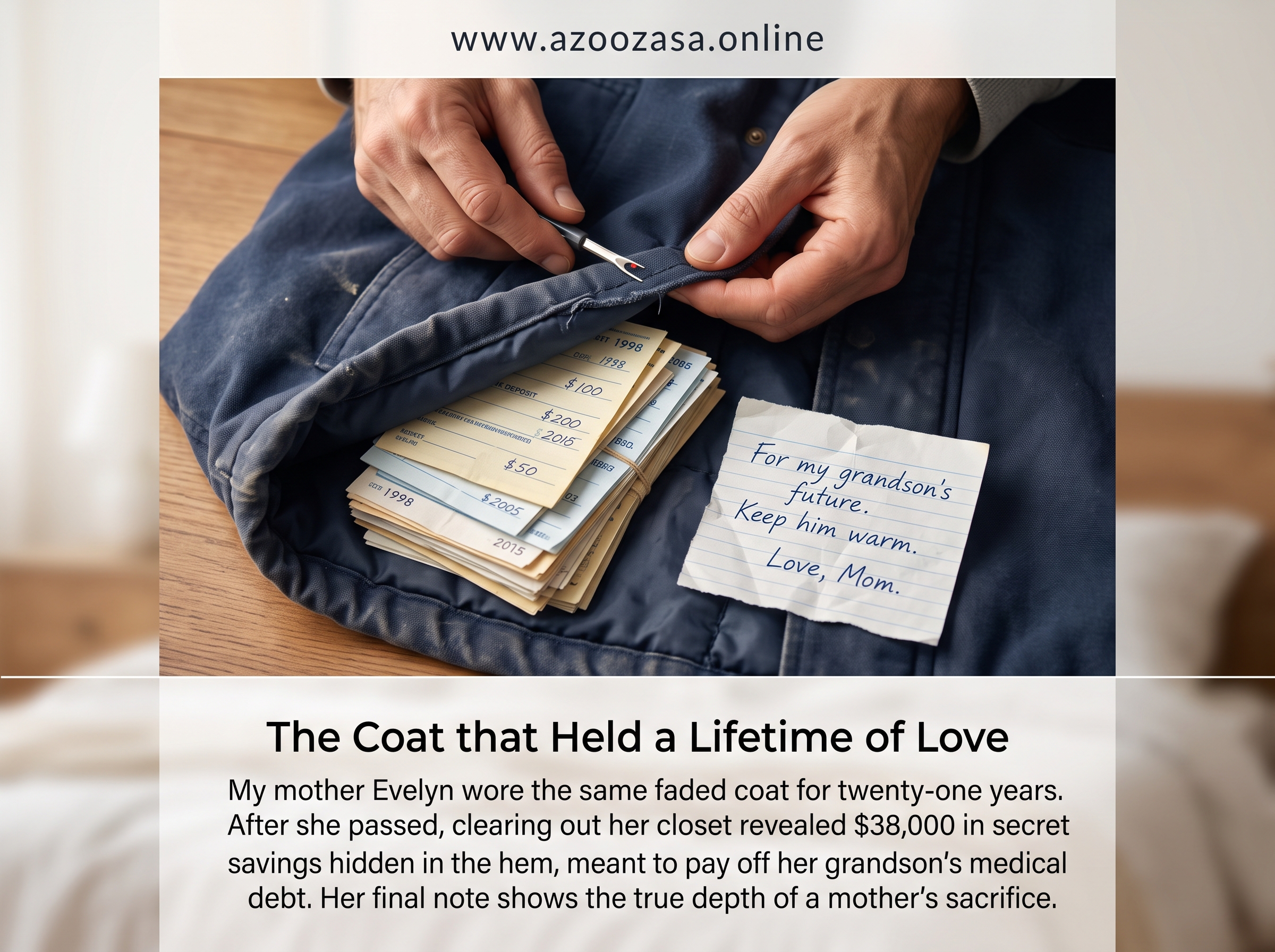
I reached out and pulled the wooden hanger off the rack. As the coat settled into my arms, my brow furrowed in confusion. The shoulders of the garment were as thin and flimsy as I remembered, but the bottom hem was unnaturally heavy. It sagged downward, feeling incredibly dense and stiff, as if someone had sewn a layer of cardboard directly into the lining.
I laid the coat flat across her floral bedspread and ran my hands along the bottom edge. The faint, undeniable crinkle of paper echoed in the quiet room.
My heart began to pound a strange, frantic rhythm against my ribs. I walked to her bedside table, retrieved her small sewing scissors, and carefully snipped the black thread holding the inner hem together.
The fabric parted. A tightly rolled bundle of paper slipped out, landing softly on the quilt.
I unstitched another section. More bundles fell out.
Unstitching the Past
I sank to the floor, my knees giving way as I stared at the hidden cache spread across the mattress. They were not cash, nor were they old letters. They were hundreds of individual bank deposit slips, neatly bound with rubber bands that had dried out and snapped long ago.
I pulled a bundle toward me, my hands trembling.
-
The Dates: The slips spanned exactly twenty-one years, beginning the very same month my son, Leo, was born.
-
The Amounts: The deposits were methodical and precise. Fifty dollars here, seventy-five dollars there, sometimes a hundred.
-
The Destination: Every single slip was stamped with a direct transfer confirmation to the billing department of Boston Children’s Hospital.
I felt the air rush out of my lungs. When Leo was an infant, he was diagnosed with a severe congenital heart defect. He underwent three open-heart surgeries before his second birthday. My husband and I were young, terrified, and entirely drowning in medical debt. We had resigned ourselves to the fact that we would spend the rest of our lives paying off the astronomical hospital bills. But mysteriously, over the years, the hospital had sent us letters stating that anonymous charitable contributions had been applied to our balance.
We had always assumed it was a billionaire’s philanthropic fund or a quiet church charity.
I grabbed a notepad from her nightstand and began frantically tallying the numbers printed on the faded blue ink of the deposit slips. When I reached the final bundle, the total stared back at me, shattering my entire understanding of my mother’s life: $38,000.
The Arithmetic of a Mother’s Love
| The Illusion (What We Saw) | The Reality (What She Did) |
| Enduring a freezing house all winter | Directing her heating budget to Leo’s cardiology bills |
| Eating cheap vegetable broth for dinner | Paying the co-pays for Leo’s post-operative medications |
| Wearing a threadbare twenty-one-year-old coat | Keeping our young family out of medical bankruptcy |
| Refusing our Christmas gift money | Ensuring the hospital never sent our accounts to collections |
Mom had gone without heat, without new clothes, and without even the most basic comforts to secretly pay off her grandson’s pediatric medical debt. She had taken her meager $1,600 monthly pension and systematically carved out a future for us, hiding the evidence of her staggering sacrifice in the very coat we had begged her to throw away.
The Note in the Lining
I sat paralyzed on the carpet, surrounded by the overwhelming, physical proof of my mother’s silent heroism. The walls of the small bedroom seemed to press inward, heavy with a love so fierce and absolute that it brought me to my knees.
Tucked inside the very last bundle of deposit slips, wrapped in a piece of clear plastic to protect it from moisture, was a small, folded piece of paper. I recognized her elegant, sloping cursive immediately.
I took a shaky breath, unfolded the paper, and read the words my mother had left behind:
My dearest daughter,If you are reading this, it means I am gone, and you have finally tried to throw away this dreadful old coat. Please forgive me for my secrecy. I know how much it frustrated you that I wouldn’t let you buy me nice things, and I know you worried about me eating my simple soups.When little Leo got sick, I saw the absolute terror in your eyes. I saw the stacks of bills piling up on your kitchen table, and I knew that fear would steal the joy of motherhood from you. It was my job to carry that weight. But I also knew that if I told you what I was doing, you would have refused the help. You would have told me to spend the money on myself.Do not cry for me, and do not feel an ounce of guilt. Every time I put on this heavy old coat and felt the bitter winter wind, I thought of Leo’s strong, beating heart. I thought of your family sleeping soundly without the shadow of debt hanging over your roof. And I promise you, I have never felt warmer.True warmth doesn’t come from insulated fabric or a high heating bill. It comes from knowing that you have protected your blood. The debt is paid. Leo is safe. Now, please, throw this ugly coat away and go live your beautiful life.All my love,Mom.
The True Meaning of Warmth
I clutched the letter to my chest, letting out a loud, fractured sob that echoed through the empty house. I sat there on the floor for hours, crying until my eyes burned, mourning the mother I thought I knew, and fiercely honoring the giant of a woman she actually was.
She had spent two decades looking like the poorest woman in town, while secretly possessing a wealth of character that most of us could not achieve in a hundred lifetimes. She had bought our freedom with her own comfort, one bowl of broth and one faded wool thread at a time.
I did not throw the coat away.
I took it home, carefully folded it to display the frayed cuffs and the snipped hem, and placed it inside a heavy wooden shadow box. It hangs in our hallway today, right next to a photograph of Leo graduating from high school—a healthy, thriving young man with a strong heart.
Whenever the winter winds howl against the windows of our home, I stop and look at that faded charcoal wool. It is a permanent, silent reminder of what true provision looks like. It reminds our family that the most profound acts of generosity do not come with a fanfare or a tax write-off; they are usually quiet, stubborn, and hidden entirely out of sight, wrapped in the lining of an old winter coat.


0 comments