
📋 Table of Contents
Power Dynamics: A Three-Minute Masterclass in “Unskilled” Labor
The Grand Solstice ballroom was a symphony of excessive wealth. Crystal chandeliers hung like frozen waterfalls from the vaulted ceilings, casting a warm, glittering light over tables draped in imported silk. It was my sister Elise’s tenth wedding anniversary, an event designed entirely to showcase the financial conquests of her husband, Richard.
Richard was a Vice President of Mergers and Acquisitions at a downtown firm. He was a man who communicated in golf handicaps, stock portfolios, and thinly veiled condescension. I, on the other hand, had married Dean. Dean was an industrial electrician, a foreman who spent his days calibrating high-voltage commercial grids and wiring manufacturing plants.
We loved each other fiercely, but at family gatherings, the divide between our worlds was always the unspoken elephant in the room. Tonight, Richard decided to make it the centerpiece.
The Insult
We were seated at the head table, surrounded by Richard’s corporate colleagues. The conversation had inevitably turned to the “stress” of the boardroom. Richard took a slow, deliberate sip of his $300 scotch and leaned back in his velvet chair, his eyes drifting across the table to where Dean was quietly cutting his steak.
Richard’s gaze landed squarely on Dean’s hands. They were the hands of a man who worked for a living—scarred knuckles, thick calluses, and a faint, permanent shadow of industrial grease worked into the creases of his palms.
“You know, Dean,” Richard said, his voice carrying just loudly enough to silence the surrounding chatter. “I was looking at the market trends for manual trades today. It’s fascinating. With all the chaos and high-stakes decision-making I deal with every hour, I have to admit, I envy you sometimes.”
Dean looked up, his expression unreadable. “Is that so, Richard?”
“Absolutely,” Richard smirked, flashing a set of perfectly bleached teeth. “No late-night panicked phone calls. No multi-million-dollar deals hanging on your every word. You just clock in, pull some wires, and clock out. Must be incredibly peaceful doing unskilled labor.”
The table went dead silent. Elise looked down at her lap, her cheeks flushing crimson. My stomach twisted into a tight, hot knot of fury, and I opened my mouth to tear into my brother-in-law.
But Dean simply placed his fork down, wiped his mouth with his linen napkin, and smiled. It wasn’t a defensive smile. It was the calm, grounded smile of a man who knew exactly who he was, and exactly what his hands were capable of.
“It has its moments, Richard,” Dean replied evenly. “But peace is a funny thing. It usually only lasts until the lights go out.”
The Blackout
Two hours later, the venue was in full swing. The ten-piece jazz band was playing, the champagne was flowing, and the waitstaff was preparing to serve a meticulously crafted dessert course.
Then, a sound like a muted shotgun blast echoed from the rear corridors of the building.
The crystal chandeliers flickered violently, surged with a blinding white flash, and then died. The music cut out instantly, replaced by a collective gasp from three hundred guests as the sprawling ballroom was plunged into absolute, pitch-black darkness. A moment later, the faint, sickly yellow glow of emergency battery lights kicked on, casting eerie shadows across the panicked room.
The immediate silence was shattered by the frantic voice of the venue manager shouting into a walkie-talkie. The air conditioning had stopped dead. More importantly, the massive commercial refrigerators in the kitchen—holding tens of thousands of dollars worth of wagyu beef, imported seafood, and delicate pastries—had begun to warm.
Richard immediately went into executive mode. He stormed over to the venue manager, his face red with indignation. “What is the meaning of this? Turn the power back on immediately! I paid fifty thousand dollars for this venue!”
“Sir, I’m so sorry,” the manager stammered, wiping sweat from his forehead. “The main $14,000 commercial power grid just suffered a catastrophic cascade failure. Our on-site maintenance techs are looking at it, but…”
A pair of men in uniform polos emerged from the kitchen doors, looking terrified. “It’s the primary junction panel,” one of the techs said, throwing his hands up in defeat. “The main breaker melted down and tripped the fail-safes. We aren’t certified for three-phase commercial voltage. We have to call the city’s emergency electrical contractor. They said it will take all night just to get a crew out here to assess it.”
Richard lost his mind. “All night?! I have three hundred VIPs sitting in the dark! I’ll pay double! I’ll pay triple! Get someone on the phone now!”
Money, for the first time in Richard’s life, was completely useless. He couldn’t buy his way out of the dark, and the realization was making him unravel.
The Intervention
Dean stood up from our table. He didn’t say a word. He just squeezed my shoulder, turned around, and walked out the side exit into the humid night air.
Two minutes later, he returned. He was carrying his battered, heavy canvas tool bag and a bright yellow Fluke diagnostic meter.
He walked past the panicking guests, past my sister, and straight up to the venue manager. “Show me the electrical room,” Dean said. His voice wasn’t loud, but it carried a weight and authority that instantly commanded the room.
“Dean, what are you doing?” Richard scoffed, his voice shrill. “Put the toys away. Leave it to the professionals. We need an engineer, not a handyman!”
Dean ignored him completely. The venue manager, desperate for any lifeline, nodded and led Dean through the swinging kitchen doors. I followed closely behind, unwilling to miss a second of this. Richard, propelled by a desperate need to maintain control, trailed after us.
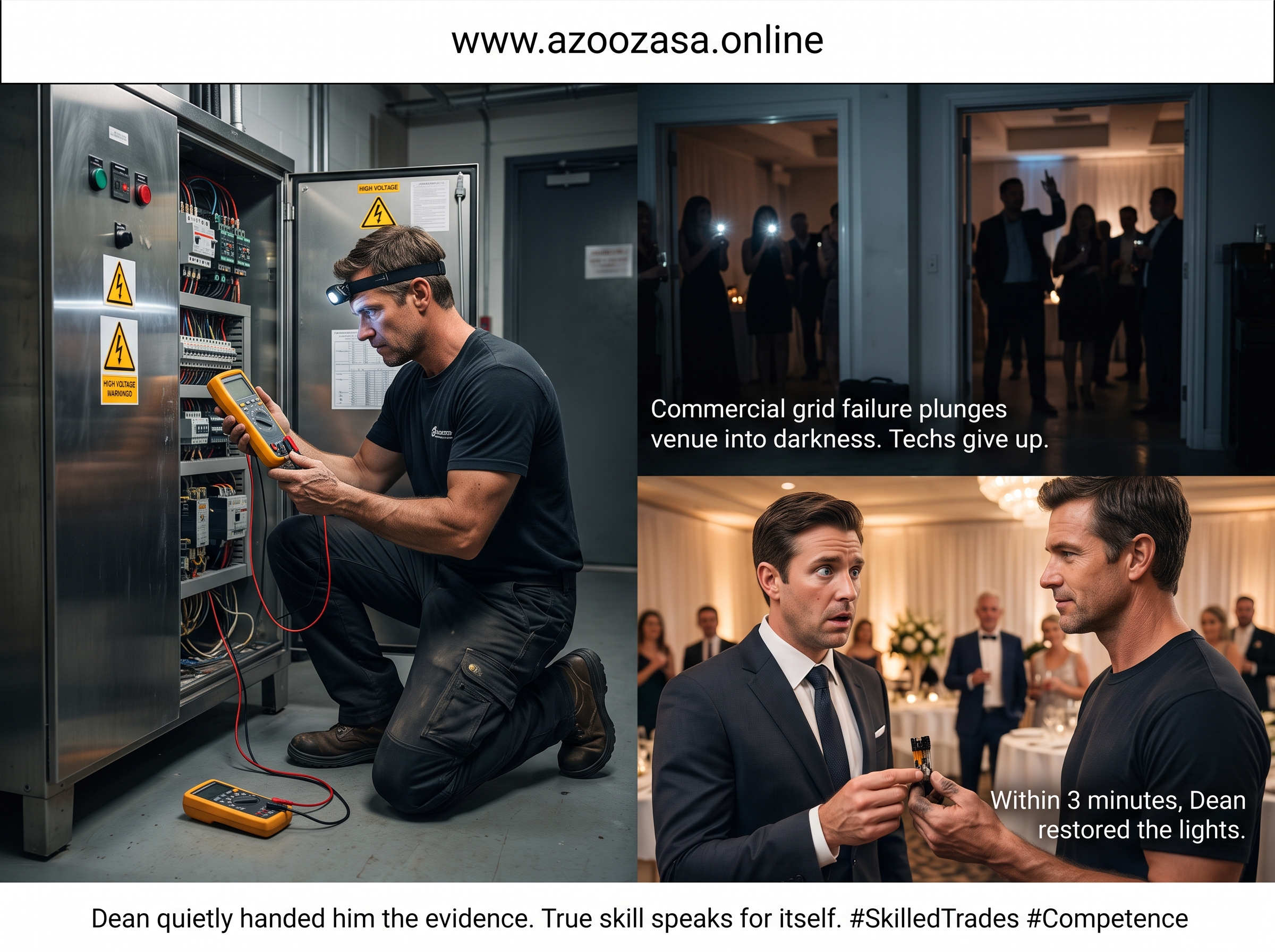
We entered the concrete electrical room. The air was thick with the acrid, metallic smell of ozone and melted plastic. On the far wall was a massive gray junction box, the size of a double refrigerator, filled with a terrifying, serpentine tangle of thick copper cables and industrial busbars.
The Contrast of Capability
| Scenario | Richard (The Executive) | Dean (The Electrician) |
| Response to Crisis | Panic, shouting, throwing money | Calm assessment, retrieving tools |
| Understanding of System | “Call an engineer” | “Show me the panel” |
| The Definition of Power | Corporate titles and bank accounts | Knowledge of voltage and circuitry |
Dean clicked on his headlamp, illuminating the charred ruins of the primary breaker. It was a solid block of blackened resin.
“Stand back,” Dean ordered. Richard took two quick steps backward, suddenly looking very small in his tailored tuxedo.
Dean moved with a fluid, mesmerizing precision. He didn’t hesitate. He didn’t guess. He clipped his diagnostic meter to the live metal, reading the voltage on the small digital screen. He pulled a pair of heavy, insulated lineman’s pliers and a specialized torque wrench from his bag.
He realized immediately what the maintenance techs hadn’t: the grid was built with a redundant bypass circuit for emergencies exactly like this, but it required manually unseating the melted primary and physically bridging the load to the secondary system without grounding out the entire building.
It was a maneuver that required an intricate, flawless understanding of electrical engineering and hands steady enough to operate millimeters away from lethal voltage.
Dean’s calloused, grease-stained hands went to work. He stripped the massive gauge wire, torqued the brass fittings, and bypassed the blown breaker with the terrifying grace of a surgeon.
“Three… two… one,” Dean muttered, wrapping his hand in a thick leather glove and throwing the heavy secondary lever upward.
CLACK.
The sound was like a gunshot. Instantly, the concrete room was flooded with blinding fluorescent light. In the ballroom beyond, the crystal chandeliers blazed back to life. The heavy hum of the commercial refrigerators kicked on simultaneously, followed by the distant, echoing cheers of three hundred party guests.
Dean checked his watch. It had taken him exactly three minutes and fourteen seconds.
The Souvenir
Dean wiped a smudge of soot from his forehead with the back of his wrist. He unclipped his meter, packed his tools meticulously back into his canvas bag, and turned around to face Richard.
My brother-in-law was standing in the doorway, his mouth slightly open, staring at Dean as if the man had just performed actual magic. The arrogant, swaggering executive had been stripped down to the bone, rendered entirely helpless by a physical world he neither understood nor respected.
Dean reached into the electrical panel and pulled out the heavy, melted, charred chunk of the primary breaker. It was about the size of a brick, smelling heavily of burnt ozone.
Dean walked over to Richard. He didn’t gloat. He didn’t raise his voice. He simply held out the scorched piece of plastic and copper.
As Richard stood speechless, Dean handed him the ruined breaker.
“Here you go, Richard,” Dean said quietly, his voice echoing slightly in the humming concrete room. “Thought you might want a souvenir for your desk. You know, a new paperweight for the corner office.”
Richard instinctively took the heavy, blackened block, his hands dropping slightly from the sheer weight of it.
Dean hoisted his tool bag over his shoulder, gave my brother-in-law a final, piercing look, and offered a small smile.
“Must be incredibly stressful,” Dean whispered, tapping the side of the charred breaker, “when you realize your entire world runs on unskilled labor.”
Dean turned and walked back out into the bright, glittering ballroom, leaving the Vice President of Mergers and Acquisitions standing in the hallway, holding a piece of burnt plastic, with absolutely nothing left to say.



0 comments