
The Resurrection in Room 14
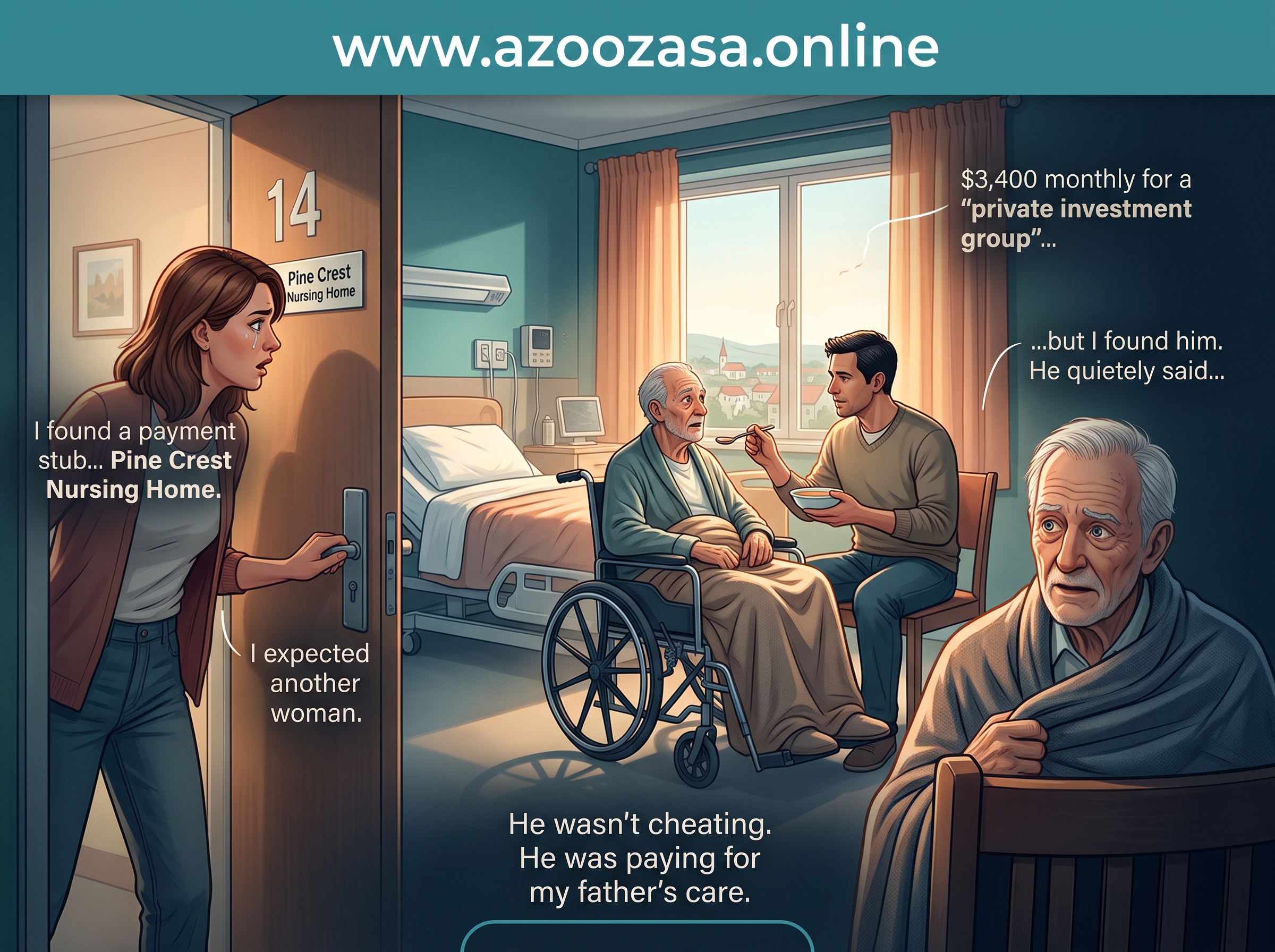
A marriage can survive anger, and it can endure profound grief, but it cannot survive a vacuum. For two years, an exact, mathematical void had been quietly devouring the foundation of my life with Julian. On the first day of every single month, precisely $3,400 vanished from our joint checking account. Over twenty-four months, it amounted to eighty-one thousand, six hundred dollars—a staggering hemorrhage of our shared future. When I first noticed the missing funds and confronted him, Julian didn’t flinch. He sat across from me at our kitchen table, sipping his black coffee, and smoothly explained it was a buy-in for a private investment group. Commercial real estate, he claimed. High yield, a long game, and strict non-disclosure agreements that prevented him from showing me the paperwork.
I didn’t believe a single syllable.
The private investigator route crossed my mind repeatedly, but I was too terrified of the definitive truth to pay for it. The human mind, when starved of facts, constructs the most agonizing fictions. I was absolutely convinced he was funneling our life savings into a second life. I imagined a younger woman, a secret apartment across town, perhaps even an illegitimate child I knew nothing about. The paranoia became a physical weight, a tightening, suffocating coil in my chest that made it impossible to breathe whenever his phone buzzed or he came home an hour late from the office. The ghost of this imagined woman haunted my kitchen, my living room, and the cold space between us in our bed.
Then came last Friday.
Julian had taken my sedan to work, leaving his heavy Ford truck in the driveway. He called around noon and asked me to retrieve a blue folder he’d absentmindedly left on the passenger seat. I climbed into the suffocating, stale heat of the truck’s cab, grabbed the folder, and accidentally knocked his insulated travel mug onto the floorboards. As I bent down to wipe up the spilled coffee, my fingers brushed against a crumpled piece of heavy-stock paper jammed awkwardly beneath the rubber floor mat.
I pulled it out, smoothing the deep wrinkles against my steering wheel. It wasn’t a love letter. It wasn’t a lease agreement for a luxury downtown loft.
It was a payment stub.
Pine Crest Nursing Home. Received: $3,400.00. Account Paid in Full.
The address listed was in Oakhaven, a sleepy, economically depressed town nearly fifty miles north of our city. In the top right corner, scribbled in hurried blue ink, was a room assignment: Rm 14.
My ears began to ring with a high, piercing frequency. A nursing home? The sheer absurdity of the receipt instantly shattered my carefully constructed theories of infidelity. Was he hiding a mistress who had been in a tragic accident? Was he paying hush money for a hidden, ailing relative of a lover? The coil of anxiety in my chest snapped, replaced by a volatile, reckless adrenaline. I didn’t wait for him to come home. I left the blue folder on the kitchen counter, grabbed my purse, and drove north.
The fifty miles disappeared in a blur of highway lines and torrential, blinding anxiety. The sky bruised into a dark, stormy purple as I pulled into the cracked asphalt parking lot of Pine Crest Nursing Home. It was a grim, brutalist brick building that looked more like a forgotten county hospital than a place of healing.
Walking through the sliding glass doors, the air was immediately thick with the heavy, institutional scent of industrial bleach, boiled vegetables, and stale linen. I didn’t stop at the front desk. I didn’t ask for directions. I followed the faded plastic signs bolted to the cinderblock walls, my heart hammering violently against my ribs.
I found the heavy wooden door of Room 14 slightly ajar. I placed my trembling hand on the wood, braced myself to witness the definitive, crushing end of my marriage, and pushed it open.
The room was small, bathed in the gray afternoon light filtering through a single, barred window. Sitting in a specialized, tilted wheelchair facing a small television was a frail, silver-haired man. He was shockingly thin, his frail hands resting limply in his lap, a thick woolen blanket draped over his motionless legs.
Sitting on a cheap plastic visitor’s chair beside him was Julian. My husband was holding a small plastic bowl, carefully blowing on a spoonful of chicken broth before raising it gently to the old man’s lips.
I stopped breathing. The linoleum floor tilted dangerously beneath my feet.
The man in the wheelchair wasn’t a stranger. He was my father.
My father, whom my older sister, Claire, had tearfully informed me had died of a massive heart attack ten years ago in a cheap motel in Nevada. I had paid for half of his cremation. I had stood in a rain-soaked cemetery holding a heavy brass urn, weeping until my lungs burned, mourning the chaotic, beautiful, deeply troubled man who had raised us.
Julian froze, the plastic spoon halting in mid-air. He looked at the doorway, the blood draining instantly from his face as he saw me standing there, clutching the crumpled payment stub in my shaking fist.
For a long, agonizing moment, the only sound in the small room was the low, tinny drone of a daytime soap opera playing on the television.
Julian slowly lowered the spoon back into the bowl. He looked up at me, his eyes brimming with an exhausted, profound sorrow, and quietly said, “He made me swear on my life to keep the ghost dead, Nora. But I couldn’t let him freeze in the dark.”
I stepped fully into the room, my legs feeling entirely detached from my body. I walked around the wheelchair and looked down into the face of a phantom. He was much older, ravaged by a decade of hidden time and severe illness. The left side of his face drooped heavily from what was clearly a massive stroke. But the eyes—those striking, pale blue eyes that used to light up when he read me bedtime stories as a child—were identical. They widened in absolute terror and devastating shame when they locked onto mine. He couldn’t speak, but a single, heavy tear tracked down his weathered, sunken cheek.
“What is this?” I whispered, the words tearing their way out of a throat tight with shock. “Julian, what have you done? Claire told me he was dead. We held a funeral. We buried him!”
Julian stood up, gently setting the bowl of soup on the metal bedside table. He reached out, not to restrain me, but to steady my trembling frame. “Claire lied, Nora. She lied to you ten years ago, and she forced him to play along.”
The truth, Julian explained as we stood in that bleak, fluorescent-lit room, was a labyrinth of familial betrayal and heartbreaking desperation. My father’s severe gambling addiction had reached a catastrophic peak a decade ago. He had secretly taken out massive, predatory loans against Claire’s name, nearly bankrupting her and destroying her young family. In a fit of absolute, uncompromising rage, Claire had offered him a devil’s bargain: she would use her own depleted savings to pay off the dangerous men he owed, but only on the strict condition that he vanish permanently. He was to leave the state, sever all contact, and allow her to tell me he had died. Claire knew that I, the softer and more forgiving sibling, would bankrupt my own future trying to save him, and she decided to brutally sever the tie to protect me from his collateral damage.
To spare me the agony of watching him continue to self-destruct, my father had agreed. He accepted his exile, and he carried the agonizing weight of his own funeral in total silence.
“Two years ago,” Julian continued, his voice thick with raw emotion, “the county hospital out here called me. They found my business card in his wallet—an old one from when we first started dating. He had suffered a massive stroke. He was paralyzed, completely broke, and the state was preparing to transfer him to a ward that looked more like a prison than a care facility.”
Julian looked down at his boots, the immense burden of the past twenty-four months evident in the heavy slump of his shoulders. “I drove up here to confront him. I was going to call you immediately. But when I walked into the hospital room, he begged me, Nora. He couldn’t speak well, but he sobbed. He begged me not to let you see him like this. He said you had mourned a man you loved, and he fiercely refused to let you spend the rest of your life burdened by the broken shell of a man he had become. He wanted you to keep the pristine memory of him. He made me swear not to tell you.”
“So you just paid for this?” I choked out, gesturing to the sterile room and the wheelchair. “For two years? Three thousand, four hundred dollars a month?”
“The state ward was a nightmare, Nora,” Julian said fiercely, stepping closer and taking my hands. “He is your father. He held you when you were a baby. I didn’t care what he had done to Claire, and I didn’t care about the money. I wasn’t going to let the man who created you rot in a dark hallway because of your sister’s cruelty or his own mistakes. I took the money from our account, and I bore your suspicion, because I swore to him I would protect your heart.”
I looked at Julian, truly seeing him for the first time in two years. I had spent countless nights visualizing him as a traitor, a liar, a man funneling our future into a hollow betrayal. Instead, he was an absolute titan of grace. He had single-handedly carried the crushing financial and emotional weight of my family’s darkest, most toxic secret, driving fifty miles in secret to visit a ghost every month to ensure he was fed, bathed, and treated with basic human dignity.
I turned back to the wheelchair. My father was weeping silently, his good right hand shaking violently as it rested on his knee. He was expecting rage. He was expecting the disgust that had driven him into exile a decade ago.
I knelt on the cold linoleum floor, unmindful of the bleach and dirt. I reached out and took his trembling hand in both of mine, pressing it fiercely against my cheek. His skin was paper-thin and terrifyingly cold, but the pulse beneath it was real. It was the pulse I had grieved for ten long years.
“I’m here, Dad,” I whispered, the dam finally breaking as I wept onto his hand. “You don’t have to be dead anymore.”
I heard the soft rustle of Julian’s jacket behind me. He knelt beside me, his strong arm wrapping around my shoulders, serving as a heavy, protective anchor in the violent storm of my shattered reality. The twenty-four months of lies, the eighty-one thousand dollars, the agonizing, suffocating paranoia—it all evaporated in the sterile air of Room 14.
I looked up at my husband, the man who had bought my father’s salvation at the cost of his own peace, and I reached out to take the plastic bowl of soup from his hands.
“Let me,” I said softly.
Julian smiled, a heartbreakingly beautiful release of tension, and nodded. As I lifted the spoon to my father’s lips, the phantom mistress I had hunted for two years vanished for good, replaced by a love so profound and heavy, it would take the rest of my life to properly repay.

0 comments