
Bitter Medicine: The Silence at Miller Farm
The Miller residence always smelled of lavender, lemon polish, and a slow, suffocating decay. For three weeks, my job as a home health aide consisted mostly of listening to the heavy mahogany grandfather clock in the hallway tick away the hours. My patient, eighty-one-year-old Agnes Miller, spent her days submerged in a deep, chemically induced slumber. Her frail, bird-like frame barely made a dent in the memory-foam mattress, her chest rising and falling in a shallow, hypnotic rhythm.
Outside her bedroom window lay two hundred acres of prime, sun-drenched agricultural land—the Miller family farm, an emerald expanse that had survived three generations of droughts, freezes, and economic downturns. Inside the house, however, a different kind of freeze had settled in.
“Mom needs her high-dose sedatives, Maya,” Chloe, Agnes’s daughter, had told me on my very first day. Chloe was forty-something, draped in neutral-toned cashmere, with a blowout that defied the humid country air and eyes as cold as river stones. “If we miss a dose, the dementia takes over. She gets violent. She’ll strike out, break things, hurt herself. And she might hurt you. We have to keep her calm. It’s for her own dignity.”
For twenty-one days, I played my part. I was the silent, obedient aide. I administered the crushed blue pills mixed into applesauce. I turned Agnes every two hours to prevent bedsores. I bathed her, brushed her thinning silver hair, and kept my mouth shut.
But I was also watching.
I noticed that Chloe’s designer wardrobe was fiercely at odds with the peeling wallpaper of the farmhouse. I noticed the way Chloe watched her mother swallow the applesauce—not with a daughter’s anxious love, but with the clinical, unblinking detachment of a warden checking a lock. Most importantly, I noticed that Agnes didn’t have the typical restless muscle twitches or erratic breathing patterns of a dementia patient fighting a heavy sedative. She just looked poisoned.
The turning point came on a Tuesday. Chloe had a “tennis lunch” in the city and left the house at noon, leaving strict instructions for the one o’clock dosage.
I sat by Agnes’s bed, the little plastic cup holding the crushed blue powder resting on the nightstand. I looked at the powder, then at Agnes. The morning dose was wearing off. Her eyelids fluttered. Instead of mixing the medication, I took a warm washcloth and gently wiped her brow, waiting.
Ten minutes later, Agnes opened her eyes. They weren’t the cloudy, vacant eyes of a woman lost in the labyrinth of dementia. They were a piercing, vivid hazel, sharp with terror and desperate clarity.
She turned her head slowly, checking the empty doorway, listening for the crunch of Chloe’s BMW on the gravel driveway. Finding only silence, she reached out. Her hand, fragile and cool, clamped around my wrist with astonishing strength.
“Don’t let her take the farm,” Agnes whispered, her voice raspy from disuse, but her tone fiercely coherent. “She’s selling it to developers. She’s keeping me under.”
A chill raced down my spine. The violent outbursts. The dementia. It was all a carefully constructed lie to maintain medical power of attorney and keep Agnes incapacitated. I squeezed the old woman’s hand, my heart hammering against my ribs.
“I won’t,” I promised quietly. “I’m going to help you.”
Agnes sagged against the pillows, tears pooling in the corners of her eyes, before the exhaustion claimed her again. I took the plastic cup containing the crushed sedatives, walked into the adjoining bathroom, and flushed the powder down the toilet. I replaced it with a crushed vitamin B supplement for the afternoon shift, just in case Chloe checked the pill counts.
The next afternoon, the opportunity I needed finally arrived. Chloe announced she was going out for a few hours to do some shopping. I stood by the window, watching the dust kick up behind her tires until the car disappeared down the long country road.
As soon as she was gone, I made my move. I bypassed the kitchen and walked straight toward the parlor at the front of the house. It was a room Chloe kept strictly off-limits, functioning as her makeshift office. The heavy oak double doors were usually locked, but in her rush to get to the boutiques, she had left them slightly ajar.
I slipped inside. The room was dark, the heavy velvet drapes drawn tight against the afternoon sun. I went straight to the antique roll-top desk dominating the far wall. The top drawer yielded nothing but high-end stationary and old utility bills. But the bottom drawer was locked.
I scoured the room, my hands shaking. I checked under the desk lamp, inside a decorative humidor, and finally, beneath a heavy brass paperweight on the bookshelf. A small silver key.
I slid the key into the desk drawer’s lock and turned it. With a soft click, it opened.
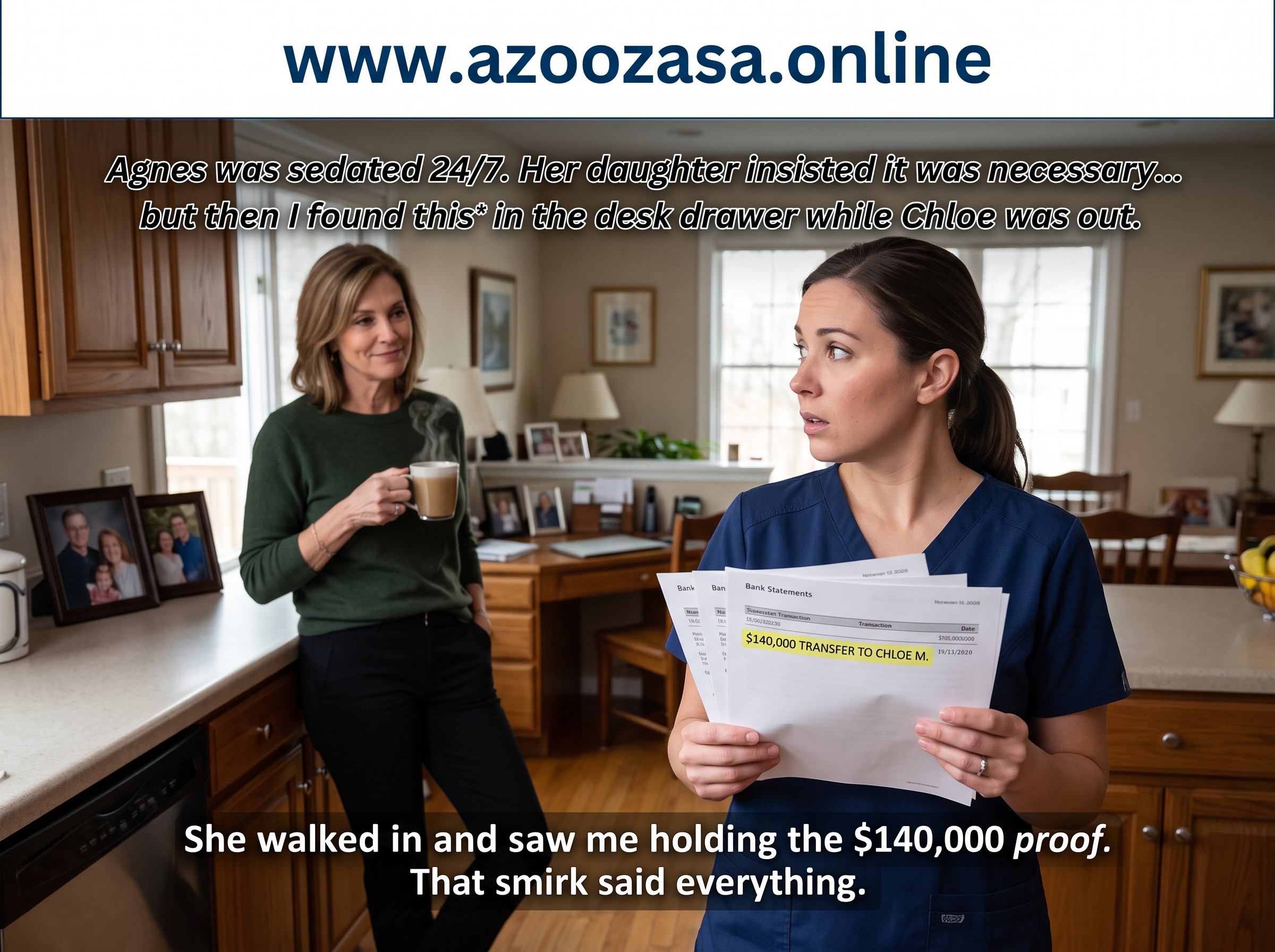
Inside was a thick manila folder labeled Estate Restructuring. I pulled it out and spread the documents across the leather blotter. The first page was a bank statement from Agnes’s primary retirement account. My eyes darted to the summary. In the last three weeks—the exact duration of my employment—Chloe had authorized three separate wire transfers totaling $140,000 to an offshore LLC.
Beneath the bank statements was a drafted deed of sale. The purchaser was a massive commercial real estate developer. The sale price was insulting, pennies on the dollar for land this rich, but it was being funneled directly into Chloe’s personal trust. The final page was a notary seal, post-dated for the coming Friday. Chloe was going to liquidate her mother’s entire legacy and siphon the cash, all while Agnes lay in a drug-induced coma upstairs.
“You’re much nosier than the last girl, Maya.”
I froze. The voice was smooth, devoid of any shock or anger.
I turned slowly. Chloe was leaning against the parlor doorway. She had slipped off her high heels in the mudroom, allowing her to walk through the house in utter silence. She didn’t look panicked. She didn’t look like a woman whose monstrous crime had just been uncovered.
Instead, she walked casually to the silver coffee carafe resting on the sideboard, poured herself a steaming cup, took a delicate sip, and smirked.
“The last aide just sat on her phone and watched TikToks,” Chloe mused, blowing gently on her coffee. “You had to go and play detective. I suppose I should have realized you were too sharp for this job. You put the pill cup down a little too carefully yesterday.”
I held the bank statements up, my grip tightening on the paper. “You’ve been drugging her. You’re draining her retirement, and you’re trying to steal the farm.”
Chloe sighed, setting the porcelain cup down with a soft clink. “Steal is such an ugly word. I am managing her assets. My mother is an antique, Maya. So is this farm. Do you know how much money it costs to keep this acreage running? It’s a money pit. The developers want to build a luxury golf community here. Everyone wins.”
“Agnes doesn’t win,” I said, my voice remarkably steady despite the adrenaline flooding my veins. “She’s perfectly lucid. You’re poisoning your own mother to keep her quiet.”
Chloe’s smirk widened into a cold, predatory smile. She crossed her arms, leaning back against the antique credenza. “And who, exactly, are you going to tell? You’re a minimum-wage home health aide with a community college certificate. I am a respected member of the local country club. My mother’s own doctor—a dear friend of mine, by the way—prescribed those sedatives because of her documented ‘violent dementia.’ If you run to the police, I’ll tell them you’ve been stealing from us, that I caught you snooping for jewelry, and fired you.”
She took a step closer, her tone dropping to a conspiratorial whisper. “Or… we can be smart about this. There’s a lot of money tied up in this land. You keep your mouth shut, keep giving her the meds, and when the sale closes on Friday, I’ll hand you twenty thousand dollars in cash. You can walk away, pay off your car, take a vacation, and never think about this dusty old house again.”
She looked at me expectantly, waiting for the greed to wash over my face, waiting for me to become just another transaction in her ledger of corruption.
I looked down at the paperwork in my hands, then back up at Chloe. I let out a long, slow breath and carefully placed the folder back on the desk.
“Twenty thousand is a lot of money,” I said quietly.
Chloe’s shoulders relaxed. The smirk returned in full force. “Everyone has a price, Maya. I’m glad you know yours.”
“I do,” I replied, reaching into the pocket of my scrub top. “But you underestimated a couple of things, Chloe.”
Her brow furrowed slightly. “And what is that?”
“First, the last girl might have watched TikToks, but my generation knows how to use technology for other things, too.” I pulled my phone from my pocket. The screen was brightly lit, a red timer counting up at the top. Recording: 4 minutes and 32 seconds.
Chloe’s face went entirely slack. The color drained from her cheeks, leaving her designer makeup looking like a mask painted on a corpse.
“Second,” I continued, stepping away from the desk and moving toward the open parlor doors, “I didn’t wait to confront you. I found the bank statements twenty minutes ago. Before you even walked through that front door, I took high-resolution photos of every single document in that drawer. The deed, the transfers, the forged notary stamp.”
“Give me the phone,” Chloe snapped, dropping the sophisticated act. She lunged forward, her manicured hands grasping air as I easily sidestepped her.
“Too late,” I said, backing into the hallway. “The photos are already in an encrypted cloud folder, and I emailed them directly to Adult Protective Services, along with a CC to the fraud division of the state police. I also flushed today’s sedatives down the drain. Agnes is upstairs, wide awake, and highly motivated to speak with the authorities.”
Chloe stood frozen in the center of the parlor, her mouth opening and closing like a landed fish. The air of aristocratic invincibility had entirely evaporated, replaced by the stark, ugly panic of a cornered criminal.
“You ruined everything!” she shrieked, taking another step toward me, her hands balled into fists.
“No,” I replied, my hand resting on the heavy brass knob of the front door. “I just stopped you from taking the farm.”
In the distance, barely audible over the relentless ticking of the grandfather clock, the faint, high-pitched wail of approaching sirens began to cut through the quiet country air. Chloe heard it, too. Her eyes darted toward the window, the realization of her impending reality crashing down upon her.
I didn’t wait for her next move. I turned and walked up the staircase, my footsteps light and purposeful. I pushed open the door to the master bedroom. The afternoon sun was streaming through the sheer curtains, casting a warm golden glow over the room.
Agnes was sitting up in bed. The oppressive fog of the sedatives had finally lifted from her face. She looked older, yes, but she looked alive. She looked at me, hearing the sirens growing louder down the county road, and a soft, trembling smile graced her lips.
“They’re here?” she asked, her voice steady.
“They’re here,” I confirmed, pulling a chair up to her bedside and taking her hand. It was warm now, her grip firm.
Downstairs, the front door crashed open, heavy boots flooding the hallway. The silence of the Miller farm was finally broken, and for the first time in three weeks, the house breathed again.

0 comments