
The Crossword Confession
The fluorescent lights of Oakridge Care Center always hummed a little louder at 5:30 in the morning, casting a sterile, unforgiving glare across the linoleum floors. I was exhausted, running on cold coffee and the sheer adrenaline of a twelve-hour night shift, but the scene unfolding at the nurses’ station sent a fresh, icy spike of clarity straight through my veins.
Eighty-one-year-old Martha sat in her transport wheelchair, looking painfully fragile. Her thin, silver hair was pressed flat against one side of her head, and her frail hands rested in her lap, trembling with a rhythmic, terrifying consistency. She looked like a bird trapped in a cage that was rapidly shrinking. Standing beside her was her son, Kevin, a man whose presence consumed all the oxygen in the room.
Kevin smelled of expensive peppermint shaving cream and dark roast espresso. He wore a tailored wool coat that draped perfectly over his broad shoulders, and he casually tossed the keys to a gleaming, $62,000 heavy-duty truck onto the countertop. He was packing Martha’s meager belongings into a cheap canvas duffel bag with a brisk, impatient energy, completely ignoring the fact that his mother was quietly weeping.
I looked down at the heavy plastic binder containing Martha’s medical chart. The ink didn’t lie. She had suffered a moderate stroke six months ago, and her recovery hinged entirely on consistent, specialized rehabilitation. Yet, the logs showed she hadn’t received her required physical therapy in four months. The payments had simply stopped. Kevin had revoked the authorization, citing “budgetary constraints” for her estate, despite driving a vehicle that cost more than my annual salary.
“Mr. Davis,” I said, my voice tight as I pressed my pen against the discharge clipboard. “I really must advise against this transfer. Your mother’s latest evaluation indicates she is a high fall risk. She requires the mechanical lift for transfers, and the physical therapy is crucial to prevent further muscle atrophy. Taking her home without professional support is incredibly dangerous.”
Kevin didn’t even look up from the duffel bag. He set his gourmet coffee down next to the clipboard, sighed heavily as if I were a particularly slow child, and said, “She doesn’t need extra care, she’s fine at home. You people just want to keep draining her Medicare. We’re leaving.”
My mouth went completely dry. The air in the corridor felt heavy, suffocating.
“I’ll go pull the truck around to the loading zone,” Kevin muttered, zipping the duffel bag shut with a sharp, aggressive tug. “Have her ready by the doors in five minutes. I have a tee time at nine.”
He turned on his heel and strode down the hallway, the heavy glass doors of the lobby sliding open to let him out into the freezing pre-dawn air.
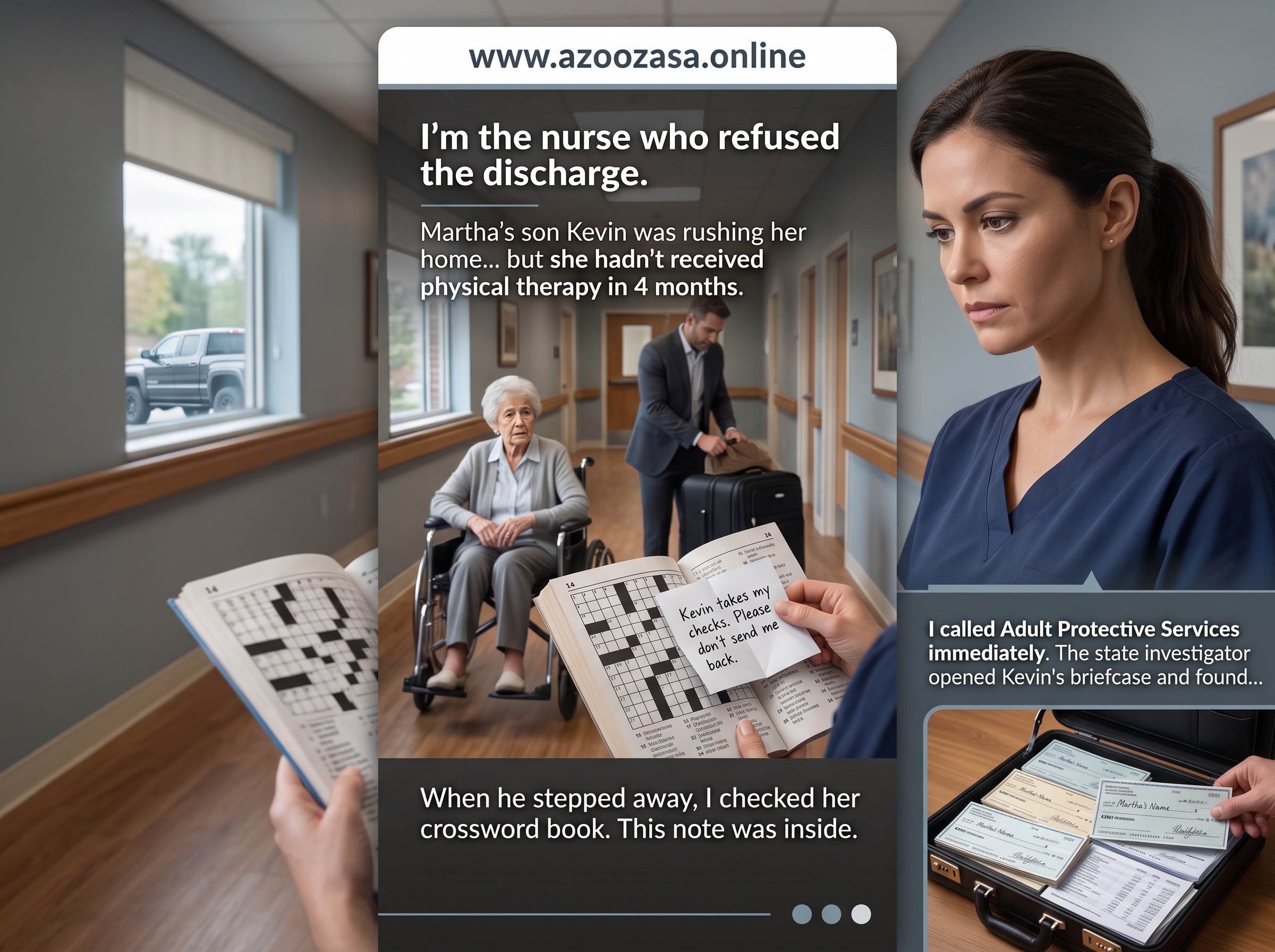
The moment he was out of sight, the silence in the corridor became absolute. I stepped around the nurses’ station and knelt in front of Martha’s wheelchair. Her eyes, a pale, cloudy blue, were wide with an unspeakable, primal terror. She wouldn’t look at my face; her gaze was locked onto the large-print crossword puzzle book resting in her lap. Her trembling finger tapped the glossy cover twice, urgently.
“Martha?” I whispered, taking her cold, frail hand in mine. “Do you want to go home with Kevin?”
She didn’t speak. She just squeezed my fingers with an astonishing, desperate strength and tapped the crossword book again.
I gently pulled the book from her lap. It was worn, the corners dog-eared and soft. I opened it, flipping past the half-finished puzzles in ink, until I reached the page she had marked. Folded neatly into a tiny, tight square and tucked deep into the binding of page fourteen was a piece of lined notebook paper.
My heart hammered violently against my ribs as I unfolded it. The handwriting was jagged and frantic, the ink smeared by what looked like dried teardrops, but the words were devastatingly clear:
Kevin takes my checks. He locks the door. He hits. Please don’t send me back.
A cold, heavy dread settled into the pit of my stomach. This wasn’t just medical neglect; this was active, malicious torture. Kevin wasn’t taking her home to care for her; he was taking her home to imprison her, siphoning her life away to fund his tailored coats and luxury trucks.
I looked up at Martha. A single tear escaped her eye, tracking a slow path down her wrinkled cheek.
“I’m not signing the paper,” I promised her, my voice dropping to a fierce, unwavering whisper. “You are not leaving this building, Martha. I swear to you.”
I stood up, leaving the clipboard on the counter, and bolted for the staff breakroom. I grabbed the landline, my fingers flying across the keypad as I dialed the emergency hotline for Adult Protective Services, followed immediately by a call to the local police dispatch. I read them the note. I told them about the truck, the canceled physical therapy, and the imminent, forced discharge.
“Stall him,” the APS dispatcher ordered, her voice clipped and professional. “Do whatever you have to do. The state investigator is on call and heading your way with a patrol unit. Give us ten minutes.”
Ten minutes. It felt like an eternity.
I returned to the lobby just as the automatic doors slid open and Kevin marched back in. He rubbed his hands together against the cold, his impatience practically radiating off him in waves.
“Alright, let’s go,” Kevin barked, reaching for the handles of Martha’s wheelchair. “Where is the discharge slip?”
“I can’t sign it yet,” I said smoothly, stepping directly between him and his mother. I grabbed the automated blood pressure cuff from a nearby cart. “State regulations require a final set of vitals taken within fifteen minutes of physical departure. Her last reading was over an hour ago.”
Kevin’s jaw tightened. A flash of pure, venomous anger crossed his face, stripping away the polished, wealthy facade to reveal the absolute monster lurking beneath. “I told you, we are leaving. Now. I am her medical proxy. You don’t get to hold us hostage.”
“It’s not a request, Mr. Davis,” I replied, wrapping the cuff around Martha’s thin arm. I purposely fumbled the velcro, moving with agonizing slowness. “If I let her leave without a final vitals check, I lose my license, and Medicare will flag the discharge as irregular, which means they might audit her home care setup. You wouldn’t want an audit, would you?”
The word audit hit him like a physical blow. He stepped back, his eyes narrowing into cold slits. “Fine. Do it. But make it fast.”
I hit the button on the machine, letting the cuff inflate. The seconds ticked by with agonizing lethargy. One minute. Two minutes. The machine beeped. I documented the numbers, moving my pen with deliberate, exaggerated care. I asked Martha standard baseline questions, checking her pupil dilation, pretending the thermometer was malfunctioning so I had to take her temperature twice.
“Enough!” Kevin finally snapped, grabbing the handles of the wheelchair. “We’re done here.”
“Actually, Kevin, you’re just getting started.”
The voice came from the lobby entrance. The heavy glass doors had slid open, admitting three people into the quiet facility. Two uniformed police officers stood on either side of a woman in a sharp gray trench coat. She wore a badge clipped to her belt and held a thick manila folder in her hand.
Kevin froze, his hands gripping the rubber handles of the wheelchair so tightly his knuckles turned white. “Who the hell are you?”
“Agent Harris, State Department of Adult Protective Services,” the woman said, closing the distance between them with measured, authoritative steps. “We received an emergency tip regarding the financial exploitation, medical neglect, and physical abuse of a vulnerable adult. Step away from the wheelchair, Mr. Davis.”
“This is ridiculous,” Kevin scoffed, though his voice lacked its previous booming confidence. A slight tremor had entered his hands. “I am her son. I manage her estate. She has severe dementia and makes things up. Whatever this nurse told you is a lie. I have her medical power of attorney right here in my briefcase.”
He grabbed his expensive leather briefcase from the counter, popping the brass latches to retrieve his documentation.
“Perfect,” Agent Harris said calmly. “I’d love to see that paperwork. In fact, under suspicion of elder exploitation, I have the authority to review all financial documents currently in your immediate possession pertaining to the ward. Open the briefcase, Kevin.”
Kevin hesitated. The color drained entirely from his face, leaving him looking sickly and pale under the fluorescent lights. He tried to snap the latches shut, but the larger of the two police officers stepped forward, his hand resting casually on his utility belt.
“Open it, sir,” the officer commanded.
With trembling, defeated fingers, Kevin flipped the leather top back.
Agent Harris stepped forward and looked inside. The silence in the lobby was deafening as she reached in and began pulling out the contents, laying them one by one on the nurses’ station counter.
First came the checkbooks. Not just one, but four separate accounts belonging to Martha, all of them pre-signed with her shaky, forced signature, ready to be filled out.
Next came the quitclaim deed. It was dated two weeks ago, effectively transferring the ownership of Martha’s paid-off, four-hundred-thousand-dollar home entirely into Kevin’s name for the sum of one dollar.
But it was the final document that made the breath catch in my throat. It wasn’t a home care plan. It wasn’t a physical therapy schedule.
It was a confirmed, non-refundable, one-way plane ticket to a rural county in a state a thousand miles away, paper-clipped to an admission brochure for a notorious, under-funded state psychiatric ward that had recently been featured in the news for severe patient neglect.
He wasn’t taking her home. He had stolen her house, drained her accounts, and was actively planning to dump her in an out-of-state asylum where she would never be heard from again.
Agent Harris looked at the plane ticket, then slowly raised her eyes to Kevin. The practiced neutrality of her profession was gone, replaced by a cold, searing disgust.
“Kevin Davis,” one of the officers said, stepping forward and pulling a pair of steel handcuffs from his belt. “Turn around and place your hands behind your back. You are under arrest for felony elder abuse, financial exploitation, and fraud.”
Kevin didn’t fight. The arrogant, untouchable veneer had shattered completely. He was a coward who preyed on the weak, and in the presence of true authority, he simply crumbled. He offered his wrists, his eyes locked onto the linoleum floor as the cuffs clicked shut with a sharp, final finality.
As they led him away, out through the sliding glass doors and into the flashing red and blue lights of the patrol cars, the heavy tension finally broke, leaving the lobby feeling vast and quiet.
I knelt back down in front of Martha. The terror had left her eyes, replaced by a profound, exhaustion-laced relief. I reached into my pocket, pulled out the folded piece of notebook paper from page fourteen, and gently pressed it into her palm.
“You don’t have to be afraid anymore,” I told her, tears finally spilling over my own lashes. “You’re staying right here with us.”
Martha looked down at the note, then back up at me. For the first time in the six months she had been at Oakridge, a small, genuine smile touched the corners of her mouth. She reached out, her frail hand resting gently against my cheek, and let out a long, shuddering breath.
The sun was just beginning to rise outside the windows, casting a warm, golden light across the lobby floors. The night shift was officially over, but as I wheeled Martha back down the hallway toward the safety of her room, I knew I was right exactly where I was meant to be.

0 comments