
The Silence of the Tally Marks
The air conditioner in my living room rattled with a desperate, metallic hum, fighting a losing battle against the unseasonable April inferno. It was the Tuesday after Easter, and the mercury had already clawed its way to ninety-two degrees by mid-afternoon. Yet, my seven-year-old granddaughter, Lily, sat rigidly on my floral sofa, sweltering inside a heavy, fleece-lined denim jacket. She looked like a tiny, fragile bird trapped in a denim cage, her pale forehead glistening with a sheen of sweat.
Across the room, her stepfather, Dale, slouched in my husband’s old recliner, the ice in his sweet tea clinking as he took a long, arrogant swallow. Dale had married my daughter, Sarah, exactly one year ago. It was an eighteen-thousand-dollar spectacle of a wedding, complete with imported orchids and a string quartet. Dale had played the part of the devoted savior perfectly, a charming real estate developer sweeping a single mother and her quiet daughter into a life of suburban comfort. But the charm had always felt terribly rehearsed to me.
“She’s just seeking attention, Margaret,” Dale said, his voice dripping with casual disdain as he gestured toward Lily with his sweaty glass. “Don’t cater to her. If she wants to roast in that coat, let her. She needs to learn that throwing silent tantrums doesn’t get her an audience.”
I didn’t answer him. I kept my eyes fixed on Lily, whose small hands were gripping the frayed hem of the jacket so tightly her knuckles were translucent.
“I’m going out to the yard to check the sprinklers,” Dale announced, groaning as he pushed himself out of the recliner. “Sarah gets off shift in an hour. We’ll take the brat home then.”
The heavy sliding glass door screeched on its tracks, clicking shut behind him. The sudden silence in the living room was suffocating.
I knelt on the plush carpet in front of Lily. Her eyes, usually a vibrant, curious hazel, were dull and completely vacant. They stared through me, fixed on some terrifying, invisible horizon.
“Lily-bug,” I whispered, keeping my voice as gentle as a falling leaf. “It is entirely too hot for this. You’re going to make yourself sick. Let Nana take the jacket off, just for a minute.”
She flinched when I reached out, a violently sharp intake of breath rattling her small ribs. I stopped, my hands hovering in the space between us. Slowly, with an agonizing hesitation, she let her hands drop from the hem.
I pulled the heavy brass zipper down. The thick denim fell open.
Beneath the jacket, she was wearing a thin, white cotton tank top. What I saw instantly drained the blood from my face and sent a wave of icy, paralyzing nausea crashing through my stomach. Dark, violent bruises mottled both of her tiny shoulders. They weren’t the clumsy, yellowish smudges of a playground fall. They were deep, angry blossoms of purple, black, and terrible crimson. The distinct shape of adult fingers was stamped into her fragile skin, overlapping in a chaotic map of cruelty where someone had grabbed her, lifted her, and squeezed with merciless force.
My breath caught in my throat, choking me. I reached out to touch her cheek, but Lily’s gaze had dropped to her lap. With trembling fingers, she unzipped the front pocket of her nylon backpack resting beside her. She pulled out a crumpled sheet of wide-ruled school paper and pushed it silently into my hands.
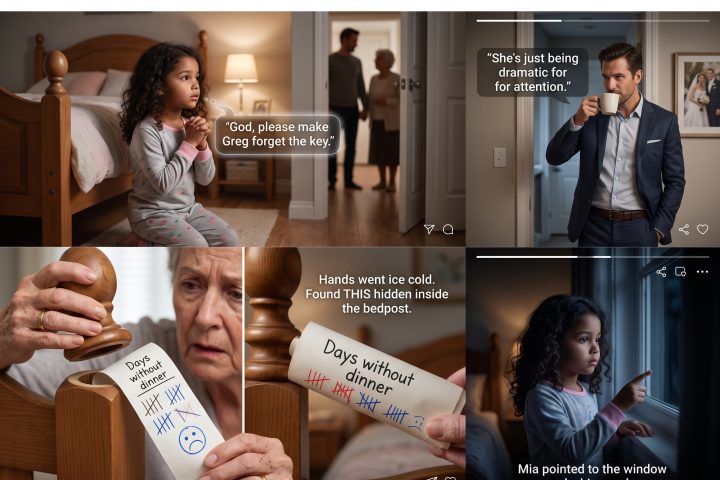
It was a drawing, done in the heavy, frantic strokes of a black crayon. It depicted a tall, narrow rectangle. A door. Around the edges of the door, the paper was shaded completely black, indicating a suffocating darkness. At the bottom of the page, beneath the drawing of the dark closet, were four deliberate, jagged red lines.
Four tally marks.
“He said the closet eats bad girls,” Lily whispered, her voice so thin it barely existed. “I had to stay in the dark. One mark for every hour. He set the kitchen timer.”
The world around me stopped spinning. The humming of the air conditioner, the distant chirp of neighborhood birds, the oppressive heat of the afternoon—it all vanished, replaced by a roaring, deafening tidal wave of maternal rage. My daughter’s husband. The man who had smiled in an expensive tuxedo, the man who was currently inspecting my petunias, had been locking this tiny, precious child in a pitch-black closet for hours at a time, dragging her by her shoulders into the dark.
My throat tightened so hard I couldn’t swallow. I folded the drawing, clutching it in my left hand with a ferocity that turned my fingernails white, and carefully zipped Lily’s denim jacket back up, concealing the evidence beneath the thick fabric.
“Do not move,” I told her, my voice eerily calm, a thin sheet of ice over a boiling ocean of fury. “Nana will be right back.”
I walked into the kitchen, my legs moving with mechanical, lethal precision. I picked up the heavy receiver of the wall-mounted landline. My fingers didn’t shake as I dialed 9-1-1.
“911, what is your emergency?” the dispatcher answered, her voice crisp and professional.
I turned my back to the glass sliding door, ensuring Dale couldn’t see my face through the kitchen window.
“My name is Margaret Hayes,” I whispered, pressing the phone agonizingly close to my mouth. “I need police officers at 442 Elmwood Drive immediately. No sirens. Turn them off before you turn onto the street. My son-in-law is in my backyard. He is actively abusing my seven-year-old granddaughter. I have physical evidence, and if he comes back inside before the police arrive, I am going to kill him.”
“Ma’am, please stay calm,” the dispatcher said, the urgency instantly escalating in her tone. “Officers are being dispatched now. Are you and the child in a safe room?”
“She is in the living room. He is in the yard. Send them now.” I hung up the phone without waiting for a reply.
I walked back into the living room and sat in the chair opposite Lily. My heart was hammering against my ribs like a trapped bird, but I forced my face into a mask of placid indifference. I watched the sliding glass door. Two minutes passed. Five minutes. The wait was an agonizing eternity, every second stretching into an unbearable hour.
Dale finally slid the door open, wiping sweat from his forehead with the back of his hand.
“Sprinklers are fine,” he grunted, walking straight to the kitchen to pour himself another glass of iced tea. “This heat is a joke. Tell the kid to get her shoes on. I want to leave as soon as Sarah pulls up.”
“She’s fine where she is, Dale,” I said, my voice steady, though my blood roared in my ears.
He paused, the pitcher of tea hovering over his glass. He looked at me, a flicker of genuine irritation crossing his handsome, arrogant face. “Excuse me?”
Before he could take a step toward me, a heavy, authoritative knock thundered against my solid oak front door. It wasn’t the polite tap of a neighbor; it was the demanding, unyielding strike of law enforcement.
Dale frowned, setting the pitcher down. “Were you expecting someone?”
I didn’t answer him. I stood up, walked to the door, and pulled it wide open.
Three police officers stood on my front porch. They were imposing, fully geared, and their eyes scanned the room instantly, moving past me and locking dead onto Dale in the kitchen.
“Can I help you officers?” Dale asked, his voice suddenly losing its arrogant edge, replaced by a nervous, forced chuckle. “Is there a problem?”
The lead officer stepped into the house, his hand resting casually but firmly on his utility belt. “Dale Vance? We need you to step outside, sir.”
“For what?” Dale demanded, his face flushing with a sudden, panicked crimson. “I haven’t done anything. Margaret, what is this?”
I stepped aside, placing myself squarely between Dale and the sofa where Lily sat. I reached into my pocket and pulled out the crumpled piece of wide-ruled school paper. I handed it to the second officer, a female deputy with sharp, observant eyes.
“Four hours,” I said, my voice finally cracking under the immense weight of the horror. “He locks her in a closet for four hours at a time. And if you look under her jacket, you’ll see exactly how he forces her inside.”
Dale lunged forward, the mask entirely gone, his face twisted into an ugly snarl of panic and rage. “You lying old—”
He didn’t finish the sentence. The two male officers crossed the living room in seconds. They hit him with the kinetic force of a freight train, spinning him around and slamming him chest-first against the kitchen counter. The metallic click of handcuffs echoed through the house, a sharp, beautiful sound of absolute finality.
“Dale Vance, you have the right to remain silent,” the lead officer growled, securing the cuffs tightly around Dale’s wrists.
As they dragged him out the front door, Dale kicking and screaming curses that shattered the quiet suburban afternoon, the female officer knelt in front of the sofa. She looked at Lily with an expression of profound, heartbreaking gentleness.
“Hi, sweetie,” she said softly. “I’m Officer Ramirez. Are you okay?”
Lily didn’t answer the officer. She looked past her, her wide hazel eyes finding mine. The paralyzing terror that had gripped her all afternoon was slowly melting away, replaced by the exhausted relief of a prisoner who realizes the cell door has finally been opened.
I walked over, knelt beside the officer, and reached for the brass zipper of that stifling, heavy denim jacket. This time, Lily didn’t flinch. She leaned into my hands.
As the jacket slid off her bruised shoulders and pooled onto the floor, the oppressive heat of the room finally seemed to break. I wrapped my arms around her tiny, trembling frame, burying my face in her hair. She was safe. The four tally marks were the last she would ever have to draw. The dark closet was closed forever, and as she squeezed me back, I knew that whatever darkness lay ahead, we would fight it entirely in the light.


0 comments