
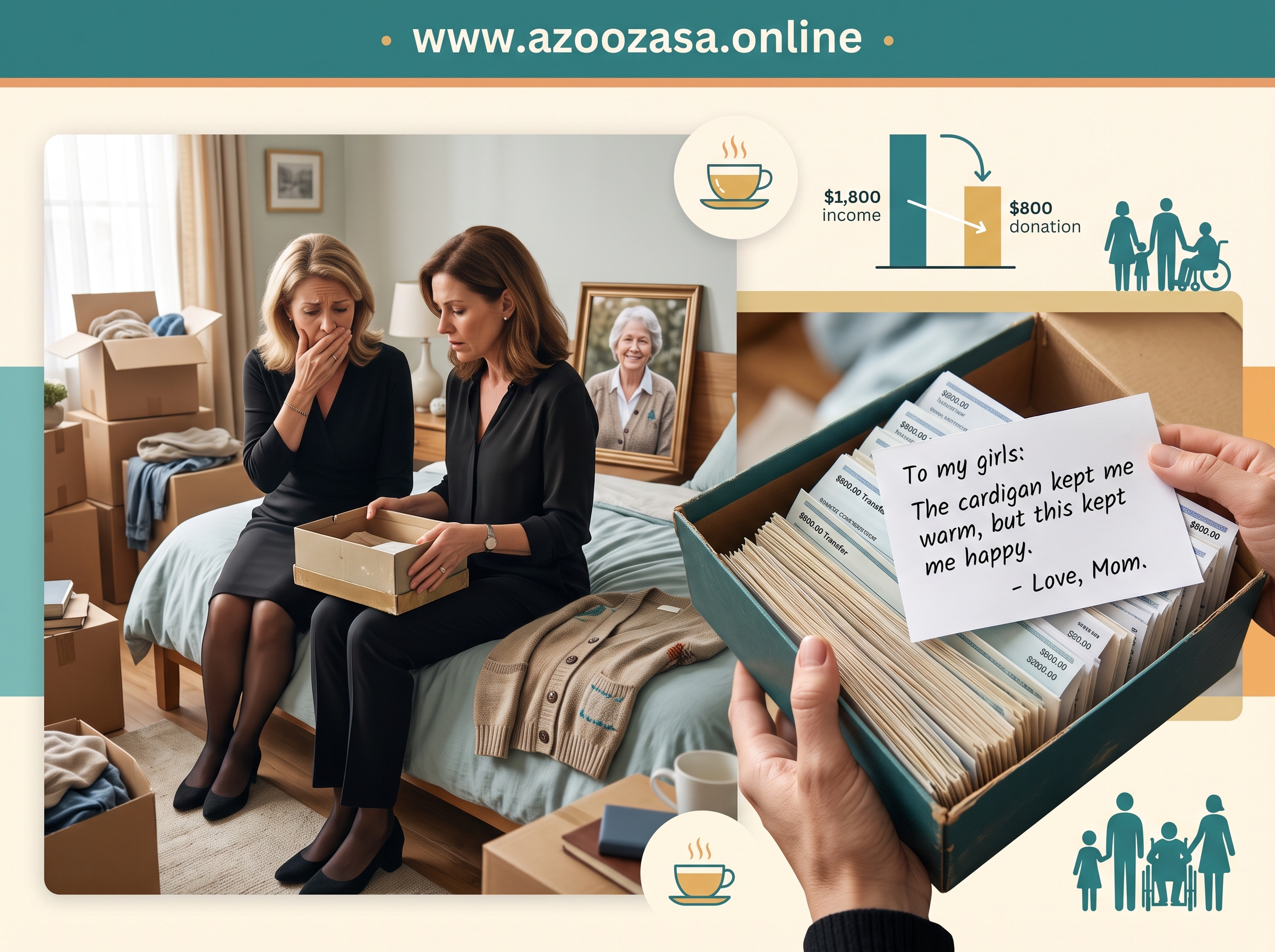
The Wealth of a Threadbare Life
The frayed hem of my mother’s navy-blue wool cardigan was a map of her stubborn endurance. She had worn that sweater for twenty-eight years. The elbows were cross-hatched with tight, meticulous grids of gray darning yarn, and the bottom button was a mismatched disk of brown plastic she had salvaged from an old winter coat. For my sister, Elena, and me, that cardigan was a source of profound, quiet frustration. It was the physical manifestation of our mother’s maddening refusal to let us make her life easier.
Mom lived on a fixed Social Security income of exactly $1,800 a month. By any modern metric, she was trapped in poverty, confined to a tiny, drafty, rent-controlled apartment on the ground floor of a brutalist brick building in the city. Yet, she moved through the world with the serene, untouchable grace of a queen. Whenever Elena and I tried to slip a hundred-dollar bill under her sugar bowl, or offered to pay her winter heating bill, she would find the money, fold it neatly into a square, and press it back into our palms. She would sit in her faded armchair, smooth the wrinkles of her ancient cardigan, take a slow sip of her Earl Grey tea, and say the exact same thing she always said: “I have everything I need, girls. Keep your money for your own families.”
We thought it was pride. We thought she was clinging to the last fragile shreds of her independence, terrified that accepting our help would mean admitting her vulnerability.
Last month, her heart finally gave out in her sleep. After the funeral, the overwhelming silence of her absence settled into the bones of her apartment. Yesterday afternoon, Elena and I arrived with a stack of flattened cardboard boxes and a roll of packing tape, tasked with the heartbreaking chore of dismantling a life. The apartment smelled fiercely of her—a comforting blend of lavender soap, old paper, and dried tea leaves.
We worked in a heavy, reverent silence. Elena took the kitchen, wrapping chipped ceramic mugs in newspaper, while I tackled the bedroom. There wasn’t much to pack. Mom owned three pairs of shoes, a handful of modest dresses, and a stack of romance novels she bought from the thrift store for fifty cents apiece.
I was pulling a dusty plastic storage bin from beneath her squeaky metal bed frame when my hand brushed against something pushed far into the back corner, pressed tightly against the baseboard.
It was a faded, scuffed Reebok shoebox.
I pulled it out, blowing a thick layer of gray dust off the lid. It felt surprisingly heavy. I sat cross-legged on the worn carpet, expecting to find old photographs, faded birth certificates, or maybe the cheap costume jewelry she had inherited from our grandmother. Instead, when I lifted the cardboard lid, I found hundreds of rectangular slips of paper, bound tightly together in groups of twelve by brittle rubber bands.
I pulled out the first stack and snapped the rubber band. It crumbled into dry pieces against my thumb. I turned the top slip over. It was a carbon copy of a bank deposit receipt. The date was stamped in faint purple ink: October 3, 2016. The amount deposited was $800.00.
I frowned, my brow furrowing in confusion. I flicked to the next slip. November 3, 2016. Amount deposited: $800.00. I kept flipping. December, January, February. Every single month, always on the third day of the month—the day immediately following the direct deposit of her Social Security check—she had transferred eight hundred dollars.
“Elena,” I called out, my voice sounding thin and hollow in the quiet room. “Elena, you need to come in here.”
My sister appeared in the doorway, a dish towel thrown over her shoulder, her eyes red-rimmed from crying over the kitchen sink. “What is it?”
I handed her a stack of the slips. “Look at the numbers. And look at the account name at the bottom.”
Elena wiped her hands on her jeans and took the papers. She squinted at the faint, dot-matrix printing on the bottom of the receipt. “Transfer to: The Miller Family Trust.” She looked up at me, the color completely draining from her face. “Sarah, this is… this is Mr. Miller. From apartment 4B.”
David Miller was our mother’s upstairs neighbor. Ten years ago, he had been a roofer. One rainy afternoon, a scaffold collapsed, and David fell three stories onto a concrete driveway. He survived, but his spine was shattered, leaving him permanently paralyzed from the neck down. His wife, Maria, had been forced to quit her job as a preschool teacher to become his full-time caregiver. They had two young boys, and no income other than a meager disability check. Elena and I had always known the Millers were struggling. We knew Mom occasionally baked them a casserole or sat with David so Maria could run to the grocery store.
We didn’t know she was keeping them alive.
Elena dropped to her knees beside me on the carpet. We began tearing through the shoebox, doing the desperate, terrifying math in our heads. Ten years. One hundred and twenty months. Eight hundred dollars a month. Our mother had quietly, invisibly transferred nearly one hundred thousand dollars to the Miller family.
“How?” Elena whispered, tears welling in her eyes, spilling over her lashes and dropping onto the bank slips. “Her rent was six hundred dollars. If she gave away eight hundred… that left her with four hundred dollars a month. For food. For electricity. For everything.”
Suddenly, the twenty-eight-year-old cardigan made devastating sense. The fifty-cent thrift store books. The way she would insist on turning the lights off the second we left a room. The way she watered down her dish soap and walked three miles to the grocery store to save the dollar-fifty bus fare. She wasn’t trapped in poverty; she had aggressively, deliberately chosen it. She had starved her own comfort to feed a family she owed nothing to.
At the very bottom of the shoebox, resting beneath the final stack of receipts, was a single piece of heavy floral stationery, folded perfectly in half. My name and Elena’s name were written on the outside in Mom’s elegant, looping cursive.
My hands shook violently as I picked it up. I unfolded the paper.
My dearest Sarah and Elena,
If you have found this box, my time has passed, and I imagine you are both very confused, and perhaps a little angry with me for living the way I did. I know how much it pained you to see me wearing that old blue sweater, and I know how desperately you both wanted to buy me a softer life. Please forgive me for refusing your generosity. I could not accept your money, because I would have just given it away, and it was not my place to spend your hard-earned lives.
When David Miller fell, I watched a beautiful family shatter. I watched Maria standing in the hallway outside their door, weeping silently into her hands because they were going to turn the electricity off, and David’s ventilator required power. I went back into my apartment, and I looked around at my life. I had two brilliant, independent daughters who were safe and thriving. I had a warm bed. I had a full life behind me.
The world tells us that when we reach the end of our lives, we should build a fortress of comfort around ourselves. But I could not sit in a brightly lit room while the family above me drowned in the dark. I realized that if I lived on the absolute minimum, I could provide just enough to keep their lights on and their children fed. My life became about finding a way to give them just one more day of peace. One more month of warmth. One more year in their home.
Do not mourn the things I didn’t buy. True wealth is not measured by the softness of the fabric on your back, but by the weight of the burdens you are able to lift from the shoulders of others. Every time I patched that old sweater, I knew David was breathing easy, and I knew Maria’s boys were eating dinner. I traded new clothes for human life, and it was the greatest bargain I have ever struck.
I did not die poor, my sweet girls. I died the richest woman on this earth. Be kind to each other. Take care of your neighbors. And please, finally throw that awful blue cardigan in the trash.
All my love,
Mom
Elena let out a ragged, agonizing sob, collapsing forward and burying her face against my shoulder. I wrapped my arms around her, crushing the letter against my chest as I cried until my ribs ached. We sat on the floor of that tiny, barren bedroom for a long time, surrounded by the undeniable paper trail of a saint.
When we finally stood up, the apartment felt entirely different. It was no longer a bleak monument to scarcity. It was a holy place, a sanctuary where a profound and quiet heroism had taken place every single day for ten years.
I walked out to the living room and picked up the navy-blue wool cardigan from the back of the armchair. I ran my thumb over the mismatched brown button and the meticulous gray darning on the elbows. It felt heavy in my hands, woven with a magic I was only just beginning to understand. I didn’t throw it in the trash. I carefully folded it, placed it inside my tote bag, and walked with my sister upstairs to apartment 4B, ready to look David and Maria in the eyes and tell them exactly who had been standing in the dark with them all along.


0 comments