
Two Hundred and Sixteen Sundays
Arthur died on the Tuesday after Thanksgiving, collapsing in the driveway with a snow shovel still gripped firmly in his gloved hands. I watched it happen from the kitchen window, the winter sun casting long, brittle shadows across the asphalt. There was no dramatic final exchange, no tearful goodbye at a hospital bedside. One moment he was clearing a path to the street, and the next, he was simply gone. We had been married for thirty-four years, but for the last eighteen, we had lived as polite strangers occupying the same quiet house, navigating the hallways like ships passing in heavy fog.
The chasm between us had opened the day we buried our twelve-year-old son, Julian.
Julian had fought leukemia with the fierce, uncomprehending bravery of a child, but the disease was a relentless thief. When he took his final, shallow breath in the pediatric ward, I fell to my knees on the linoleum floor, completely undone. I screamed until my vocal cords bled. But Arthur didn’t make a sound. Through the autopsy, the awful meetings with the funeral director, and the burial itself, Arthur stood like a man carved from slate. He never shed a single tear. He didn’t hold my hand at the graveside. He simply watched the small mahogany casket lower into the earth with a blank, impenetrable stare.
I thought he was cold. I thought the tragedy had bypassed his heart entirely, leaving only a hollow, unfeeling shell behind.
In the years that followed, the silence in our home thickened until it felt like a physical weight pressing against the walls. Arthur began taking voluntary overtime shifts at the manufacturing plant, leaving the house before the sun rose and returning long after I had gone to sleep. When we did share a room, he chewed his meals while staring blankly at the evening news. He never spoke Julian’s name. If a television show featured a sick child, he would quietly stand up and leave the room. I interpreted his avoidance as erasure, a cruel refusal to honor the memory of the boy we had made. Eventually, the resentment calcified. We moved into separate bedrooms, bound together only by a shared mortgage and the exhausting inertia of a broken life.
Three weeks after Arthur’s brief, sparsely attended funeral, the first heavy blizzard of the season buried the town. I was sitting at the kitchen table, nursing a cold cup of black coffee and staring at the empty driveway, when a heavy, rhythmic knock rattled the front door.
I pulled my wool cardigan tighter around my shoulders and opened the door to a wall of freezing wind.
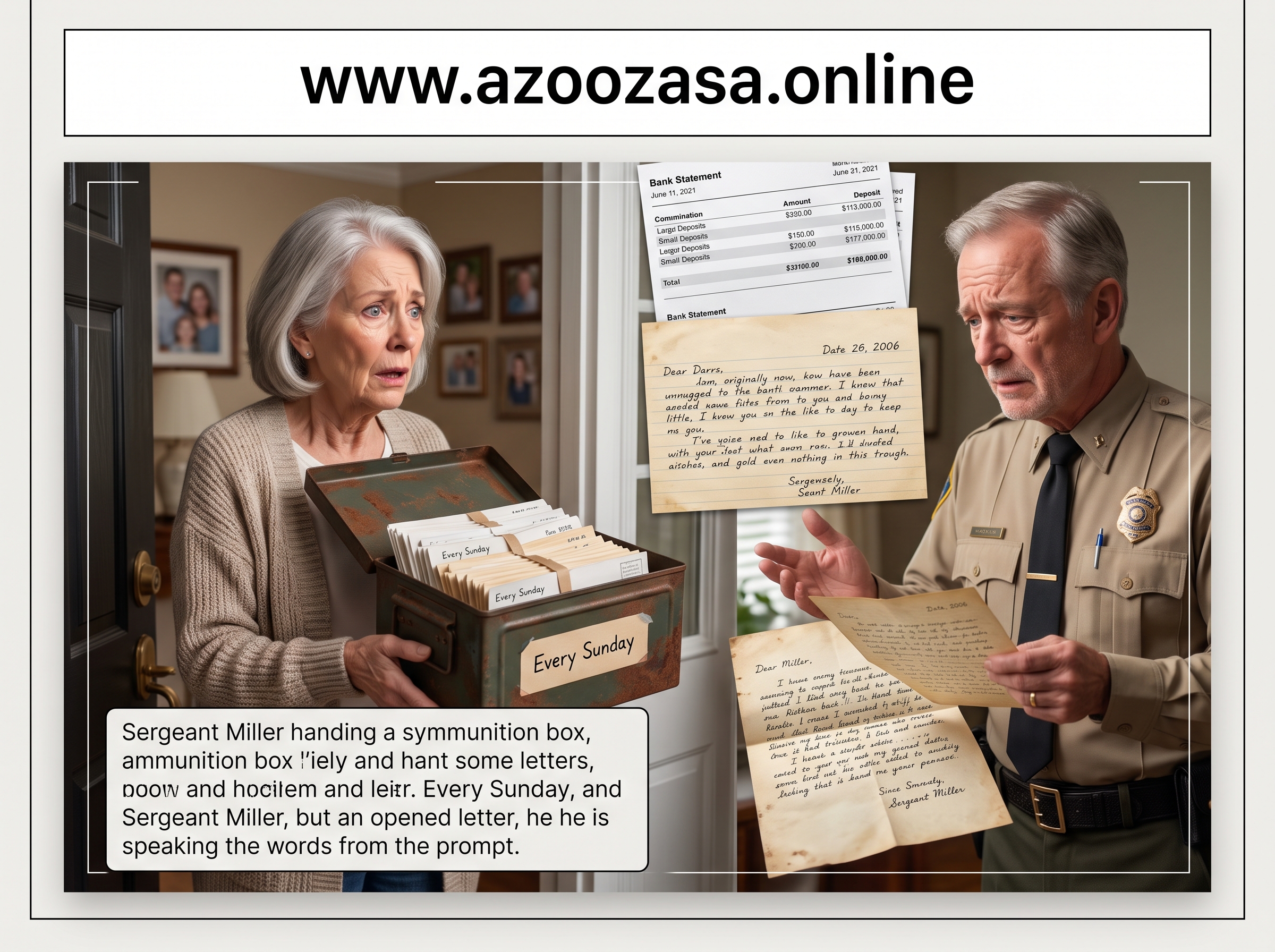
Standing on the porch was a tall, broad-shouldered man in a heavy charcoal overcoat. His face was weathered, lined with the kind of deep fatigue that comes from carrying other people’s burdens, and a faded military tattoo peeked out from the cuff of his right sleeve. Cradled awkwardly against his chest was a heavy, olive-green metal ammunition box, severely rusted at the hinges and corners.
“Mrs. Vance?” he asked, his breath pluming in the freezing air.
“Yes,” I replied, keeping the storm door cracked just enough to speak. “Can I help you?”
“My name is Sergeant Miller,” he said, shifting his weight against the cold. He looked down at the heavy box, then back up to my face, his eyes suddenly glistening. “Arthur sent me.”
I unlatched the storm door and stepped back, wordlessly inviting him into the foyer. He stomped the snow from his heavy boots and followed me into the living room, bringing the sharp scent of ozone and pine needles with him. He didn’t sit down on the sofa. Instead, he knelt on the Persian rug and placed the rusted metal box carefully onto the glass coffee table, treating it with a profound, almost desperate reverence.
“Arthur and I met eighteen years ago, down at the VA hall,” Miller said, his voice a low, gravelly rumble. “I run a grief support group for veterans who lost children. Arthur wasn’t a veteran, but he showed up one Tuesday night, stood in the back of the room, and refused to leave. He came every week for nearly two decades.”
The room seemed to tilt slightly beneath my feet. “Arthur didn’t go to support groups,” I said, my voice barely more than a whisper. “He worked late. He worked double shifts at the plant.”
“He did work double shifts, ma’am,” Miller nodded slowly. “He worked them so he could do this.”
Miller reached out and snapped the heavy metal latch of the ammo box. It shrieked in protest before popping open. The heavy lid fell back, revealing the dark interior.
Sitting on top of the pile was a thick, bound ledger from the county bank. I reached down, my hands trembling uncontrollably, and opened the leather cover. Page after page was filled with Arthur’s meticulous, jagged handwriting, detailing small, relentless deposits. Seventy-five dollars here. A hundred and fifty there. The math was agonizing. He had skipped lunches. He had sold his prized vintage watch collection piece by piece. He had driven his truck until the transmission fell out, refusing to buy a new one, funneling every spare cent into a single external account.
I flipped to the final page. The total was circled in red ink: $140,000.
The destination account was typed clearly at the bottom of the ledger: The Julian Vance Endowed Grant for Pediatric Oncology Research.
“He funded a grant,” Miller said quietly. “He told me he couldn’t save his own boy, but he was going to make damn sure he bought some time for someone else’s. He didn’t want you to know. He said you had already lost enough, and he didn’t want you sacrificing your own comfort to fund his crusade.”
I stared at the number, the breath leaving my lungs in a violent rush. The late nights, the worn-out boots he refused to replace, the quiet exhaustion that I had mistaken for indifference—it had all been a monument. A silent, bleeding monument to our son.
But it was what lay beneath the ledger that completely broke the foundation of everything I thought I knew.
Stacked in neat, chronological rows inside the rusted metal box were hundreds of white envelopes. They were yellowed with age at the bottom, growing starkly white near the top. I recognized the blue ink. I recognized the heavy, deliberate press of Arthur’s pen.
They were letters. Exactly two hundred and sixteen of them. Dated the first Sunday of every single month for the last eighteen years.
“He wrote one every month,” Miller said, his voice finally trembling, betraying the stoic military posture he had tried to maintain. “He brought them to the group. He’d hold them in his lap, but he’d never read them out loud. He just said they were the only things keeping him anchored to the earth.”
I reached into the box and let my fingertips graze the edge of the envelopes. I had spent nearly two decades believing my husband’s heart had turned to stone, when in reality, it had been breaking, month after month, Sunday after Sunday, in absolute, agonizing silence. He hadn’t abandoned our son’s memory; he had simply locked himself inside a prison of grief to keep me from having to look at it.
Miller reached into the box and pulled out the very top envelope—the final letter Arthur had written, dated just two days before he died in the snow.
Miller opened the envelope, pulled out the single sheet of lined notebook paper, and handed it to me.
“He made me swear on my life to bring this box to you when his watch ended,” Miller said, a single tear escaping and tracking down his weathered cheek. “He asked me to make sure you read this one first.”
I took the paper. The handwriting was shakier than it used to be, the blue ink bleeding slightly where a drop of water—or a tear—had struck the page. I took a ragged breath and read my husband’s final words.
My dearest Eleanor,
If you are reading this, I am finally with Julian. For eighteen years, I have watched you look at me and see only a ghost. I know you thought I was cold the day we buried him. I know you hated me for not crying. But Ellie, the truth is, if I had let myself shed a single tear that day, I would have drowned us both. You were completely shattered, and one of us had to be made of stone so the house wouldn’t collapse on top of you.
I couldn’t be warm. Warmth meant feeling the shape of his absence, and if I felt it, I wouldn’t have survived it. So I built this wall, and I stayed on my side, and I worked until my bones ground to dust to try and buy a cure for a boy who is already gone.
I am so terribly sorry for the silence. I loved you enough to carry the unbearable weight of this grief alone, so you wouldn’t have to carry it for two. Please, forgive the stone I became. Spend the money on the living, let the sun back into the house, and know that in the quiet, I never stopped screaming his name, and I never stopped loving you.
Yours in the dark, and in the light,
Arthur.
The paper slipped from my fingers, fluttering softly onto the glass table. The heavy, suffocating winter that had trapped my house for eighteen years suddenly cracked wide open. I collapsed onto the sofa, pulled my knees to my chest, and let out a sob that had been trapped in my throat since the day we stood at Julian’s grave.
Sergeant Miller didn’t leave. He didn’t offer empty platitudes. He simply sat down in the armchair across from me, a silent sentry, keeping watch while I finally wept for the beautiful, broken man who had loved me in the only way he knew how to survive.

0 comments