
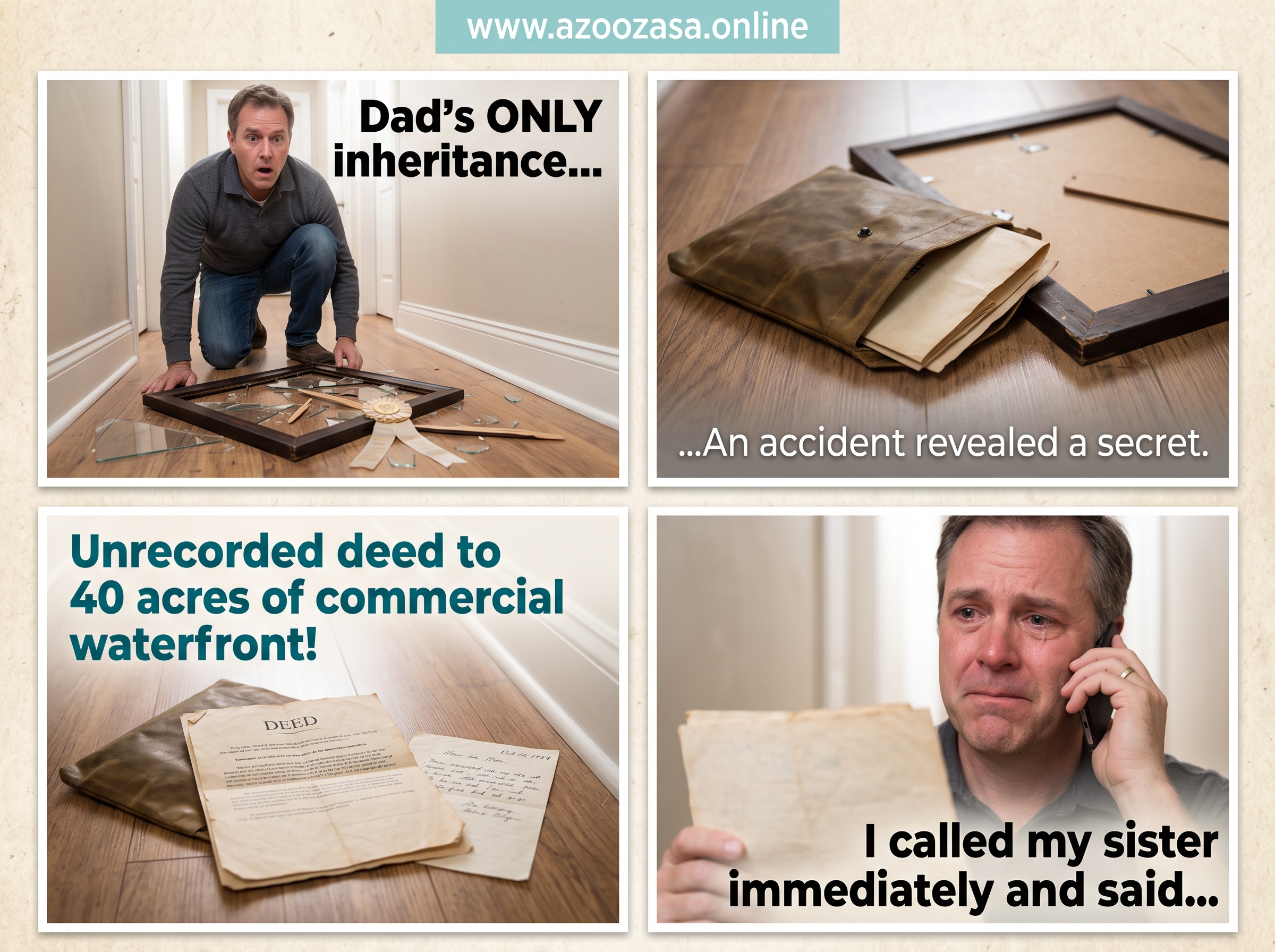
The Blue Ribbon Legacy
The mahogany grandfather clock in the corner of Mr. Abernathy’s office ticked with the heavy, rhythmic finality of an executioner’s drum. The air in the probate attorney’s suite was thick with the scent of lemon polish and the suffocating, cloying aroma of my older sister Elaine’s expensive Chanel perfume. She sat perfectly composed in the high-backed leather chair beside me, her designer sunglasses pushed up into her meticulously highlighted hair, tapping her manicured nails against the edge of the polished desk.
I sat with my hands folded in my lap, wearing a worn wool sweater that suddenly felt incredibly inadequate for the occasion.
“To my eldest daughter, Elaine,” Mr. Abernathy read, his spectacles slipping down the bridge of his nose as he studied my father’s final will and testament, “I leave the primary residence on Elm Street, the restored 1968 Mustang, and the entirety of my remaining liquid assets, totaling four hundred and twenty thousand dollars.”
Elaine didn’t gasp. She didn’t cry. A slow, satisfied smile crept across her face, the kind of smile a predator makes when the trap finally snaps shut. She had spent the last five years hovering around our father’s declining health, ensuring her name was on every contact list, suffocating him with a manufactured devotion that only appeared when bank statements were left out on the kitchen counter.
Mr. Abernathy cleared his throat, adjusting the heavy parchment paper. He looked up at me, a flicker of genuine pity softening his stern eyes. “And to my youngest child, I leave the framed 1954 county fair blue ribbon, currently hanging in my workshop.”
The room plunged into a deafening silence. Even the attorney seemed embarrassed by the profound disparity. I felt the blood rush to my cheeks, burning with a mix of profound humiliation and a deep, aching grief. It wasn’t about the money. I had never asked my father for a dime. But the absolute dismissal, the reduction of my entire existence to a single, faded piece of silk from a childhood long gone, felt like a physical blow to the chest.
Elaine stood up, smoothing the front of her tailored silk blouse. She didn’t even try to hide her triumphant smirk. She leaned over my chair, the heavy scent of her perfume making my stomach violently churn.
“Don’t look so shocked,” Elaine whispered, her voice dripping with venomous pity. “You always were Dad’s disappointment. Now you have the souvenir to prove it.”
I didn’t say a word. I signed the necessary waiver forms, stood up, and walked out into the cold November afternoon. I drove my ten-year-old sedan to my father’s empty house, walked past the boxes Elaine had already started packing, and retrieved the cheap, cracked wooden frame from the dusty wall of the garage workshop.
For the next two months, that cheap wooden frame hung in the narrow, dimly lit hallway of my third-floor walk-up apartment. The ribbon inside was a deeply faded navy blue, awarded to my father when he was just sixteen years old for a handcrafted wooden skiff he had built from scrap lumber. It was a testament to hard work, precision, and the value of building something with your own two hands—virtues my father had desperately tried to instill in us. Virtues that Elaine had mocked, preferring the fast track of corporate real estate and heavily leveraged luxury developments.
Every time I walked past the frame, it served as a bitter reminder of my own perceived inadequacy. I was the quiet one. The one who became a high school history teacher instead of a high-powered executive. The one who showed up to fix his leaky faucets on Sundays while Elaine sent expensive, impersonal gift baskets.
Last night, the winter rain was lashing aggressively against the thin windowpanes of my apartment. I was in the middle of my weekly cleaning, carrying a yellow microfiber rag and a can of lemon polish. The hallway was shadowed, illuminated only by the flickering bulb of a nearby streetlamp bleeding through the blinds.
I sprayed the rag and reached up to wipe a thick layer of dust off the top edge of the old pine frame.
Perhaps the hanging wire in the back had finally rusted through, or perhaps my fingers simply slipped on the damp wood. The frame violently twisted out of my grip. I lunged to catch it, but I was a fraction of a second too late.
The frame hit the hardwood floor with a sharp, explosive crash. The ancient glass shattered into a hundred jagged, glittering shards, scattering across the hallway runner.
“Damn it,” I muttered, dropping to my knees. I began carefully picking up the larger pieces of glass, terrified of burying a shard in my heel. I reached for the wooden frame to push it aside, but as I lifted it, the thick, rigid cardboard backing detached completely from the wood.
The faded blue ribbon fluttered to the floor, landing softly on the rug.
But it didn’t fall alone.
Taped to the reverse side of the thick cardboard backing was a flat, meticulously sealed oilskin pouch. It was the color of dark amber, tied shut with a heavy piece of waxed nautical twine.
My heart stalled in my chest. The air in the quiet apartment suddenly felt incredibly thin. I brushed the remaining glass from my knees, picked up the heavy pouch, and carried it to the kitchen table. My hands were shaking so violently that I had to use a pair of kitchen shears to cut through the tough nautical twine.
I peeled back the stiff, waterproof flaps of the oilskin. Inside rested a thick stack of heavy legal parchment and a single piece of lined notebook paper.
I pulled the legal document out first. It was heavily stamped by a municipal notary, featuring a raised gold seal at the bottom. I read the bold, capitalized header: UNRECORDED DEED OF TRANSFER.
My eyes scanned the legal jargon, the dense paragraphs of property demarcations and longitudinal coordinates, until I reached the summary clause. It was a deed to forty acres of prime commercial waterfront property at Blackwood Point. The official tax assessment value was printed clearly in the margin: $180,000.
My breath caught in my throat. Blackwood Point. It was the last undeveloped stretch of deep-water access in the county. For the last three years, Elaine’s luxury real estate development firm had been publicly bleeding money, sinking every asset they had into a massive, multi-million-dollar marina and resort project nearby. But the entire project was currently stalled in a brutal zoning war because they lacked direct commercial water access. Elaine had spent months furiously searching for the anonymous owner of the Blackwood Point parcel, desperate to buy it before her firm’s investors pulled out and forced her into bankruptcy.
I set the deed down on the table, my pulse hammering a frantic, deafening rhythm in my ears. I reached into the pouch and pulled out the single sheet of lined notebook paper.
It was my father’s handwriting, jagged and rushed, dated exactly two weeks before the massive heart attack that took his life.
My dearest, steadfast child,
If you are reading this, the glass finally broke. I always knew you would be the one to keep the ribbon. You were the only one who ever understood that true value isn’t found in a bank account; it’s found in what you build, and what you protect.
I know what happened in Mr. Abernathy’s office. I know Elaine took the money, the house, and the cars. She thinks she has won, because she has spent her entire life measuring love in dollar signs. But what I did not tell her—and what the probate courts will not discover until the creditors file their claims next month—is that the $420,000 in those accounts is entirely collateralized against a massive, failed corporate loan from my old construction business. The house has two hidden liens against it. By the time the banks are finished auditing the estate, Elaine will be left with absolutely nothing but the legal fees.
I left her the illusion of wealth, because it is the only thing she respects.
But I left you the reality of power. The deed in your hands is completely unencumbered, free and clear. On paper, it is worth $180,000. But to your sister, it is the absolute key to her survival. Without Blackwood Point, her marina fails, her investors walk, and her empire crumbles. She always thought I sold this land out of spite. She never knew I saved it for you.
You were never my disappointment. You were my anchor. Do with this leverage exactly what you will.
Love always,
Dad.
A hot, blinding tear slipped down my cheek, splashing against the faded blue ink. The resentment, the suffocating grief, the years of feeling like a ghost in my own family—it all washed away in a profound, crashing wave of realization. My father hadn’t abandoned me to poverty. He had handed me a loaded gun, pointed directly at the sister who had tormented me for a lifetime, and trusted me to pull the trigger.
I looked at the clock on the microwave. It was 11:45 PM.
I didn’t care.
I grabbed my cell phone from the counter, pulled up my contacts, and pressed the green call button next to Elaine’s name. The line rang three times before she answered, her voice thick with sleep and heavy with immediate annoyance.
“Do you have any idea what time it is?” Elaine snapped. “If you’re calling to ask for a loan out of Dad’s money, the answer is still no. I’m not running a charity.”
I looked down at the unrecorded deed resting on my kitchen table, the gold notary seal catching the warm overhead light. A slow, incredibly calm smile spread across my face.
I called my sister immediately and said, “I don’t need a loan, Elaine. I just wanted to give you a courtesy call about your Blackwood Marina project. I know your investors are threatening to walk by Friday if you don’t secure the deep-water access parcel.”
The line went dead silent. I could hear the sudden, sharp intake of her breath. “How do you know about that?” she demanded, her voice suddenly awake and laced with paranoia. “Who told you about Blackwood Point?”
“Nobody had to tell me, Elaine,” I replied, leaning back in my chair and tracing the edge of the 1954 blue ribbon with my index finger. “I’m just looking at the unrecorded deed for the forty acres of commercial waterfront Dad hid behind my disappointment. I’m meeting with a commercial broker tomorrow morning to list it on the open market, but since we’re family, I figured I’d offer you the first opportunity to beg your new landlord for a lease.”


0 comments