
The Sins of the Iron Flue
For forty years, the rusted iron plate bolted over our attic chimney flue was the sole, undisputed mystery of my childhood. It was secured by two heavy, brass padlocks that looked as though they belonged on a medieval dungeon rather than a mid-century colonial home in upstate New York. My father, Thaddeus, was a quiet, methodical man who worked at the local hardware store and spent his weekends meticulously tending to his tomato garden. But his demeanor would instantly darken into something terrifying if I ever ventured near the attic stairs. Every summer, when the heat made the old timbers groan, he would stand at the base of those steps and deliver the same chilling mandate: “Never open that flue if you want to stay alive.”
I always assumed it was a morbid exaggeration to keep a curious child from inhaling toxic soot or falling foul of a dormant wasp nest. But Thaddeus passed away last month, taking his secrets to a quiet grave beneath the weeping willows of Rest Haven Cemetery.
Yesterday, the sky bruised into a violent, churning purple. An intense summer storm battered our small town, unleashing a torrential downpour accompanied by artillery-fire thunder. I was sitting in the living room, sorting through boxes of my father’s old flannel shirts, when a deafening crack shook the very foundation of the house. It wasn’t just thunder; it was the sickening sound of structural failure. I sprinted up the narrow, creaking stairs to the attic, my flashlight beam cutting through the swirling dust.
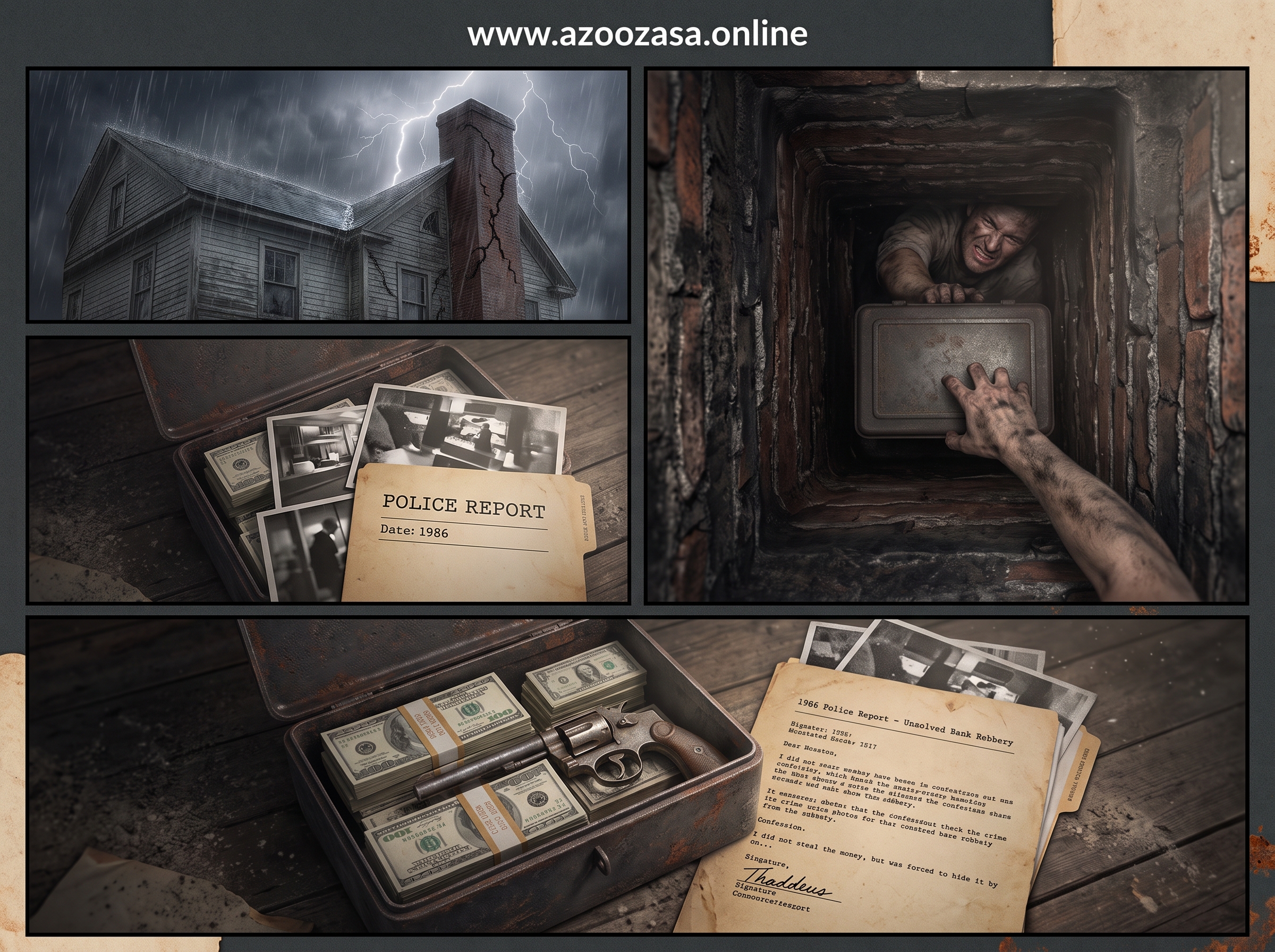
A lightning strike had clipped the top of the chimney. The ancient brickwork had buckled under the kinetic force, causing a jagged, weeping crack to spiderweb straight down the masonry, right through the mortar framing the iron plate.
My knees shook as I approached the chimney. The structural shift had snapped the heavy iron eyelets right out of the deteriorating brick. The two padlocks were still fully engaged, but the plate itself hung loose, dangling by a single bent hinge. The rusted latch had finally broken free.
I hesitated, my father’s raspy, tobacco-stained voice echoing in my ears, warning me of death. But the silence of the empty house urged me forward. I wedged my flashlight into my armpit, gripped the cold, jagged edge of the iron plate, and pulled. It gave way with a agonizing metallic screech, revealing a dark, hollow cavity that smelled intensely of ozone, dry rot, and old steel.
Resting on a brick ledge deep inside the dark throat of the chimney was a heavy, sealed iron box.
It took all my strength to pull it free. The box was roughly the size of a large briefcase, coated in decades of untouched soot. I dragged it to the center of the attic floor, the wood groaning beneath its sheer weight. The latch on the box wasn’t locked—merely rusted shut from decades of humidity. I grabbed a flathead screwdriver from my pocket and wedged it under the hasp, throwing my weight against the handle. With a sharp crack, the lid popped open.
I fell back onto the dusty floorboards, my heart hammering against my ribs as my flashlight beam spilled over the contents.
Neatly stacked in the center were bricks of cash. Hundreds of them. The paper wrappers were yellowed and brittle, bearing the fading insignia of the Blackwood First National Bank. I didn’t need to count it to know it was a fortune—the bands read $160,000 in untraceable, non-sequential bills. Nestled beside the cash was a snub-nosed .38 caliber revolver, its blue-steel barrel gleaming with a fresh coat of gun oil that had miraculously preserved it against the ravages of time.
But it was the manila folder pressed against the lid that made the blood freeze in my veins.
The tab read Blackwood PD: Case #86-042 in faded red ink. I opened the folder with trembling hands. Inside were glossy, black-and-white crime scene photos from September 12, 1986—the night of our town’s most infamous, unsolved tragedy. The Blackwood Bank had been robbed, and the beloved night watchman, an elderly man named Arthur Higgins, had been shot twice in the chest. The photos were gruesome, capturing the shattered glass of the teller windows and the dark, pooling blood on the linoleum floor.
Beneath the horrifying photographs was a single sheet of heavy stock paper, rolled out from a typewriter. At the bottom was my father’s unmistakable, sloping signature. I held the flashlight closer, the beam trembling over the faded typeface.
To whoever finds this, if I am dead, I pray God has mercy on my soul for my cowardice.
I did not rob the Blackwood First National. I did not pull the trigger on Arthur Higgins. But I know who did, because the murderer stood in our kitchen at two in the morning, drenched in the storm, with Arthur’s blood splattered across his boots. He pointed his service weapon at my wife’s pregnant belly and told me that if I did not hide this money, my child would never take his first breath.
I am a weak man. I chose my family over justice.
I was forced to hide this blood money by Deputy Elias Thorne.
I stopped breathing. The flashlight nearly slipped from my grip. Elias Thorne. The name hit me like a physical blow to the chest. Thorne wasn’t just a deputy anymore. He had spent the last twenty-five years as the undisputed Chief of Police in Blackwood. He had attended my father’s funeral just three weeks ago, placing a heavy, sympathetic hand on my shoulder and telling me what a “good, quiet man” Thaddeus had been.
Thorne killed the guard, the letter continued. He needed a patsy, someone off the grid to hold the cash until the FBI stopped looking. But I bolted the flue shut and swallowed the key. I told him if he ever came for the money, or if anything ever happened to me, I had left a dead-man’s switch that would send the evidence straight to the state police. It was a bluff. A desperate, terrified bluff. But it kept us alive. It kept him away. Until now. If you are reading this, Thorne knows I am gone.
A sudden, sharp sound cut through the rhythmic drumming of the rain on the attic roof.
It wasn’t thunder. It was the distinct, heavy crunch of tires rolling slowly up our gravel driveway.
I scrambled to the tiny, grime-caked attic window and wiped away the condensation. Down below, partially obscured by the violent downpour, a black police cruiser had killed its headlights. It sat idling in the dark, the exhaust pluming in the cold rain. The driver’s side door swung open, and a towering, broad-shouldered silhouette stepped out into the storm. Even through the darkness, I recognized the heavy, confident gait of Chief Elias Thorne.
He hadn’t come to check on the storm damage. He had waited patiently for forty years, waiting for the only man who knew his secret to finally die, waiting for the dust to settle before reclaiming his violent retirement fund.
The heavy thud of a fist hitting the front door echoed up through the floorboards.
“David?” a deep, gravelly voice called out, barely audible over the roaring wind. “It’s Chief Thorne! Saw the lightning strike the roof from the highway! Just making sure you’re alright in there, son!”
Panic, cold and sharp, threatened to paralyze me. My father’s warning hadn’t been about a curse, or asbestos, or a crumbling chimney. Never open that flue if you want to stay alive. He meant that opening the box would expose the truth, and the truth was a death sentence. Thorne wasn’t going to leave without his money, and he certainly wasn’t going to leave a witness behind to spend it.
The front door rattled violently. I heard the unmistakable metallic snick of a lockpick sliding into the brass tumblers of the front door. He wasn’t waiting for an invitation.
I looked down at the iron box. I looked at the fragile, yellowed typed confession that held the weight of my father’s forty-year torment. And finally, I looked at the snub-nosed .38 revolver resting atop the stacks of cash. My father had called himself a coward, but he had spent his entire life living in the shadow of a monster just to keep me breathing. He had held the line. Now, the line was mine to hold.
I reached into the box and wrapped my hand around the checkered grip of the revolver. It was heavy, perfectly balanced, and ice-cold. I flipped the cylinder open—six brass hollow-points gleamed in the dim light. I snapped it shut with a fluid, terrifyingly loud click. I carefully folded my father’s confession and tucked it deep into my chest pocket, right over my pounding heart.
Downstairs, the front door creaked open, the wind howling through the entryway. Heavy, wet boots stepped onto the hardwood.
“David?” Thorne called out again, his voice dropping the friendly neighbor charade, taking on a hard, calculating edge. “You up there, boy?”
I clicked the flashlight off, plunging the attic into absolute darkness. I moved away from the chimney, stepping silently over the groaning floorboards, and positioned myself at the top of the narrow stairwell. Below me, the beam of a heavy Maglite swept across the bottom landing. The stairs creaked as Thorne began his ascent, his heavy breaths audible in the tight space. He was holding his service weapon drawn, the silhouette of the barrel sweeping the darkness ahead of him.
He reached the midway landing, his flashlight illuminating the dust motes dancing in the air.
“Chief Thorne,” I said.
My voice rang out through the pitch-black attic, shockingly steady and calm. Thorne froze, his flashlight jerking upward, attempting to find my face in the dark.
“David,” Thorne sighed, a sinister, practiced relief in his tone. “Thank God. I got worried. You shouldn’t be up here in the dark, son.”
“My father left me an inheritance, Chief,” I said, raising the .38 and resting my finger gently against the trigger guard. “He said you might come by to collect it.”
Thorne went perfectly still. The silence stretched between us, thicker than the storm outside, heavier than the iron plate that had guarded this secret for four decades. I could see the moment the realization washed over him—the bluff was over, the box was open, and the terrified hardware clerk’s son was no longer terrified.
“Now,” I said softly, the hammer of the revolver clicking back under my thumb. “Let’s talk about 1986.”


0 comments