
The Master of the Hidden Seam
The air in L’Étoile always smelled of cold lilies and old money, a carefully curated atmosphere designed to make the wealthy feel right at home while making everyone else feel exquisitely out of place. At sixty-two, I belonged firmly in the latter category. I had spent thirty-five years mastering the language of fabric—listening to the drape of heavy velvet, coaxing stubborn organza, and understanding the delicate, unforgiving temper of raw silk. But in this ultra-luxury bridal boutique, my decades of expertise were considered secondary to aesthetics. I was the help. I was the invisible hands that made the magic happen, expected to remain out of sight while the sales team took the glory.
It hadn’t always been this way. Five years ago, before the corporate bankruptcy of my former employer swallowed my pension whole, I had been the head of alterations at a prestigious design house. Now, I was starting over, keeping my head down and pushing fabric through my reliable Bernina machine just to keep the lights on in my modest apartment.
The boutique manager, Lance, was a man whose arrogance was outmatched only by his sheer incompetence. Lance was thirty-two, wore suits that were half an inch too tight in the shoulders to emphasize his gym time, and possessed a vocabulary consisting entirely of buzzwords. He knew nothing of garment construction. To him, a dress was just a price tag and a commission.
On a rainy Tuesday afternoon, the tension in L’Étoile was stretched as tight as a bobbin thread. Eleanor Sterling, a matriarch whose family essentially owned half the city’s real estate, was in for her daughter’s final fitting. The gown in question was a breathtaking, custom-imported Italian silk masterpiece that retailed for a staggering $12,000. It was an architectural marvel of a dress, built with an intricate interior corset and an invisible zipper that required absolute precision to lay flat against the spine.
I had been working on the hem, carefully wheeling my alteration rack out onto the edge of the showroom floor to catch the natural light from the front windows. I needed to see the sheen of the silk to ensure the thread match was utterly flawless.
Lance spotted me just as Mrs. Sterling and her daughter emerged from the VIP suite. His meticulously moisturized face twisted into a sneer. He marched over, grabbed the chrome bar of my alteration rack, and shoved it violently toward the corridor leading to the back room. The metal wheels squeaked in protest, jarring against the pristine hardwood floor.
“What are you doing out here?” Lance hissed, his voice pitched low but dripping with venom.
“I need the natural light for the silk thread, Lance,” I replied calmly, keeping my voice even. “Incandescent lighting shifts the dye color.”
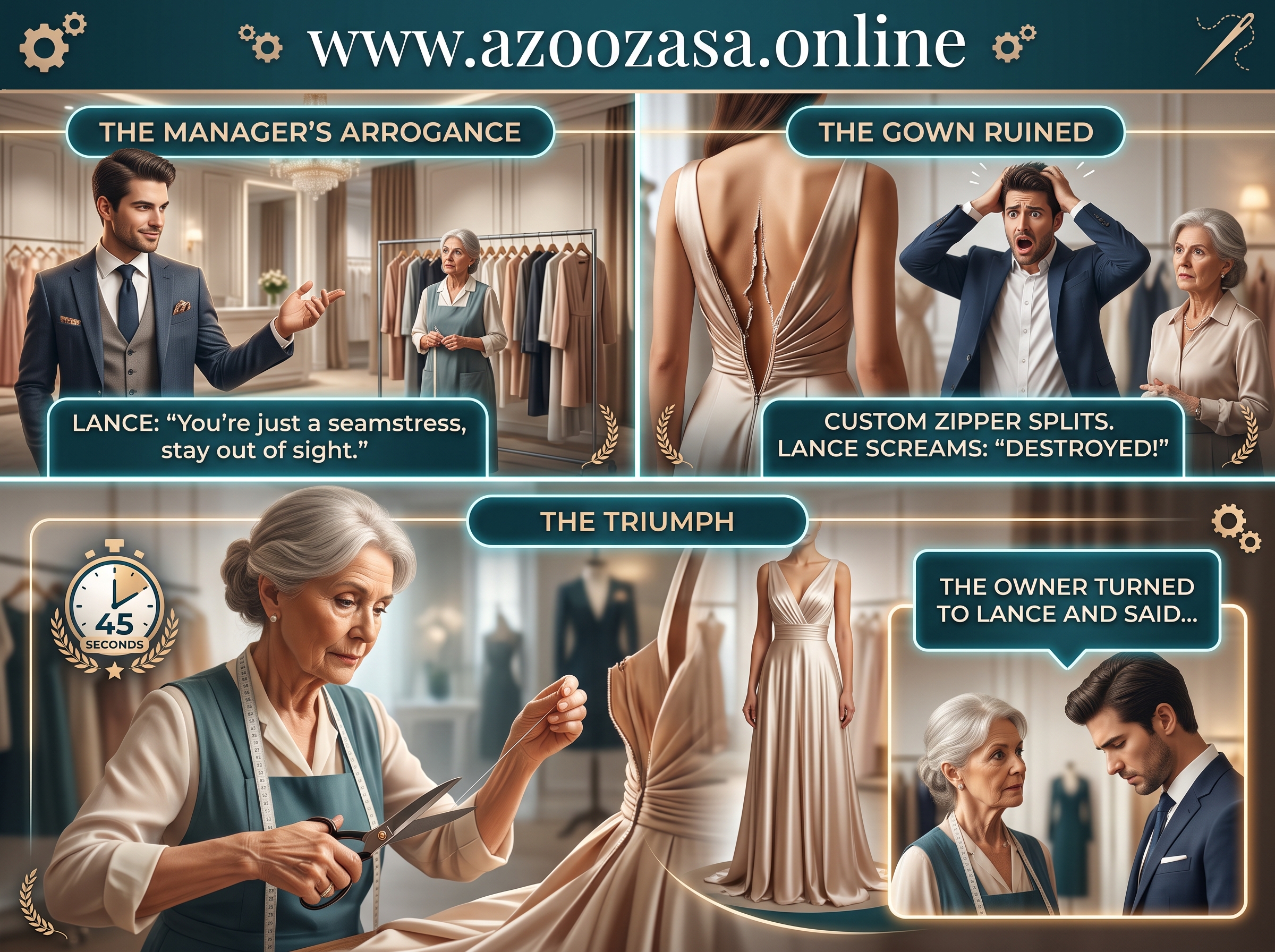
Lance scoffed, glancing nervously over his shoulder at the wealthy clients who were now sipping complimentary champagne. He leaned in close, his cologne overpowering and sharp. “Listen to me, Helen. These people are paying for an exclusive, luxury experience. They don’t want to see the hired help squinting over a needle like a sweatshop worker. You’re just a seamstress. Stay out of sight.”
I looked at him for a long, quiet moment. I could have told him about the time I designed the structural underpinnings for a dress worn at the Oscars. I could have told him that the “exclusive luxury experience” would fall apart at the seams without my hands to hold it together. Instead, I bit my tongue, grabbed the edge of my rack, and pulled it the rest of the way into the cramped, windowless back room. I sat down at my machine, turned on my harsh fluorescent desk lamp, and kept sewing.
Two hours later, the fitting was reaching its crescendo. I could hear the muffled sounds of delight from the showroom, the clinking of crystal flutes, and Lance’s overly loud, sycophantic laughter. The bride, a slender, nervous girl, was being laced into the $12,000 gown.
And then, the laughter abruptly stopped.
It was replaced by a sharp, panicked gasp, followed by the unmistakable, horrifying sound of splitting nylon and tearing thread. It was a sound that every tailor knows in their bones—the sound of catastrophic structural failure.
“Oh my god! Oh my god, the dress!” the bride shrieked.
I dropped my needle and stood up.
Through the open doorway, I heard Lance’s voice, an octave higher than usual, laced with pure, unadulterated panic. “Don’t move! Just—just stop breathing! I can fix this, we can order another—no, the wedding is on Saturday! Oh, god, the silk is destroyed!”
I walked calmly out onto the showroom floor. The scene was pure chaos. The bride was standing on the pedestal, sobbing into her hands. Mrs. Sterling looked furious enough to burn the building down with her gaze. And Lance was fluttering around the girl like a trapped bird, his hands hovering uselessly over her back.
The gown’s custom, invisible zipper had completely burst open down the spine. The teeth had misaligned under the tension of the bodice, and the zipper track had split wide open. To the untrained eye—and certainly to Lance’s—the dress was ruined. But my eyes bypassed the panic and went straight to the architecture of the garment. The problem wasn’t the silk, and it wasn’t even the zipper. The problem was the internal tension. The hidden boning inside the corset had slipped from its channel, placing the entire weight of the tightly fitted bodice directly onto the delicate zipper teeth.
“Get away from her, Lance,” I said. My voice wasn’t loud, but it cut through the hysteria like a newly sharpened blade.
Lance whipped around, his face flushed red and dotted with sweat. “Helen, get back in the back! I am handling this! The zipper is busted, the fabric is pulling—it’s a disaster!”
“Step. Aside,” I commanded, pulling my heavy, carbon-steel tailor’s shears from the leather holster on my apron.
Mrs. Sterling placed a hand on Lance’s shoulder and shoved him out of the way with surprising force. “Let the woman work,” she snapped.
I stepped onto the pedestal behind the trembling bride. “Take a deep breath for me, sweetheart,” I murmured soothingly. “Exhale slowly. You’re completely fine. The dress is completely fine.”
I didn’t have time to take her out of the dress; the zipper teeth were jammed at the bottom, and forcing it would tear the delicate Italian silk. I had to fix the structural integrity while she was wearing it. I dropped to one knee. In my right hand, my shears flashed under the chandelier light.
With three lightning-fast snips, I bypassed the luxury fabric and cut directly into the interior lining—the hidden architecture of the dress. I reached two fingers into the small incision, feeling blindly for the rogue piece of spiral steel boning that had slipped its casing. I found it. It was digging into the side seam, warping the fabric’s tension.
Using the flat edge of my shears for leverage, I forced the steel boning back into its proper channel, pressing it hard against the hip seam. Immediately, the fabric of the bodice relaxed. The immense pressure on the zipper vanished.
“Hold this right here,” I instructed the bride, guiding her hand to press against her own hip to keep the boning in place for just a moment.
I stood up, grasped the bottom of the split zipper, and gave the slider a sharp, practiced tug downward. Because the tension was gone, the jammed teeth popped free. I realigned the pins at the base, held the track perfectly straight, and pulled the zipper up.
It slid closed with a smooth, satisfying zzzzzzp. The gown settled perfectly against the bride’s spine, flawless and flush, exactly as the designer intended.
I pulled a pre-threaded needle from my lapel cushion and, in four rapid, blind stitches, anchored the boning channel shut from the inside so it would never slip again. I bit the thread, snapped it clean, and smoothed the silk flat.
I looked at my watch. Forty-five seconds.
The showroom was completely silent. The only sound was the bride’s ragged breathing, which slowly leveled out as she turned to look at herself in the three-way mirror. The dress was perfect. There wasn’t a single pucker, not a single flaw.
“Oh,” the bride whispered, tears of relief pooling in her eyes. “Oh, it’s beautiful.”
Mrs. Sterling let out a long, shaky breath and looked at me, her eyes wide with a newfound, profound respect. “That was… extraordinary.”
Lance, having recovered slightly from his panic, puffed out his chest and tried to step back into the spotlight. He smoothed his tie and let out a nervous chuckle. “Well! Crisis averted! As I always say, our team here at L’Étoile is equipped to handle absolutely any minor hiccup—”
“Shut up, Lance.”
The voice came from the grand staircase.
Everyone turned. Standing on the landing was Mrs. Montgomery, the owner of L’Étoile. A fierce, uncompromising woman in her seventies, she rarely came down to the showroom floor. But she was standing there now, her hands resting elegantly on the mahogany railing, her sharp eyes taking in the entire scene. She had seen everything.
She descended the stairs slowly, her heels clicking rhythmically against the hardwood. She walked right past Lance without so much as a glance and stopped in front of me. She looked at my worn apron, the heavy shears in my hand, and the magnificent, perfectly fitted $12,000 gown.
Mrs. Montgomery turned slowly toward her boutique manager. Lance swallowed hard, his Adam’s apple bobbing nervously against his tight collar.
“Lance,” Mrs. Montgomery began, her voice soft but deadly. “Do you know what the difference is between a manager and a master?”
“I… um, Mrs. Montgomery, I was just explaining to the client—”
“A manager,” Mrs. Montgomery interrupted, talking over him as if he were nothing but a mild draft in the room, “knows how to read a price tag. A master knows what holds the dress together.”
She gestured toward the bride. “You just stood there and screamed that a twelve-thousand-dollar piece of inventory was destroyed because you don’t understand the basic anatomy of what you sell. You insulted the very foundation of this business. You told this woman”—she pointed a perfectly manicured finger at me—”to stay out of sight.”
Lance opened his mouth, his face pale, but no sound came out.
“This woman,” Mrs. Montgomery continued, her voice rising to carry across the quiet showroom, “has forgotten more about tailoring in the last five minutes than you will learn in your entire, inevitably short career in fashion. You are a liability to my brand, Lance. Pack up your office. You are fired.”
Lance stood frozen, his eyes darting between Mrs. Montgomery, the wealthy clients who were watching him with open disdain, and finally, me. He opened his mouth to argue, but the sheer, icy authority in Mrs. Montgomery’s posture silenced him. Deflated and thoroughly humiliated, he turned and practically fled toward the back offices.
Mrs. Montgomery turned back to me. The icy demeanor melted into a warm, genuine smile of deep professional respect.
“Helen, isn’t it?” she asked gently.
“Yes, ma’am,” I replied, sliding my shears back into their leather holster.
“I apologize for the indignity you’ve suffered in my shop, Helen. It seems I have been severely underutilizing my staff.” She looked at the flawless seam on the bride’s back, then met my eyes. “I find myself suddenly in need of a Director of Alterations and Floor Management. It comes with a private office, a window with natural light, and a salary that appropriately reflects thirty-five years of mastery. Plus full benefits and a retirement plan. Would you be interested?”
I looked at the bride, who was beaming at me in the mirror. I looked at the beautiful, temperamental silk beneath my fingertips. And for the first time in five years, the heavy, anxious knot in my chest completely unraveled.
“I would be very interested, Mrs. Montgomery,” I said, a slow smile spreading across my face. “But only if I can keep my sewing machine out on the floor. I like to be in the light.”
Mrs. Montgomery laughed, a bright, clear sound. “My dear, with talent like yours, you belong nowhere else but the center of the room.”




0 comments