
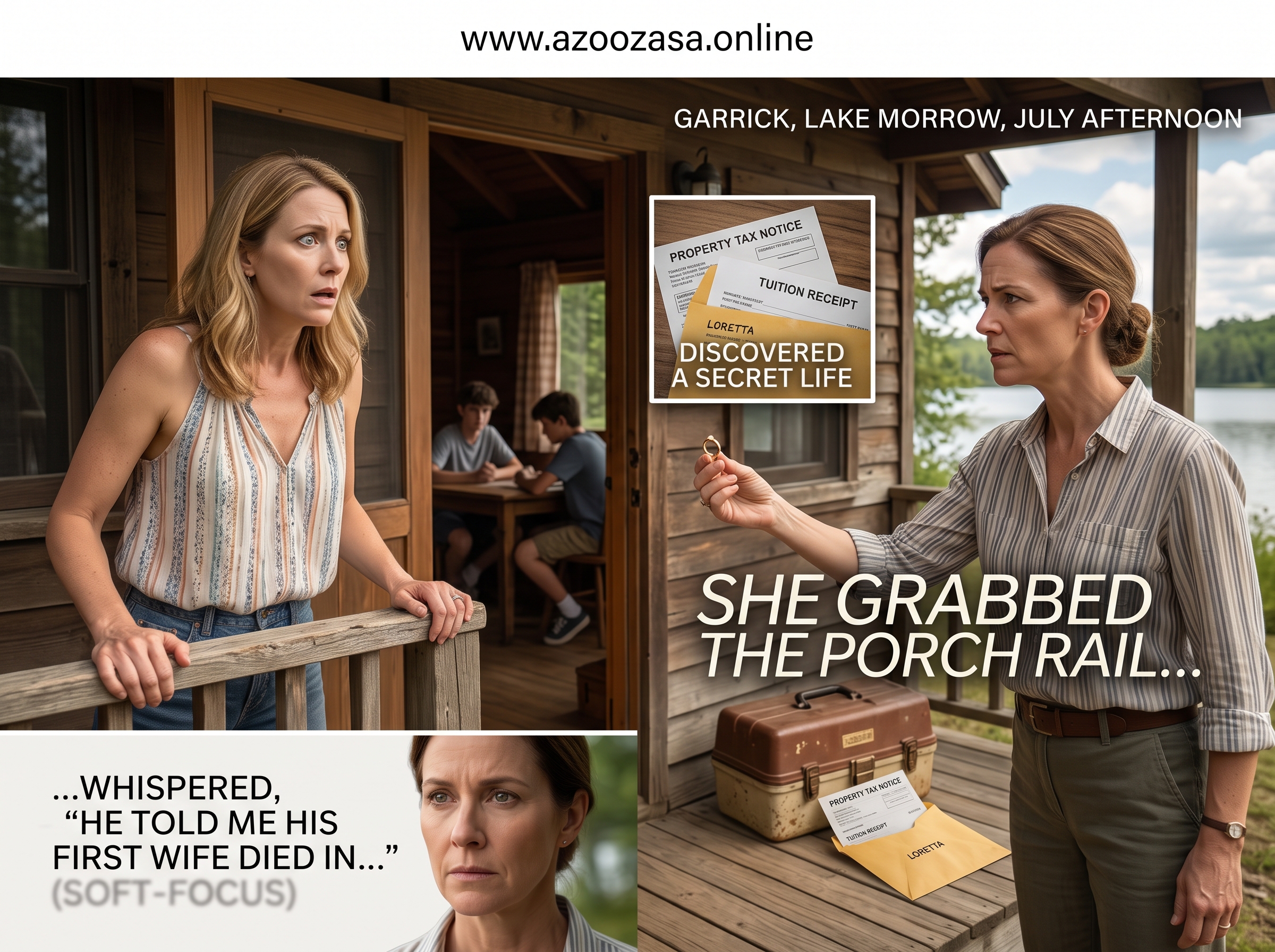
The Ghosts of Lake Morrow
The July heat was oppressive, pressing down on the roof of our suburban garage like a physical weight. I had only gone out there to retrieve a box of citronella candles for the patio, but Garrick’s vintage, olive-green tackle box was sitting precariously on the edge of a high shelf. When I reached past it, my elbow clipped the rusted metal edge. The heavy box plummeted, hitting the concrete floor with a deafening crack. The rusted metal latches sprang open, violently vomiting its contents—neon rubber worms, tangled spools of monofilament line, and rusted hooks—across the dusty ground.
And a single, heavily yellowed envelope.
It had been wedged beneath a molded plastic tray, hidden in a space that wasn’t meant to hold paper. I knelt on the hot concrete, the sweat gathering at the nape of my neck, and picked it up. My husband, Garrick, spent every August weekend for eighteen years “bass fishing” exactly one hundred and twelve miles away at Lake Morrow. He claimed the isolation was the only thing that cured the stress of his corporate accounting firm. He never brought fish back, citing a strict catch-and-release policy. I never questioned it. I enjoyed the quiet weekends to myself.
I tore the brittle seal of the envelope.
Inside was a heavy stock paper, folded neatly into thirds. It was a county property tax notice for a half-acre lakefront lot and a cabin. The names registered on the deed were Garrick Miller and Loretta Miller. Beneath the tax notice were two carbon-copy receipts from a private preparatory academy, neatly clipped together. They were tuition payments. They totaled exactly sixty-four thousand dollars.
I didn’t scream. I didn’t cry. Instead, a cold, absolute silence fell over my mind, freezing the sweltering air in the garage. My jaw clenched so violently that a sharp, shooting pain radiated up into my temples, making my back teeth throb. I carefully placed the papers back into the envelope, leaving the scattered hooks and neon lures scattered on the concrete floor.
I survived the next three days by moving like a ghost through my own house. I cooked dinner. I kissed Garrick’s cheek when he came home from the office. I listened to him complain about his junior partners and wash down his perfectly seared salmon with a glass of Pinot Noir. I watched the man I had been married to for twenty-two years—the man who told me a decade ago that he was medically incapable of giving us the children I so desperately wanted—and I felt nothing but the icy, terrifying calm of a brewing hurricane.
When Friday morning arrived, Garrick loaded his newly packed duffel bag into the trunk of his SUV. He kissed my forehead, smelling of expensive aftershave and peppermint toothpaste. “See you Sunday night, honey,” he said, his smile as easy and practiced as a television anchor’s. “Wish me luck with the smallmouths.”
“Catch something good,” I replied, my voice dangerously hollow.
I waited exactly one hour after his taillights disappeared down our tree-lined street before I got into my sedan. I programmed the address from the tax notice into my GPS. One hundred and twelve miles.
The drive took two hours, the scenery slowly shifting from the gray concrete arteries of the city to the lush, suffocating green of the pine-studded mountains. The road wound higher, twisting around massive boulders and deep, dark valleys until the shimmering, glass-like surface of Lake Morrow appeared through the trees. The GPS led me down a private, gravel-paved road lined with mailboxes shaped like largemouth bass and black bears. I pulled to a stop at the end of a long driveway.
The cabin was magnificent. It wasn’t the rustic, mosquito-infested shack Garrick had described over the years. It was a towering, two-story A-frame made of rich cedar, featuring massive floor-to-ceiling windows that overlooked a private, deep-water cove. Two kayaks were pulled up on a manicured patch of grass, and a late-model Volvo SUV was parked near the front steps.
I turned off the ignition. The only sound was the clicking of my cooling engine and the distant cry of a loon. I stepped out of the car, the gravel crunching violently beneath my sandals, and walked up the wide wooden stairs to the wraparound porch. I didn’t hesitate. I raised my fist and knocked firmly on the heavy oak door.
A moment later, the door swung inward.
A woman in her early forties stood in the foyer. She had sun-kissed skin, a loose, messy bun of auburn hair, and kind, crinkling eyes. She wore a faded blue sundress and held a dishtowel in one hand. From deep inside the house, I could hear the unmistakable sounds of a television playing a video game and the booming, boisterous laughter of teenage boys.
“Hi,” the woman said, offering a warm, effortless smile. “Can I help you? Are you lost? The GPS gets a little confused around the cove.”
“I’m not lost,” I said, my voice eerily steady. I looked past her shoulder, catching a glimpse of two boys, maybe fifteen and seventeen, wrestling over a game controller on a massive leather sectional. They had Garrick’s dark, curly hair. They had Garrick’s broad shoulders.
“Oh,” she said, politely waiting for me to explain my presence.
“I’m looking for Garrick,” I said.
Her smile brightened, completely devoid of suspicion or malice. “Oh, you must be from the lake association! He told me someone was coming by to look at the new dock pilings. He’s down at the water right now.” She gestured toward the back of the house with the dish towel. “He’s at the dock with the kids’ fishing gear. You can just walk right around the side deck.”
I didn’t move. I kept my eyes locked on hers. I slowly raised my left hand, extending my fingers so the morning sun caught the brilliant, blinding flash of the two-carat diamond and the platinum wedding band wrapped around my ring finger.
I held it between us, a silent, undeniable weapon.
“I am not from the lake association,” I said quietly. “My name is Elena Miller. Garrick and I have been married for twenty-two years.”
Loretta’s warm smile didn’t just fade; it shattered. The color drained from her face so rapidly I thought she might collapse. Her eyes darted from my face to the diamond ring, and back to my face. The easy, comfortable air of the cabin vanished, replaced by a suffocating vacuum. The dish towel slipped from her fingers, pooling silently on the hardwood floor.
She reached out blindly, her hand violently gripping the heavy wooden doorframe to steady herself. Her mouth opened and closed, struggling for air, before she leaned forward, her eyes wide with a terror that mirrored my own internal devastation.
“No,” she whispered, her voice trembling, shaking the very foundation of the life she had built. “No, that’s impossible. He… he told me his first wife died in a car accident. Nineteen years ago.”
The words hung in the air, heavy and suffocating. A dead wife. I wasn’t just a secret; I had been buried alive in the mythology of this alternate universe. He hadn’t just built a second family; he had murdered me to do it.
I looked at Loretta. In that terrible, suspended moment, I didn’t see a mistress. I didn’t see an enemy. I saw a woman who had just been dragged into the same suffocating abyss I had fallen into three days ago. We were two ghosts haunting the same house, entirely unaware of one another until this exact second.
“I assure you,” I said, stepping closer, lowering my voice so the boys inside wouldn’t hear. “I am very much alive. But the man we both married is about to wish I wasn’t.”
Loretta stared at me, the initial shock giving way to a devastating, crushing realization. She looked back into the living room at her teenage sons—boys raised on a foundation of absolute rot—and a tear spilled over her eyelashes, tracing a wet path down her cheek. She turned back to me, her grip on the doorframe tightening until her knuckles turned bone-white.
“Show me,” Loretta whispered, her voice hardening into something sharp and dangerous.
She didn’t lead me around the side deck. She stepped out onto the porch, pulling the front door shut behind her with a definitive click. We walked side-by-side down the sloping, manicured lawn toward the water.
The dock extended thirty feet out into the deep, emerald-green water of the cove. At the very end of it, sitting in a canvas folding chair, was Garrick. He was wearing khaki shorts and a faded polo shirt, leisurely tying a bright neon lure onto a fishing line, humming a tune that drifted over the gentle lapping of the waves.
Our footsteps thudded heavily against the wooden planks of the dock.
Garrick didn’t turn around immediately. “Boys finally give up the television?” he called out playfully, his back still to us. “I told you, the bass are biting near the drop-off today.”
“Garrick,” Loretta said.
The tone of her voice—flat, cold, and completely devoid of its usual warmth—made his shoulders stiffen. He paused, the fishing line pulled taut between his hands. Slowly, reluctantly, he turned his head, a quizzical smile plastered on his face.
The smile died the instant his eyes found mine.
I watched his mind fracture in real-time. I watched the arrogant, perfectly constructed architecture of his eighteen-year deception collapse into dust. His hands began to shake, the neon lure dropping from his fingers and bouncing on the wooden planks. He scrambled to his feet, knocking the canvas chair backward. It teetered on the edge of the dock before splashing into the lake, sinking quickly into the dark water.
“Elena,” he choked out, the name sounding like gravel in his throat. He looked at me, then at Loretta, his eyes darting frantically between us, searching for an escape route that didn’t exist. “Elena, what… what are you doing here? Loretta, I can explain.”
“You told her I was dead,” I said, my voice echoing loudly across the quiet cove, carrying the weight of two decades of stolen time. “You told me you were fishing. Tell me, Garrick, which lie was harder to keep track of?”
“Elena, please,” he stammered, raising his hands in a pathetic gesture of surrender. “Just… let’s go back inside. Let’s not do this in front of the boys.”
“The boys you told me we couldn’t have?” I took a step forward, closing the distance between us. “The boys you bought with a sixty-four-thousand-dollar tuition check paid for by the joint account I deposit my paycheck into every month?”
Loretta stepped up beside me. She didn’t yell. She didn’t cry. She simply reached into the pocket of her sundress, pulled out her own set of keys, and stared at the man who had authored her entire existence through a lie.
“You have until I walk back up this hill to get your things out of my cabin,” Loretta said to him, her voice terrifyingly calm. “If you are still here when I reach the porch, I am calling the sheriff, and I am telling our sons exactly what kind of coward their father is.”
Garrick opened his mouth to speak, to beg, to spin another web, but the words failed him. He looked at Loretta, whose face was a mask of furious resolve. He looked at me, standing tall in the morning sun, completely unburdened by the ghost he had made me. He was utterly trapped, pinned between the two lives he had tried to master, left with absolutely nothing.
I didn’t wait to watch him pack. I didn’t need to hear his apologies. I turned my back on the dock, walking side-by-side with Loretta back up the sweeping green lawn. We didn’t speak. We didn’t need to. We reached the driveway, where my sedan and her Volvo sat parked in the sun.
I opened my car door and paused, looking across the roof at the woman who had lived an entire lifetime in my shadow, just as I had lived in hers.
“Take care of those boys, Loretta,” I said quietly.
“Drive safe, Elena,” she replied, her chin held high.
I slid into the driver’s seat, started the engine, and put the car in drive. As I pulled away from the cabin, leaving the deep waters of Lake Morrow behind me, I rolled the windows down. The hot July air rushed in, sweeping away the cold, suffocating silence of the last twenty years. I wasn’t a ghost anymore. I was finally, truly alive, and I had a whole world to discover.


0 comments