
The Table She Built From Splinters
The Earl Grey tea was scalding, but I barely felt it seeping through my linen trousers. I just sat there in my pristine, silent living room, staring at the local news broadcast on the television, the porcelain cup shattered on the hardwood floor.
There she was. Sabrina.
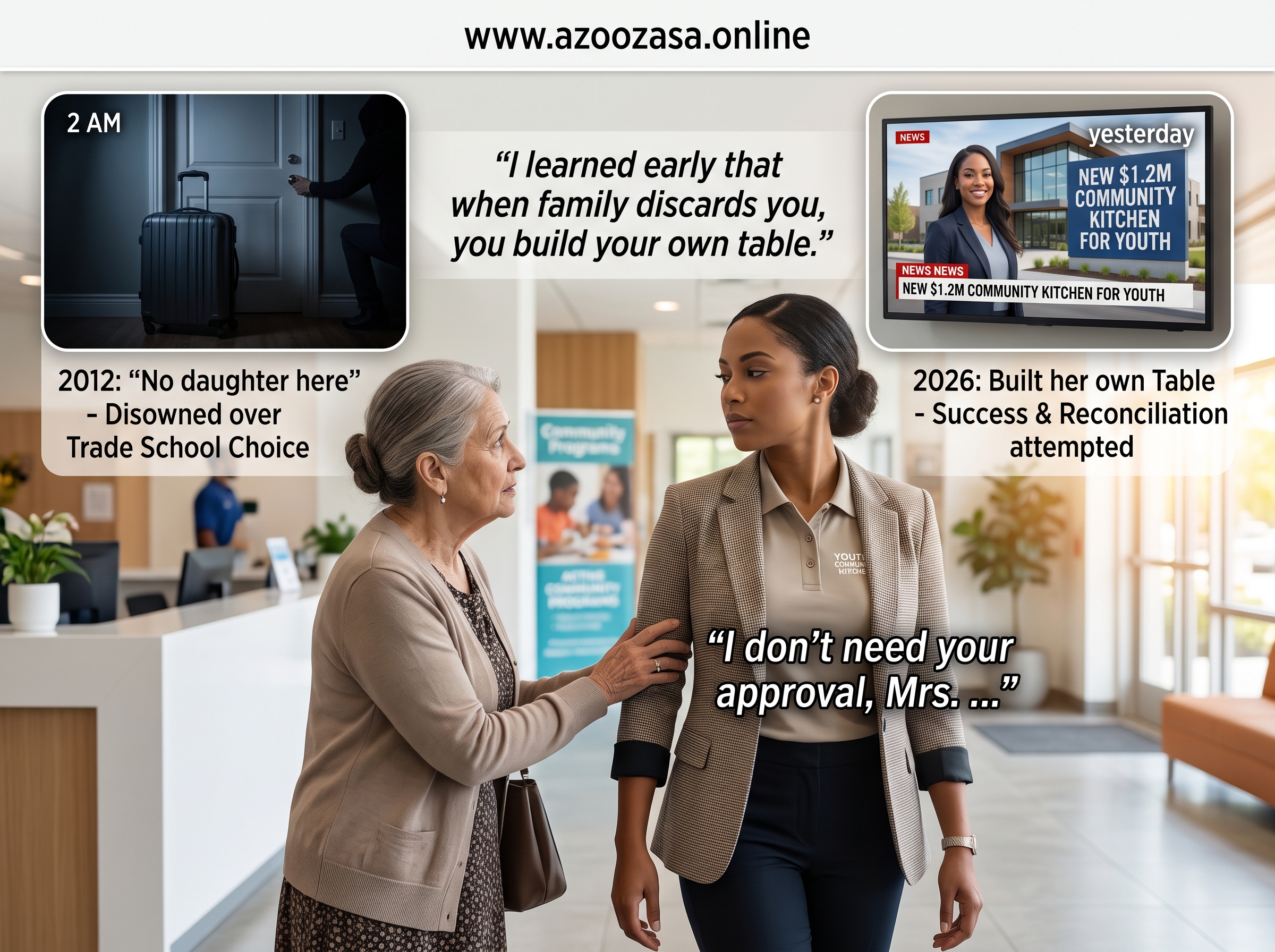
Fourteen years had carved away the baby fat of her teenage rebellion, leaving behind a woman with sharp, deliberate features and eyes that held the steady confidence of a plumb line. She was standing in front of a sprawling, light-filled structure of glass and polished timber. The chyron across the bottom of the screen read in crisp white letters: Local Builder Opens $1.2M Community Kitchen for At-Risk Youth.
I hadn’t spoken to my daughter since 2012.
The memories of that night came rushing back with the violent force of a kicked-in door. Sabrina was eighteen, standing in the entryway of this very house, her hands stained with engine grease and wood glue. I had laid out the brochures for the universities on the mahogany dining table—schools with ivy creeping up their brick walls, schools that produced lawyers and executives, schools that fit the legacy of the Vance family name.
Instead, she had slammed a community college trade school application down on top of them. She wanted to build things. She wanted to work with her hands, surrounded by sawdust and calluses, a life I viewed as an ultimate, humiliating failure.
We screamed until our throats bled. I demanded obedience; she demanded autonomy. And so, fueled by a toxic cocktail of pride and rage, I did the unthinkable. I marched to her room, shoved a chaotic handful of her clothes into a duffel bag, and dragged it to the front door. I handed her two crisp twenty-dollar bills—forty dollars to survive the world—and shoved her out into the damp, freezing October night. It was 2:00 AM.
I stood on the inside of the door, listening to her pound her fists against the wood, and I slid the deadbolt shut. The next morning, I paid a locksmith double to change every lock on the property. When the county sheriff knocked on my door three days later, asking to collect her birth certificate and social security card on her behalf, I looked him dead in the eye and said the words that would define the rest of my life: “You have no daughter here.”
I believed, with the arrogant certainty of a bitter parent, that she would fail. I believed the cold reality of the world would break her spirit, and she would come crawling back, begging for my money, my roof, and my rules.
Fourteen years of agonizing, deafening silence followed. The world did not break Sabrina. It forged her.
On the television, a local reporter thrust a microphone toward my daughter. “Sabrina, this facility is entirely funded by your construction firm. You were homeless at eighteen. How did you survive alone long enough to build an empire that gives back like this?”
Sabrina looked directly into the camera lens. Her smile wasn’t triumphant or vindictive. It was serene. It was the smile of someone who had survived a shipwreck and learned to breathe underwater.
“I learned early that when family discards you, you build your own table,” she said, her voice smooth and resonant. “And then, you invite others to sit at it.”
The breath left my lungs in a ragged gasp. The words were a physical blow, fracturing the fragile glass house of denial I had lived in for over a decade. I suddenly saw the absolute emptiness of my life. My house was immaculate, my bank accounts were full, my legacy was intact—and I was entirely alone. I had traded my only child for control, and I was holding a fistful of ashes.
I didn’t bother changing my tea-stained trousers. I grabbed my keys, stumbled to my car, and drove.
The address was on the east side of the city, in a neighborhood I typically avoided. But there it stood, rising like a beacon on a formerly abandoned lot. The building was stunning. Exposed cedar beams, massive paneled windows letting in the morning sun, and a line of young people laughing as they carried crates of fresh produce through the double doors. Above the entrance, hand-carved into a massive slab of oak, were the words: The Open Table.
I parked down the street, my hands trembling so violently I could barely retrieve the keys from the ignition. The walk to the entrance felt like a march to a guillotine. What was I expecting? Forgiveness? A tearful reunion? The delusional part of my brain, the mother who still thought of her as a lost child, hoped that seeing me would wash away the fourteen years of ice. I thought my presence would be enough.
I pushed through the glass doors and stepped into the lobby.
The smell of freshly baked bread and raw timber hit me instantly. The space was alive, vibrating with the energy of a dozen conversations, the clinking of industrial pots, the laughter of teenagers finding refuge. It was warm. It was everything my house was not.
And then I saw her.
Sabrina was walking across the polished concrete floor, holding a clipboard, speaking animatedly to a man in a chef’s apron. She wore a tailored blazer over a plain white t-shirt, her work boots clicking rhythmically against the floor. She looked powerful. She looked entirely whole without me.
As she passed near the reception desk where I stood frozen, she stepped within arm’s reach. My heart hammered against my ribs like a trapped bird. I reached out. My trembling fingers brushed the rough fabric of her blazer sleeve.
“Sabrina,” I whispered, the name feeling foreign and heavy on my tongue.
She stopped. The man in the chef’s apron paused, sensing the sudden shift in the air, but Sabrina waved him on. Slowly, she turned to face me.
I looked into my daughter’s eyes, searching for the scared eighteen-year-old girl standing on my porch in the freezing cold. I looked for anger, for resentment, for the fiery rage we had shared on that terrible night. I would have welcomed anger. Anger meant she still cared. Anger meant there was a wound to heal.
But there was no anger. There was only the polite, guarded curiosity one reserves for a stranger asking for directions. She looked at my face, at my graying hair, at my tea-stained trousers, and then down to the hand I had desperately pulled back to my chest.
“I saw you,” I choked out, tears finally spilling over my eyelashes, hot and humiliating. “On the television. I… I saw what you built. Sabrina, I am so…”
“Mrs. Vance,” she interrupted gently. The sound of my formal name in her mouth felt like a knife twisting in my stomach.
She didn’t raise her voice. She didn’t cause a scene. She simply looked at me with an ocean of distance between us, standing in the heart of the sanctuary she had built from the scrap wood of the life I had destroyed.
“I appreciate you coming down here,” Sabrina said, her voice terribly calm. “But I don’t need your approval, Mrs. Vance. Not anymore. I haven’t needed it in a very long time.”
“Please,” I begged, the word scraping against my throat. “I just want to talk. I just want to sit down with you.”
Sabrina looked around the bustling room. She looked at the massive dining tables her own hands had crafted, tables where cast-out children were currently sitting, eating, and laughing. Then she looked back at me, her eyes devoid of any lingering debt or filial obligation.
“Every seat at my table is taken,” she said softly.
She didn’t wait for a response. She didn’t look back to see if I was crying. Sabrina simply turned around and walked back into the kitchen, the heavy swinging doors closing gently behind her, shutting me out.
I stood alone in the bright, warm lobby of the community kitchen. I had come with a heart full of apologies, ready to unlock the door I had bolted fourteen years ago. But standing there, surrounded by the beautiful life my daughter had forged from the forty dollars and the darkness I had given her, I finally understood the agonizing truth.
I hadn’t just locked her out. I had locked myself in. And now, I was the one standing on the wrong side of the door, with nowhere to go, and absolutely no one to let me in.


0 comments